


Forty minutes past the last gas station, there is a cabin with two walls framed and a tarp roof gone the color of a bruise, a real-estate sign zip-tied to a fence post nobody has cut down in three years. It is not haunted. It is stuck — on land its owner still pays tax on, still cannot legally reach with a delivery truck, still cannot get a septic permit for. Every off-grid market has one of these parcels. Agents call it a “motivated relisting.” Everyone else calls it a warning nobody read in time.
None of the seven mistakes below are exotic, and nobody here was careless — most did more homework than the average suburban buyer bothers with. They just did not know which questions actually decide whether raw land is buildable, because the answers are not on the listing and the seller has no duty to volunteer them. Ask these before you are under contract, and you skip becoming the cabin with the bruised tarp roof.
The 7 Mistakes That Turn Cheap Land Into an Expensive Lesson
Each of these has closed on a real parcel, on a buyer who read the listing carefully. What they missed was the thing no listing mentions.
1. No Deeded Access — the ‘Paper Road’ Trap
The county plat shows a road reaching the parcel. On the ground that road is a line on a map, never graded or built, legally belonging to whoever owns the land it crosses. Landlocked parcels are astonishingly common on cheap rural listings. A standard owner’s title policy guarantees you own the dirt; it does not guarantee you can drive to it. That takes a separate “insured access” endorsement, which most buyers never think to request.
Fixing it after closing means negotiating an easement with a neighbor under no obligation to grant one, or suing for an easement by necessity: $15,000–$50,000+ in fees, over a year, no guaranteed win. Europe’s version wears a different name: a servitude de passage in France, or a right of way described verbally but never registered at the land registry — it evaporates the moment the land changes hands. Either side of the Atlantic, the fix is the same: drive the access route yourself before you offer, then confirm in writing that it is an insured, deeded easement, not a courtesy.
2. A Parcel That Fails — or Never Took — a Perc Test
Septic capacity is decided by one test result, and plenty of “buildable” rural listings have never had it run. Fail a percolation test on the proposed drainfield site and a lot of counties will not permit any on-site septic at all. That is the gap between a roughly $7,000–$15,000 conventional system and a $20,000–$45,000 engineered one — or a parcel that is simply unbuildable. Sellers rarely order a perc test on spec; “perks fine” on a listing is hearsay, not paperwork.
Much of Europe gates the same decision differently — a percolation-equivalent soil study, or increasingly a required mains-sewer connection instead of anything on-site. Whichever applies where you are looking, make the offer contingent on a fresh test at the actual building site, run after you are under contract, not a decades-old result from the seller’s file. The county-by-county numbers are in our US permitting guide.
3. A Well That Comes Up Dry, or 600 Feet Down
Drilling is billed by the foot whether you hit water or not. A US well commonly runs $15–$30 per foot; a 400-foot dry hole, or one too deep or mineral-laden to pump economically, still costs the full $6,000–$12,000 — proving a negative. Depth and yield are rarely random: wells within a half-mile usually tell the story, and in most states well logs are public record through the state water board, searchable before you call a driller.
Southern Europe’s version is scarcity, not depth — parts of Spain, Portugal and southern France now cap new well permits by basin, with a hydrogeological study required just to apply. There the risk is a permit refused outright, not a dry hole. Either way, treat “well needed” as a cost-and-permission question to answer before closing. Our water source guide walks the well-vs-spring-vs-catchment math in full.
4. A Building Site Photographed in July, Shaded by December
Land gets shown in the season that sells it. A clearing reading full sun in July can sit in near-total shade by December — and the physics is exact, not a feeling: at 40°N, roughly the Denver-to-Madrid line, the sun sits about 73° above the horizon at summer-solstice noon and only 26° at winter-solstice noon, a 47° swing. A treeline clearing your roofline by thirty feet of shadow in July can swallow the array once the sun drops that low in January, exactly when a battery system needs winter production most.
There is no US/Europe fork here — it is the same sun everywhere in the Northern Hemisphere. The fix is a site visit near the winter solstice, or at minimum a free shading-tool run on the coordinates, before you offer. A lot that faces north, sits in a hollow, or backs onto a south ridge is fighting geometry no inverter can correct.
5. Flood Maps and Fire Zoning Nobody Pulled Before Closing
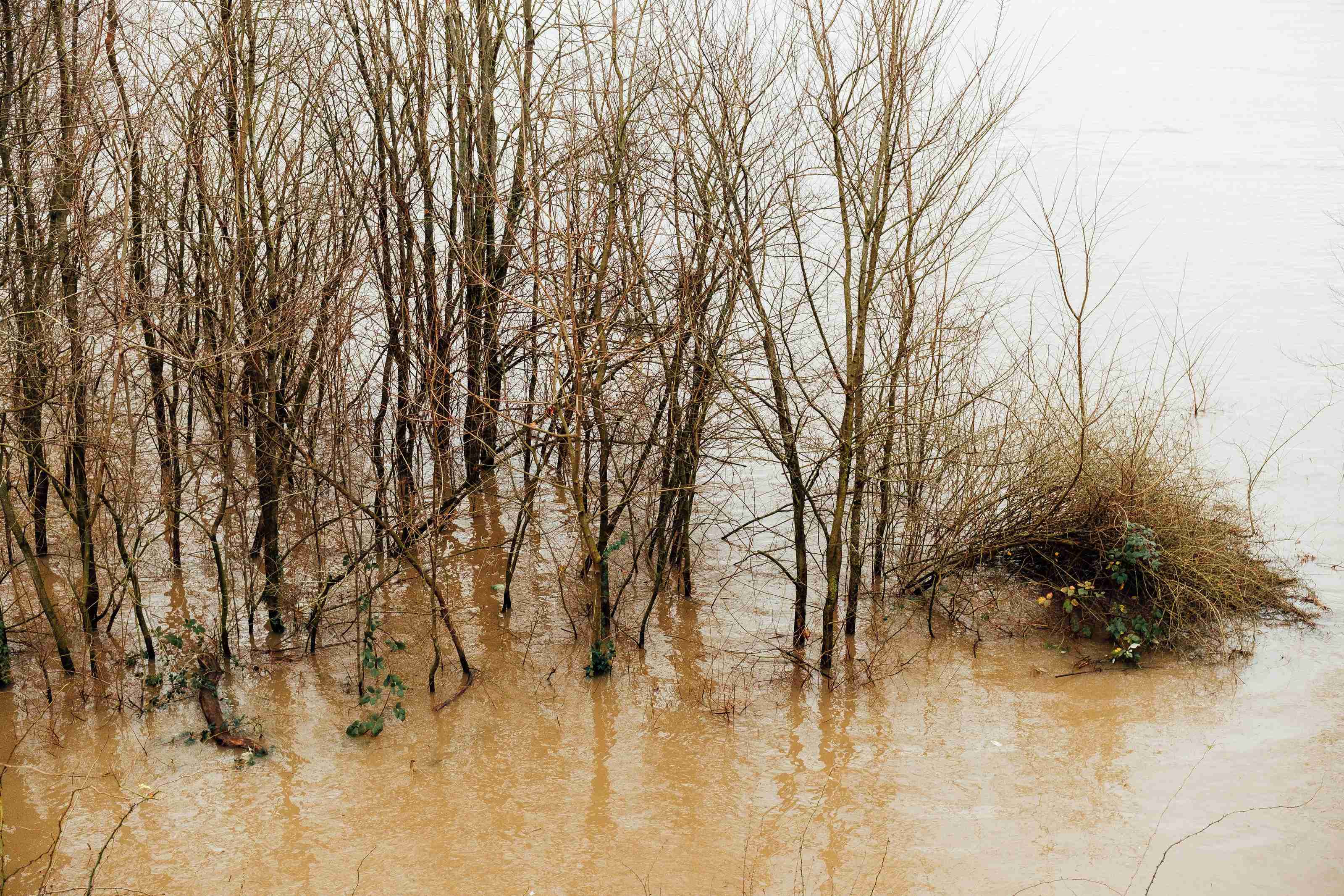
A FEMA flood-hazard designation does three things a listing never mentions: it usually blocks septic permits outright, can force elevated foundations that add tens of thousands to a build, and makes flood insurance mandatory on anything mortgaged — commonly $700 to well over $2,000 a year. The flood map for any parcel is free and public; pull it before you offer, because a remap after purchase can hand you a mandatory-insurance parcel you never signed up for.
Wildfire zoning cuts the same way across the Wildland-Urban Interface in California, Colorado and Oregon — ember-resistant vent codes, mandatory defensible-space clearing, and increasingly insurers declining to write a policy at all, pushing owners onto a state FAIR plan at a steep premium. Europe’s parallel is the local risk map — France’s PPRI for flood, equivalent wildfire zoning across the Mediterranean south — which can mark a parcel non-constructible regardless of what a seller tells you. In both regions the map is public and free; the mistake is buying without pulling it.
6. A Deed Covenant That Outlaws the Reason You Bought the Land
Plenty of rural subdivisions were platted decades before “off-grid” was a category anyone anticipated, and the deed restrictions — recorded once, binding on every buyer since — reflect that. A minimum-dwelling-size covenant of 1,200–2,000 square feet can quietly veto a small, efficient cabin. A clause requiring public-utility connection “if available,” or a flat ban on visible solar panels or non-standard water systems, can veto the entire plan on paper, even where the county itself would issue every permit.
Roughly half of US states have a solar-access law overriding an HOA ban on grid-tied rooftop solar — but most say nothing about off-grid, whole-property battery and generator systems, exactly what these buyers usually plan. The only way to know is to pull the recorded covenant yourself, not an agent’s summary. The European equivalent runs through the local urban plan and, in protected zones, a subdivision charter dictating roof material and visible equipment — sometimes ruling out street-facing panels, sometimes the whole install.
7. Mineral Rights Sold Off Before You Ever Saw the Listing
Across much of the US, mineral rights and surface rights can be — and routinely are — severed, especially in Texas, Oklahoma, Colorado, North Dakota, Pennsylvania and West Virginia. You can own the surface outright while someone else owns the oil, gas or coal underneath, and under most state law the mineral estate is dominant: its owner can legally enter, drill and disturb your surface to reach it, with only limited leverage on your side. A standard title search often misses this; a dedicated mineral title search, run by a specialist landman or title company, costs roughly $200–$800 in an active basin and is the only way to know before a rig shows up on your hayfield.
Europe largely sidesteps this trap — subsurface minerals are essentially always state-owned, so a private party cannot out-claim your land the way a US mineral owner can. The European parallel risk sits above ground instead: a protected-habitat or landscape designation restricting what you can build or clear on land you fully own, found the same way — by checking the registry before you buy.
Key number
$0
What it costs to pull a FEMA flood map, search state well logs, or read a recorded deed covenant — all free, public information, available before you write an offer. None of the seven parcels behind this article were lost to bad luck. They were lost to a search nobody made while the earnest money was still refundable.
| Mistake | What the listing implies | Catch it before you close |
|---|---|---|
| No deeded access | “Road access” | Insured-access title endorsement, plus drive the actual route yourself |
| Failed or missing perc test | “Perks fine” | Fresh perc test at the exact build site, written into the offer as a contingency |
| Dry or too-deep well | “Well needed” | Pull neighboring well logs from the state water board first |
| Winter-shaded building site | Photos taken in summer | A site visit near the winter solstice, or a shading-tool run on the coordinates |
| Flood or wildfire zoning | Rarely mentioned at all | The free FEMA flood map and local wildfire-risk zoning lookup |
| Restrictive deed covenant | “Some HOA rules apply” | The recorded covenant document itself, not an agent’s summary |
| Severed mineral rights | Rarely mentioned at all | A dedicated mineral title search, separate from the standard title search |
Five of the Fifteen Checks, Free, Tonight
You do not need a lawyer or driller on retainer to start. Five of these cost nothing and take one evening:
- Pull the FEMA flood map for the parcel’s exact coordinates — free, five minutes.
- Search the state water board’s well-log database for wells within a half-mile.
- Request the recorded plat and any covenants from the county recorder, not the listing agent’s summary.
- Confirm in writing whether the title company will issue an insured-access endorsement.
- Ask directly whether mineral rights convey with the sale, or were severed at any point in the chain of title.
The other ten, including the exact perc-test contingency language and the full winter-solstice shading check, are on the complete printable sheet.
Members only · free account
The 15-Point Off-Grid Land Checklist, on one printable page
Every check here, plus eight more most buyers never think to run, as a single sheet for a showing or your title company. Free to save to your account.
The One Question That Prevents All Seven
Every trap above shares one fix: make the purchase contingent, in writing, on the thing that worries you — access, perc, water, sun, flood or fire zoning, covenants, minerals — and get a real answer before your earnest money is at risk. None of it costs much to check. All of it costs a fortune to discover the hard way — the entire difference between the finished cabin two ridges over and the one with the tarp roof gone the color of a bruise.
Off-Grid Land-Buying FAQ
Can I back out of a land purchase if I discover one of these problems?
Only if the offer had the right contingencies before you signed. A due-diligence period contingent on a passed perc test, confirmed access, or a clean mineral-rights search lets you cancel and recover earnest money if the answer comes back wrong. Without that language, you are buying whatever the land turns out to be.
Is landlocked land ever still worth buying?
Sometimes, if priced for the risk and you negotiate a recorded, insured easement with the neighbor before you close — not a handshake to sort out later. Assuming “someone will surely let me through” is the exact mistake this article is about.
Do these checks matter if I already own the land?
Yes. All seven run retroactively, worth doing before you break ground — especially the perc test, mineral-rights search, and winter shading check, which most owners never confirm until a permit or a dark January stalls them.
What is the fastest way to check all seven at once?
Run the five free checks the evening you find a serious parcel, then get a local pro — an installer, well driller, or surveyor already working that county — to walk the site before you remove contingencies. They catch shading, access and soil issues in one visit that take an outsider weeks to piece together from records.