


The short answer
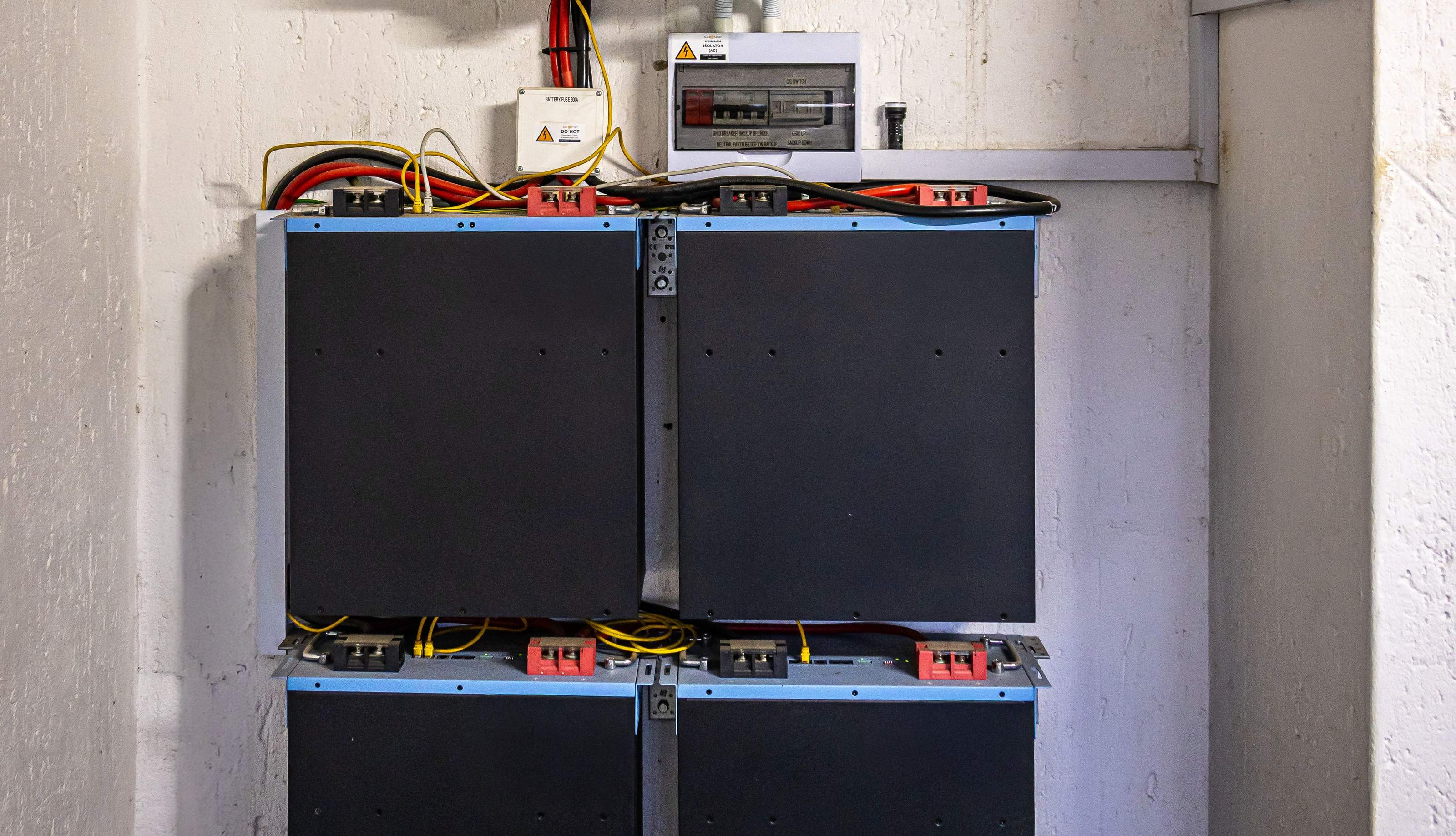
A home battery buys silence, an instant handover and no fuel to think about. A standby generator buys runtime nobody has to ration, and the muscle to start a well pump and a compressor on the same cold night. The whole decision is working out which of those two things you are short of.
Answer the seven questions below in order. Most households know by question three, and the ones that do not are usually the households that should own both.
On this page
Nearly every article on this subject lines the two technologies up and compares them feature by feature. That is useful once you know what you are buying for, and useless before. Two houses on the same street, quoted the same two products, should often buy opposite things, because the outage one of them gets is four hours long and the outage the other gets is four days long.
So this page is a diagnostic rather than a comparison. If you want the head-to-head on runtime, fuel, noise, maintenance and cost, that is written up separately in standby generator vs home battery. Start here, and go there once you know which column you are reading.
What each one does that the other cannot
Strip the brochures back and each product has three genuine advantages the other cannot copy at any price.
A battery, and only a battery:
- Picks up the load in milliseconds, so nothing reboots, nothing spoils and nobody wakes up.
- Makes no noise, no exhaust and no heat, which means it can live in a garage in a dense suburb without a conversation with your neighbor.
- Earns money on the days nothing is wrong, shifting solar into the evening and trimming peak-rate draw. A generator sits idle for years between paydays.
A generator, and only a generator:
- Runs as long as the fuel supply lasts, which on a gas main means longer than nearly any outage on record.
- Starts a house cold, all at once, with the surge headroom to bring a well pump, a compressor and a heat source up together.
- Carries the whole house instead of a curated circuit list, which is the difference between an outage you manage and an outage you barely notice.
Those two lists never merge. Anything a salesperson tells you that blurs them is a sizing claim, and sizing claims are what the calculator is for.
The seven questions in order
Order matters. The first three do most of the work, and answering the later ones first is how people end up with a 26kW generator for a house whose longest outage in a decade was ninety minutes.
1. How long do outages actually run where you live?
Not nationally. Not on the news. In your county, over the last ten years.
The spread inside one country is enormous. In 2024, customers in South Carolina averaged nearly 53 hours without power, while customers in Arizona, North Dakota, South Dakota and Massachusetts averaged under two hours (US Energy Information Administration, Electric Power Annual 2024). Same year, same grid rules, a twenty-fold difference in what you are insuring against. Look up your own state before you look at a single product page.
Western European distribution networks are, on average, in a different league. Germany’s regulator put the 2024 average interruption at 11.7 minutes per customer, against a ten-year average of 12.7 minutes (Bundesnetzagentur, October 2025). That average is also why the European risk profile differs in kind: the thing worth insuring against is the rare system-wide event rather than the ordinary fault. On 28 April 2025 the Iberian peninsula lost 31 GW of load in seconds, and transmission restoration was only complete around 16 hours later (ENTSO-E expert panel final report, March 2026).
Translate your answer into one of three bands:
- Hours. A battery covers it outright, silently, with nothing to start and nothing to buy afterwards.
- Days. One battery will not reach the end of it without sun. Either a generator, or a battery with a generator behind it.
- A week or more. Fuel logistics become the design problem, and a generator with a supply you have actually sized is the only honest answer. What breaks first over a week with no grid is worth reading before you spend anything.
2. Do you have solar, or will you inside five years?
This question changes a battery from an insurance policy into a working asset. Paired with an array, a battery cycles daily, and the outage performance is a by-product of something you were already paying for. Without solar, a battery is a very good uninterruptible supply that does nothing on the 364 days the grid behaves.
It also changes the runtime answer. A battery with sun over it refills every morning, which turns a fixed number of hours into an indefinite supply at a reduced load. That argument is set out properly in do you need a backup generator for off-grid solar, alongside the honest case for keeping a generator anyway. The equipment side of it lives under battery storage and buffering.
3. Is there a gas main at your meter?
A standby generator on a utility gas line is the cheapest unlimited runtime money can buy, because the fuel logistics are somebody else’s problem. Without that line, the same machine becomes a propane project with a tank, a delivery relationship and arithmetic you should do before you sign.
Natural gas was the main space-heating fuel in 47% of US homes in the last full Residential Energy Consumption Survey (US Energy Information Administration, RECS 2020), which is a rough proxy for who has a main at the meter and who does not.
Permanent gas-fed standby generators are rare in European housing stock, and in most countries the practical equivalent is a wired-in inverter generator on an automatic changeover, fed from bottled LPG or a can you refill by hand. That trades away the unlimited-runtime advantage, which pushes the balance of this decision towards storage.
The propane arithmetic is the part people skip. Generac’s own spec sheet for its 20/22/24kW air-cooled Guardian range puts liquid propane consumption at 2.53 gallons an hour at half load and 3.90 at full load. A 500-gallon tank filled to the standard 80% holds 400 usable gallons, so a 22kW unit at half load runs roughly 160 hours, about six and a half days, and under three days if the house leans on it hard. That is a real number to check against the band you picked in question one.
4. What is on your heavy circuits?
Capacity decides how long you last. Power decides whether the thing starts at all, and this is where quotes quietly diverge.
A Powerwall 3 holds 13.5 kWh of usable energy and delivers 11.5 kW continuous, with up to four units on a system (EnergySage’s Powerwall review, updated May 2026). A 22kW Guardian is rated 19,500 watts on natural gas and 22,000 watts on propane (Generac spec sheet, 20/22/24kW Guardian). One battery therefore covers a house with a well pump and one compressor. It does not cover a house running two air handlers, an electric dryer and a pump at the same time, and no amount of extra kilowatt-hours changes that. Batteries stack, and stacking is how the ceiling moves.
If the load you are worried about is 240V, meaning a submersible well pump, an electric dryer or ducted air conditioning, read 120V vs 240V: well pump, dryer, mini-split before you compare anything else. Single-leg equipment delivers exactly zero 240V regardless of its wattage badge, and that trap catches people at every budget.
On a 230V single-phase supply the equivalent trap is the surge rating rather than the leg count, and three-phase properties add a wiring question on top. Powering a 230V off-grid home in Europe covers what actually starts a borehole pump and a heat pump.
5. Can you live with the noise, the setbacks and the permit counter?
Generac publishes 67 dB(A) at 23 feet with the generator at normal load, and 55 to 57 dB(A) during the low-speed exercise cycle. That exercise runs five minutes every other week by default, forever, in a spot chosen by code rather than courtesy. NFPA 37 section 4.1.4 wants engines at least five feet from wall openings and combustible walls, and Generac’s enclosure is listed for installation as close as 18 inches from a structure only when it is sited clear of doors, windows and fresh-air intakes.
Add those constraints up on a narrow lot and the pad often lands somewhere expensive, because the gas line and the electrical run are both priced by the foot. A battery has siting rules of its own, mostly clearances and fire-code limits on how many units share a wall, but it makes no noise and needs no setback from a window. On a tight urban plot that difference decides the whole thing.
6. Is anything in the house life-safety rather than convenience?
Oxygen concentrators, ventilators, dialysis, refrigerated medication, a stairlift, a sump pump holding water out of a finished basement. The US Department of Health and Human Services maps electricity-dependent Medicare beneficiaries down to ZIP code in its emPOWER Map, which tells you how ordinary this category is.
For these houses the instant automatic handover matters more than the runtime, because a ten-second start delay and a failed start are different risks with the same consequence. A battery gives you the seamless part and a generator gives you the endurance part, which is why life-safety loads are the clearest case for owning both. The specifics, device by device, are in backup power for CPAP, insulin and medical devices.
7. Which budget band are you honestly in?
Ask this last, because it is the only question whose answer changes if you get the first six right. A well-chosen $12,000 system beats a badly chosen $30,000 one, and the sizing step is what separates them. The bands are below.
Free calculator
Backup Power Calculator
Pick the circuits you keep alive and get generator kW, battery kWh and transfer-switch amps. Live, free, no sign-up — and the result becomes a brief you can buy against.
What each path costs
Benchmarks, not quotes. Every one of these swings with your site, and the generator numbers swing hardest of all, because half the invoice is trenching, panel work and permits rather than the machine.
| Path | What it actually covers | Installed benchmark, 2026 |
|---|---|---|
| Battery, critical circuits only | Fridge, lights, comms, one pump, medical devices. Hours to a day and a half. | $5,000–$7,000 and up (EnergySage, July 2026) |
| Battery, one full unit | 13.5 kWh usable, 11.5 kW continuous. A day and a half curated, indefinite with sun. | ≈$15,650 before incentives; a Powerwall 3 specifically averages $13,473 (EnergySage, 2026) |
| Battery, whole house | Multiple stacked units, no circuit rationing, still bounded without sun. | ≈$34,000 (EnergySage, July 2026) |
| Generator, 18–26kW standby | Whole house, unlimited runtime on a gas main, ten-second handover. | $8,000–$25,000+ all in (our own 2026 line-item breakdown) |
| Propane instead of a gas main | Adds the tank and the delivery relationship. Roughly six days at half load on 400 usable gallons. | Add $1,500–$3,000 for a 500-gallon tank |
| Both, sized as a pair | Silent instant cover for the common outage, fuel-fed endurance for the tail. | $20,000–$35,000 for one battery plus a right-sized unit |
One tax note changes the arithmetic against every guide written before 2026: the 30% US federal Residential Clean Energy Credit under Section 25D was repealed by the One Big Beautiful Bill Act signed on 4 July 2025, and no credit is available where the installation completed after 31 December 2025 (Congressional Research Service, Expiration and Carryforward Rules for the Residential Clean Energy Credit). Standby generators never qualified in the first place, so for the first time in years neither path carries a federal discount. State, utility and storage-specific programs still exist in places, and they are worth one phone call before you sign.
The generator line above is the one people misread most often, because the sticker price of the machine is a third to a half of the project. The six line items behind it are itemised in what a whole-home generator really costs in 2026, and the sizing tiers that feed it are in what size generator for a whole house.
There is a third path worth pricing if the standby quotes are out of reach: stacked portable power stations, wired in through an inlet, which land between a battery and a generator on both cost and capability. That comparison is stacked power stations vs a standby generator, and the hardware is listed on power stations and expansion.
When both is the right answer
Four answers together make the pair the correct purchase rather than a luxury: multi-day outages in your history, solar on the roof or planned, a well pump or another heavy motor load, and anything in the house that is life-safety rather than comfort. Two of those four is a maybe. Three or four is a yes.
Sizing it as a pair is cheaper than sizing either one alone, and that is the part that gets missed. The battery covers the events that end inside a day, which in ordinary years is nearly all of them, since interruptions outside major storm events routinely average about two hours a year per customer. The generator therefore never has to be the whole-house monster a generator-only house needs. One 13.5 kWh battery on a critical-loads subpanel plus a 14 to 18kW standby unit generally beats a 26kW generator with no battery at a similar total, and it beats three stacked batteries with no fuel-fed backstop in any winter with a week of cloud.
Buy in the order your risk dictates. Whichever failure mode you actually see most often gets bought first, and the second one goes in when the money is there. The only thing that has to happen on day one is leaving room: a critical-loads subpanel, space at the service entrance, and a transfer arrangement a second source can join without rewiring the house. Ask for that in writing on the first install, whichever it is.
Failure modes the brochures skip
Every product page lists what its own thing does well. Here is what each one does badly, which is the information you are actually short of.
Where batteries let people down:
- A battery is a tank rather than a well. No sun and a long outage empties it, and then you are on whatever is left.
- Whole-home backup and critical-loads backup are different products at very different prices. The quote you were shown is often the second one described in the language of the first.
- The power ceiling is real. Continuous output caps what can run together no matter how many kilowatt-hours you bought.
- Warranties run ten years to about 70% of original capacity on the mainstream units. Year eleven is your problem, and it arrives while the generator next door is still on its original engine.
- An empty battery has no manual override. There is no equivalent of walking out with a can.
Where generators let people down:
- Gas mains are not immune. In the February 2021 freeze, natural gas production fell 71% by 17 February and processing fell 82% by 15 February, according to the FERC and NERC final report published that November. Unlimited runtime is a supply assumption, never a property of the machine.
- Propane tanks get sized against the brochure instead of the burn rate. Run the gallons-per-hour figure against the days you actually need before you accept the tank the installer proposes.
- It only starts if it has been kept alive. A charged starting battery, an oil interval of up to two years or 200 hours, and a five-minute exercise cycle every other week are the price of the ten-second handover.
- The panel upgrade discovered on install day is the classic five-figure surprise, and it is an electrical fact about your house rather than anything to do with the generator you chose.
- Portable-generator workarounds kill people. CPSC attributes close to 100 carbon monoxide deaths a year in the United States to portable generators, almost all from running the machine too close to the house or inside it. A permanent outdoor standby unit is a different risk profile entirely, and that gap is worth real money.
When you are ready to specify hardware rather than a category, the shortlists are backup power and transfer for the fixed side and survival and self-sufficiency gear for everything that has to work once the power is back on.
Common questions
If I can only buy one, which one do I buy?
Buy for the outage you actually get. If your typical event ends inside a day, a battery covers it silently and keeps working on the days nothing is wrong. If your region loses power for multiple days at a time, a generator is the only one of the two that cannot run out on its own, and it is the safer single purchase.
Will a home battery run a well pump or central air conditioning?
It depends on the power ceiling, not the capacity. A Powerwall 3 delivers 13.5 kWh of usable energy and 11.5 kW continuous, so it can start and hold most residential well pumps and many single compressors, but a whole house with two air handlers, a dryer and a pump running together will exceed one unit. Batteries stack, and stacking raises the ceiling as well as the runtime.
Can I add a generator to a battery later, or the other way round?
Yes, and layering is usually cheaper than buying the biggest version of either one up front. What matters is that whoever installs the first one leaves room for the second: a critical-loads subpanel, space at the service entrance, and a transfer arrangement that a second source can be brought into without rewiring the house.
Is a home battery worth it if the power almost never goes out?
Only if it is paired with solar. Then it works every day, shifting production into the evening and shaving peak-rate draw, and the backup capability comes along with it. Bought purely for a rare outage, with no solar, a battery is an expensive way to solve a problem a generator solves for less.
How big a generator do I actually need?
Size it against your own critical-load list, not the square footage of the house. Add the running watts of the circuits you would genuinely keep alive, note the largest motor start among them, and check the service amperage the transfer switch has to match. The backup power calculator does that arithmetic and returns generator kW, battery kWh and transfer-switch amps together.
Is a portable generator plus a transfer switch a real substitute for a standby unit?
It is a legitimate path when it is wired properly, with an inlet box and an interlock so the house can never be backfed. It is also where most of the harm happens: CPSC attributes close to 100 carbon monoxide deaths a year in the United States to portable generators, almost all of them from running the machine too close to the house or inside it. The savings are real, and so is the discipline the setup demands.