


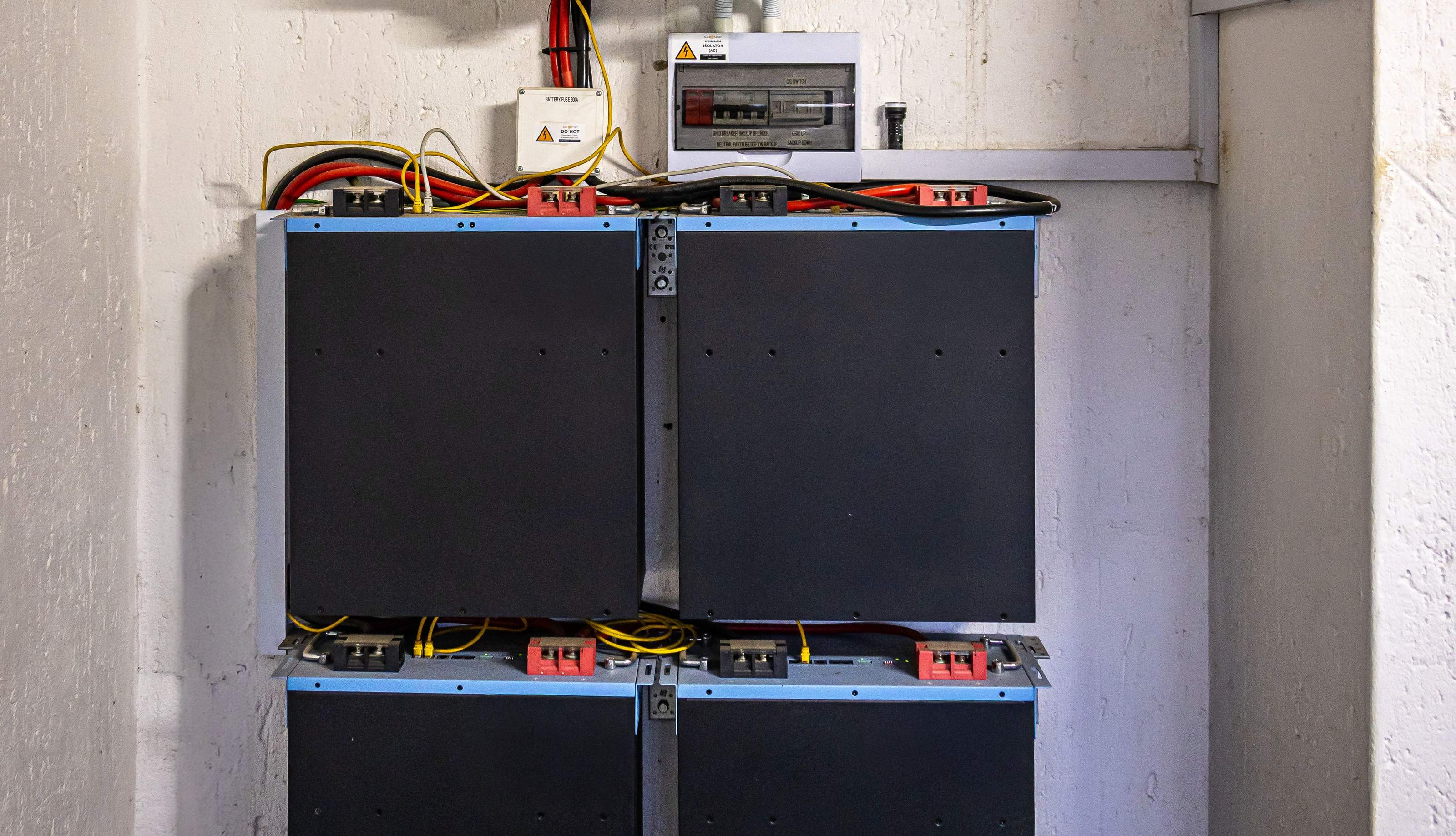
Two-thirty in the morning, the power drops. In one house, a generator outside catches on the second pull of the ignition cycle, and ten seconds later the panel is live again. In the house next door, nothing makes a sound at all — a battery in the garage picked up the load in under 20 milliseconds, and the fridge never even blinked. Both homeowners wake up to a working refrigerator. Only one of them knows what happens if the outage runs five days instead of five hours, or if it's the fortieth blink this year instead of the first.
That's the decision hiding underneath "generator vs battery." It isn't really a hardware comparison. It's a question about which failure mode you're insuring against — and most people buy the wrong policy because nobody ever makes them ask it.
Wrong question: "which is better." Right question: "what am I insuring against?"
Ask ten homeowners why they want backup power and nine will say some version of "so the power doesn't go out." That's not specific enough to size anything. The outages that spoil a freezer and the outages that make the evening news are different events with different odds, and the two technologies answer them very differently.
Most residential outages resolve in well under a day — a tree limb on a line, a blown fuse, a squirrel. The outages people actually spend real money preparing for are the tail-risk events: a multi-day ice storm, a hurricane that flattens the grid for a week, a heat dome that rolls blackouts three afternoons running. Size for the median outage and you'll under-build for the one that actually matters. Size for the worst week your region has seen in the last ten years, and the choice mostly makes itself.
Five things decide it: runtime, fuel or refuel, noise, maintenance, and total cost. Run your own situation through all five before you run it through your wallet.
The five deciders, side by side
| Decider | Standby generator | Home battery |
|---|---|---|
| Runtime | Effectively unlimited on natural gas; propane is tank-limited (days to weeks) | Hours to roughly a day or two on stored charge; indefinite once solar is recharging it |
| Fuel / refuel | Needs a supply — an NG line, or a propane tank you monitor and refill | No fuel; recharges from the grid once it returns, or from solar |
| Noise | ~60–70 dB while running — a central AC unit that never shuts off | Silent — no moving parts, no combustion |
| Maintenance | Annual service, oil changes, weekly self-test, engine wear parts | None scheduled — software-managed, no fluids to change |
| Total installed cost (2026, US benchmarks) | $10,000–$18,000 for a 22kW whole-home unit; $20,000+ on larger homes or hard sites | $11,000–$17,000 for one unit; cheaper per unit if you stack a second |
Runtime, worked out in actual hours
In the US, a 22kW standby generator on natural gas runs until the utility stops delivering gas, which in practice means it outlasts the outage — the one exception is an extreme deep-freeze event severe enough to knock out gas wellheads too, which is rare enough not to be your first design constraint. Propane is the finite version: a 500-gallon tank filled to the standard 80% line (400 usable gallons), feeding a generator burning roughly 1.5–2 gallons an hour at a realistic average household load, lasts somewhere around 8–12 days of continuous running. That's longer than nearly every outage on record. European inverter-generator setups are usually smaller and portable rather than buried-tank permanent installs, so they trade that multi-week autonomy for a jerrycan you top up by hand every day or two.
A home battery is bounded by its kWh, full stop. A Tesla Powerwall 3 or a FranklinWH unit holds roughly 13.5–15 kWh usable depending on model. An average US home burns about 29 kWh a day running everything — at that rate, one battery empties in around 11 hours. But backup mode doesn't run everything; it runs whatever you've told the panel to keep alive. Curate the circuits down to a fridge, some lighting, wifi and router, a sump or well pump, and phone charging, and you're closer to 6–10 kWh a day — which stretches one battery to a day and a half, two batteries to three days, and turns indefinite the moment solar starts refilling it every morning.
Key number
One Powerwall-class battery (13.5 kWh) runs your whole house for about 11 hours. Curated down to fridge, lights, wifi and a well or sump pump, that same battery runs for a day and a half — and indefinitely once solar is topping it up every day.
Total cost, with no federal thumb on the scale
Run the 2026 numbers honestly and there's a wrinkle worth knowing before you take a US quote: the 30% US federal Residential Clean Energy Credit that used to apply to battery storage expired for anything installed after December 31, 2025. It never applied to standby generators in the first place — a fossil-fuel genset was never a "clean energy" purchase in the tax code's eyes. So for the first time in years, neither option carries a federal discount in the US in 2026. Sticker price is the real price. Some US states, utilities and storage-specific rebate programs still knock money off a battery install; that's one phone call worth making before you sign anything. European buyers should look to national and regional storage and generator incentives instead — they vary a great deal by country, and a local installer will know what's currently live faster than any guide can.
In the US, a 22kW whole-home generator lands at $10,000–$18,000 installed on a straightforward site — existing gas service, a short trench, easy panel access. Older homes needing a panel upgrade or a long gas-line run push toward $20,000 and up. A single home battery installs for $11,000–$17,000; stacking a second or third unit costs less per unit than the first, because the inverter, labor and permit overhead are already paid for. Treat every figure on this page as a US planning benchmark, not a quote — European installs run in euros, at smaller typical unit sizes, under different labor and permitting norms, so get a local number before you budget against these.
Size your own critical load before you shop
Every quote starts with a number nobody hands you: how many kilowatt-hours a day your must-keep circuits actually draw. It's a five-minute exercise, and it's the number that turns a generator's kW rating or a battery's kWh rating from a spec-sheet abstraction into hours you can actually count on.
List the circuits you'd genuinely keep alive in an outage, not the ones you'd like to. For each, note its running wattage and how many hours a day it actually draws — not how many hours it's plugged in.
| Circuit | Running watts | Hours/day | kWh/day |
|---|---|---|---|
| Refrigerator/freezer | 150W (cycles ~1/3 of the time) | 8 | 1.2 |
| Well or sump pump | 1,000W | 1 | 1.0 |
| Wifi, router, modem | 30W | 24 | 0.7 |
| Lighting (LED, several rooms) | 150W | 6 | 0.9 |
| Phones, laptops, a medical device | 100W | 10 | 1.0 |
| Total critical load | ≈4.8 kWh/day |
That's a light household. Add a second fridge, a CPAP, a furnace's igniter and blower, or a home office running all day, and it climbs toward 8–10 kWh. Whatever number you land on, that's what you size against — not a generator's kW rating or a battery's kWh rating in isolation, but your daily number divided into theirs. If you want the fuller version of this exercise with generator sizing tiers, we've written it up separately: what size generator actually backs up a whole house.
Once you know your number, matching it to an actual unit is a different conversation than guessing from a spec sheet. In the US that's typically a Generac-class natural-gas or propane standby unit sized in 14–26kW steps; in Europe, permanent gas standby is rare and the equivalent is a wired-in inverter generator with an automatic transfer switch, sized more modestly because whole-home electric heating and air conditioning are less universal.
Ready to put real numbers on a standby unit for your specific site and critical load?
What a battery buys you that a generator can't
Cost and runtime aren't the whole story, and this is the part a spec sheet doesn't put a number on. A battery switches over in under a second with no combustion, no exhaust, and nothing to smell if a garage door gets left cracked. It needs no annual service call, no oil, no self-test that occasionally fails to relight. And on a day when nothing is wrong at all, a battery keeps working — shifting solar production into the evening, trimming peak-rate grid draw, doing something useful with the sun on your roof every single day instead of sitting idle waiting for an emergency that might not come this year.
A generator only earns its keep during an outage. A battery paired with solar earns its keep every day, and the outage performance comes along for free.
- Instant, silent transfer — no engine, no start-up delay, nothing to hear from the yard.
- Zero scheduled maintenance — no oil, no fluids, no annual service contract.
- Works every day, not just during an outage, when it's paired with solar.
- Nothing to refuel, monitor, or run out of at the worst possible moment.
In the US, the two names that dominate this category are the Tesla Powerwall 3 and FranklinWH; in Europe, sonnen and BYD hold the equivalent position, usually installed alongside an existing or new solar array.
See current battery packages sized against a household like yours:
So which one actually fits your house?
Run your household through both lists below. Whichever one you check more boxes on is your first move — not necessarily your only one.
Generator wins if:
- You live somewhere multi-day outages are a real, recent memory — ice belt, hurricane coast, wildfire shutoff territory.
- You don't have solar and aren't planning to add it.
- You want to run the whole house, air conditioning included, not a curated circuit list.
- A battery going dark mid-outage with no sun for days is a risk you're not willing to carry.
Battery wins if:
- You already have, or are installing, solar — the battery earns its keep daily, not just in emergencies.
- Your outages are frequent but short: blinks, brownouts, an hour here and there.
- Noise, exhaust and a fuel tank in the yard are dealbreakers.
- You want zero scheduled maintenance and don't want to think about it again after install day.
The honest answer for a lot of resilient homes, eventually, is both — a battery for the silent daily reality and a generator, or a fuel-fired top-up on a hybrid inverter, as the backstop for the multi-day tail event a battery alone can't outlast without sun. You don't have to solve for both on day one. Solve for the failure mode you're actually likely to see, buy that, and layer the second one in later if your risk picture changes.
Common questions
Can I install both a generator and a home battery?
Yes, and it's a common setup for whole-home resilience: the battery carries the daily reality and short outages silently, and the generator (or a fuel top-up on a hybrid inverter) covers the multi-day event once the battery runs down. They share the same transfer-switch logic, and most installers can quote both from one site visit.
What happens if the outage outlasts my battery and there's no sun?
The battery runs down and you're on whatever's left, unless it's paired with a generator or another charging source. That single scenario is the strongest argument for a generator, or a hybrid setup, in regions with real multi-day outage risk and unreliable winter sun.
How long does a standby generator actually last?
Most whole-home standby units are rated for roughly 10,000–30,000 running hours depending on air- vs liquid-cooling, with annual service — in practice 20–30-plus years for a household that only runs it during outages and a monthly self-test, since it's rarely under continuous load.
Is a home battery worth it if my power almost never goes out?
If it's paired with solar, yes — it's working daily on self-consumption and rate arbitrage, not just sitting in reserve. Without solar, a battery bought purely for rare outages is a more expensive way to solve a problem a cheaper generator also solves; daily use is what changes the math.