


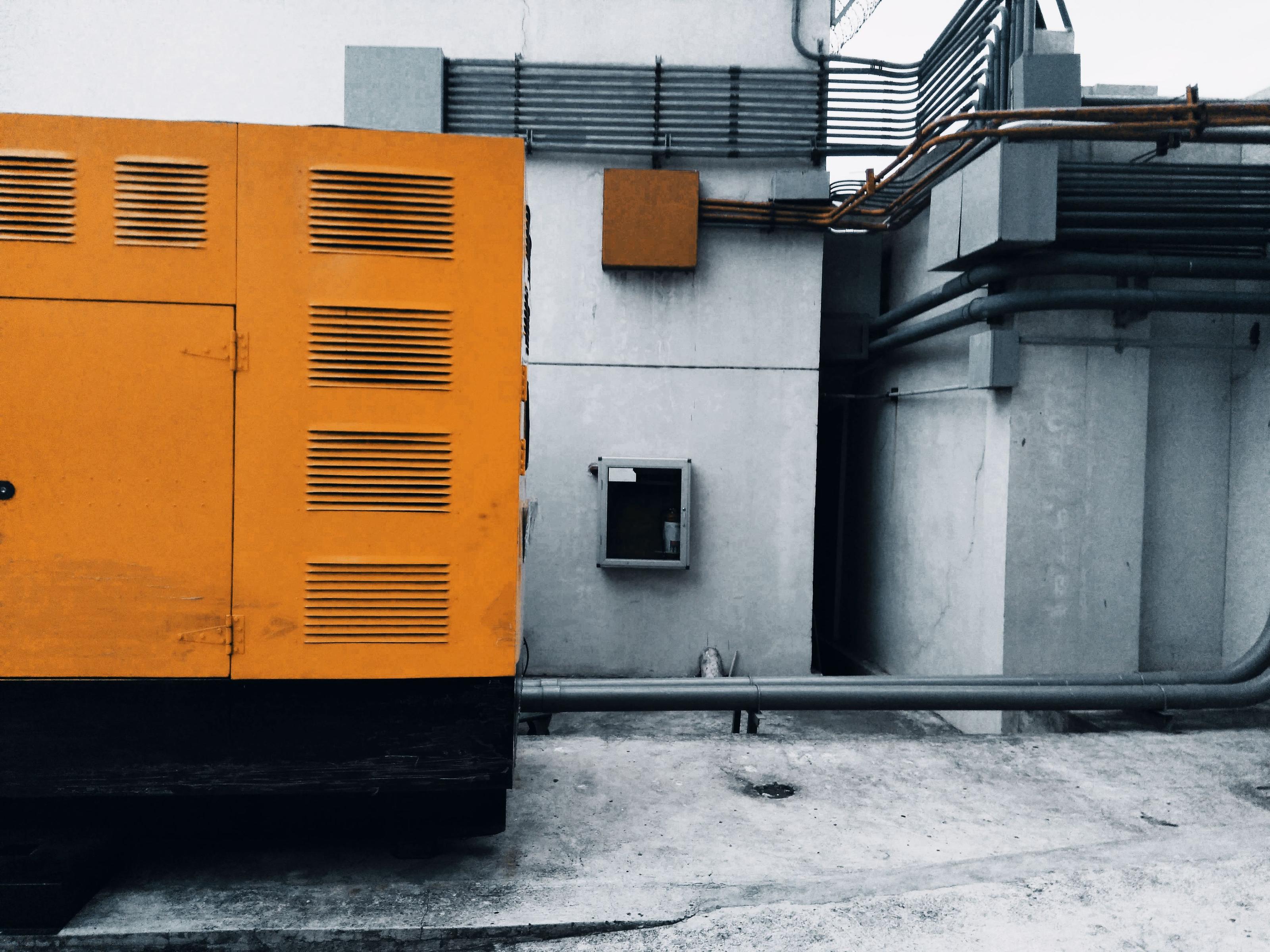
Search “backup generator for off-grid solar” and every result assumes you’re protecting a grid-tied house from a blackout: a 20 kW standby unit sized to run the whole panel the instant the utility drops. That machine solves the wrong problem for you — there’s no grid to lose. What an off-grid house needs is smaller, cheaper, and does a different job: it tops up the battery bank fast enough to survive the week in December when the sun doesn’t show up.
A Generator’s Job Off-Grid Isn’t “Run the House”
On the grid, a standby generator is an understudy. The grid is the star; when it goes dark, the generator steps fully into its shoes and runs everything — furnace, fridge, well pump, the lot — until the outage ends. Sizing it means adding up every circuit you want alive.
Off-grid, solar and battery are already the star, running the house every day of the year. The generator’s job is narrower: show up when the bank is sliding toward empty faster than the panels can refill it, push enough amp-hours back in to get ahead of the next cloudy stretch, and go quiet again. It doesn’t power the house — the batteries already do that. It out-charges the deficit.
That reframes the sizing question entirely. The number that matters isn’t “what could I run in a blackout” — it’s “what’s the maximum rate my inverter/charger will actually accept.” Feed a bank faster than its charger can pull power in and the surplus wattage just idles the generator, burning fuel to spin an alternator doing nothing useful. Buying the 10,000-watt unit “because it sounds safer,” then running it at 20% load for six hours, is the single most common off-grid oversizing mistake — wasteful, and hard on a small engine (glazed cylinders, fouled plugs, the classic light-load “wet-stacking” problem).
Key number
A well-designed off-grid array might deliver 28–32 kWh on a clear June day and only 8–11 kWh on a clear December day at the same mid-latitude site — before three cloudy days in a row drop daily yield under 2 kWh. The generator’s real job is covering that last stretch, not the average day.
Why More Panels Don’t Fix a 4-Day Cloud Bank
The instinct is to solve winter shortfall by oversizing the array and battery bank until they survive the worst week of the year alone. It’s the wrong lever.
Covering an extra 10 kWh/day for four sunless days with zero generator means sizing the array for weak December sun, not a clear day — often 3–4x the panel wattage — plus extra battery to bridge the run. Installed LiFePO4 capacity runs roughly $400–$600/kWh once wiring, BMS, and labor are in, so 15 kWh of “just in case” battery alone is commonly $6,000–$9,000, on top of the oversized array. All of it sits idle 350-plus days a year, because most winters deliver two or three shorter cloudy runs, not one four-day whiteout.
A generator sized for the same gap costs a few hundred to about two thousand dollars, runs a handful of hours a handful of times a winter, and doesn’t care how rare the event is. This is the trade every off-grid designer eventually makes: size solar and battery for a normal bad week — 1–2 days of autonomy — and buy an appliance for the rare week instead of a permanent 40% surcharge on the whole system.
| Covering a 4-day, ~40 kWh winter deficit | Extra hardware | Approx. installed cost | Cost to actually run it |
|---|---|---|---|
| Oversized solar + battery | +2–3 kW panels, +15 kWh battery | $9,000–$14,000 | $0 fuel — but paid for 365 days a year whether it’s used or not |
| Right-sized system + generator top-up | 5,000–7,500W dual-fuel generator, wired in | $900–$2,200 | $15–$25 in propane per top-up, a handful of times a winter |
Size the Generator to the Charger, Not the House
Four steps.
1. Find your charger’s real appetite. Every off-grid inverter/charger has a rated AC charge current at its input voltage — commonly 30–50A at 120V (3,600–6,000W) for a stacked all-in-one, more on 240V split-phase setups. That number, not your fridge or table saw, sets the floor. European 230V systems size against the same charger-input rating on their own AC-in terminals — see the European 230V off-grid power guide for the equivalent numbers.
2. Add the loads running at the same time. While the generator charges, the fridge cycles, lights stay on, maybe the well pump kicks in — add the realistic concurrent load, usually 500–1,800W in a small home, on top of the charger’s draw.
3. Check it lands in the efficient zone. Small engines are happiest loaded 50–90% of rated output; below that they run rich and burn more fuel per kWh delivered. If charger-plus-loads only pulls 35% of a unit’s rating, drop a size.
4. Round up and keep surge headroom. Leave 15–20% for the well pump or a compressor cutting in mid-charge.
Worked example: a 15 kWh usable bank that’s drifted to 30% state of charge needs about 9–10 kWh back to reach a healthy 85–90%. The charger accepts up to 4,000W AC input; at roughly 90% charging efficiency, that refills the bank in about 2.5–3 hours. If the well pump might cycle on mid-charge (1,500W running, near 3,000W surge), the generator needs to carry the 4,000W charge load plus that pump without stalling — call it 5,500–6,000W running. A common 6,500–7,000W dual-fuel unit lands in the sweet spot: comfortably loaded while charging alone, with headroom for the pump.
The formula
Generator running watts ≥ charger’s max AC input (W) + likely concurrent load (W), rounded up to a common size — then check that charging alone still loads it past ~50%. Undersized, it never catches up before the next storm. Oversized, it idles rich and burns fuel for nothing.
| Usable battery bank | Typical charger input | Recommended generator (running W) |
|---|---|---|
| 5–8 kWh — cabin / weekend place | 2,000–2,500W | 3,500–4,000W |
| 10–15 kWh — small year-round home | 3,000–4,000W | 5,000–6,500W |
| 20–30 kWh — whole home, single inverter stack | 4,000–6,000W | 7,500–10,000W |
| 30 kWh+ — multi-inverter, 240V split-phase | 6,000–8,000W+ | 10,000–14,000W, or two paralleled units |
Match voltage and phase to your inverter’s AC input before anything else — a 240V split-phase setup needs a generator (or two paralleled units) producing balanced 240V, not a 120V-only portable. If your numbers don’t sit neatly in a row above, run them through the Home Backup Power Sizing Calculator for an exact range.
Propane vs Dual-Fuel: What Matters When It Sits Idle for Months
Off-grid generators don’t run daily like a jobsite compressor — they sit for weeks, sometimes months, then need to start cold and carry a load immediately. That usage pattern, more than headline wattage, should decide the fuel question.
Gasoline degrades. Left in a carburetor for 30–60 days without a stabilizer, it varnishes and gums up the tiny jets that make small engines run — the single most common reason a “backup” generator won’t start the one time it’s needed. Propane doesn’t have that problem: sealed in a tank, it doesn’t oxidize or go stale, so a unit sitting since spring lights on the first pull in December. It also burns cleaner, meaning longer oil life and less carbon buildup at the partial loads these units run more often than a construction genset does.
The trade-off is power and cold weather. An engine makes roughly 10–15% less output on propane than on gasoline, because vaporized LP takes up cylinder volume that would otherwise be air — a generator rated 5,000W on gasoline might deliver 4,300–4,500W on propane. And standard vertical LP tanks vaporize fuel more slowly as temperature drops; below roughly 20°F (−6°C), a small tank can struggle to keep up with a generator’s draw unless it’s sized generously, mounted horizontally, or fitted with a tank heater.
That’s the real case for dual-fuel over propane-only: not which fuel is “better,” but not being locked out by whichever one is having a bad day. Default to propane for scheduled top-ups — reliable starts, no stale-fuel roulette — and keep a few gallons of stabilized gasoline on hand as the override for a deep cold snap or a tank that runs dry before the truck can get down your road.
In the US, delivered propane runs roughly $2.50–$3.50/gal (national average near $2.67 through 2026, from under $2 in the Midwest to over $4 in parts of the Northeast and Florida); a 6,500W dual-fuel unit recharging that 9–10 kWh deficit burns about 1.5–2 gallons — roughly $4–$7 a top-up, under $30 for a hard winter’s worth. In Europe, LPG is sold by the kilogram, not the gallon, and pricing swings further by country — but the logic holds either side of the Atlantic: a sealed tank that survives an unused summer beats a jerrycan of gasoline that doesn’t.
Let the Inverter Decide When to Start It
The best off-grid generator setups aren’t manually started at all. Inverter/chargers built for this — Victron, Schneider XW, Outback, Sol-Ark, EG4, and similar — carry an auto-gen-start function: set a state-of-charge floor (commonly 30–40%) or a low-voltage threshold, and the unit closes a relay to crank the generator itself, charges to a target SOC (typically 80–90%), then shuts it down. Most allow quiet hours so it won’t fire at 2 a.m. unless the bank is in real trouble, and a max-runtime cutoff so a stuck relay or a jammed choke can’t run a tank dry unattended.
This matters more than it sounds. Manually-started backup gets skipped — nobody wants to check a battery monitor in the snow, so the generator either doesn’t start until the fridge has already gone off, or runs six hours “just in case” when 90 minutes would’ve done it. Automatic start on a real SOC threshold does exactly what’s needed and nothing more — the fuel-efficient answer to the sizing question above: it charges in the generator’s efficient load band, then stops.
- Auto-start compatible with your inverter brand — the remote-start dry contact has to match Victron/Schneider/Outback/Sol-Ark wiring, not just “has a remote start button.”
- A CO detector at the house, not just near the generator — off-gridders are usually caught by their own unit venting toward a window, not a manufacturing defect.
- Neutral-ground bonding matches your inverter — pairing a bonded-neutral generator with a bonded-neutral inverter is a common cause of nuisance GFCI trips; check which one should float before first start.
- Sound level for your set-back — open-frame units commonly run 68–74 dBA at 23 ft; quiet inverter-style units bring that to roughly 52–58 dBA, worth paying for near neighbors or quiet hours.
- LP hose and regulator rated for the draw — an undersized quick-connect kit chokes propane flow exactly when the generator is working hardest.
The generators that fit this use case — dual-fuel, auto-start-ready, sized in the 3,500W–10,000W band above — aren’t always the ones on the hardware-store endcap. Here’s what we’d point a cloudy-week problem at right now:
How many cloudy days should my system survive on its own?
Most off-grid designers build 1–2 days of true battery autonomy — enough to ride out a single storm without the generator — and let the generator cover anything longer. Sizing the battery alone to survive 4–5 sunless days is what pushes off-grid systems toward $60k+ for marginal protection against an event that might happen once a winter.
Is a bigger solar array cheaper long-term than a generator?
Usually not. Extra panels and battery sized for the worst week sit unused most of the year, while a generator costing a fraction of that hardware only burns fuel on the days it’s actually needed. The math only flips if the generator ends up running dozens of times a winter — at that point the system itself is undersized, not just missing a generator.
Do I need a transfer switch if I’m already off-grid?
Not in the on-grid sense — the AC-in port on an off-grid inverter/charger already isolates generator power from battery power, so there’s no backfeed risk. Check neutral-ground bonding instead: most inverters expect a floating-neutral generator, and a bonded-neutral unit paired with a bonded-neutral inverter is a common cause of nuisance GFCI trips.
Will cold weather stop a propane generator from starting?
The fuel won’t freeze at any outdoor temperature you’ll see, but it vaporizes more slowly as the tank cools, which can starve the generator under load below roughly 20°F/−6°C from a small vertical tank. A bigger tank, a horizontal tank, or switching a dual-fuel unit to gasoline for the coldest snap all solve it.