


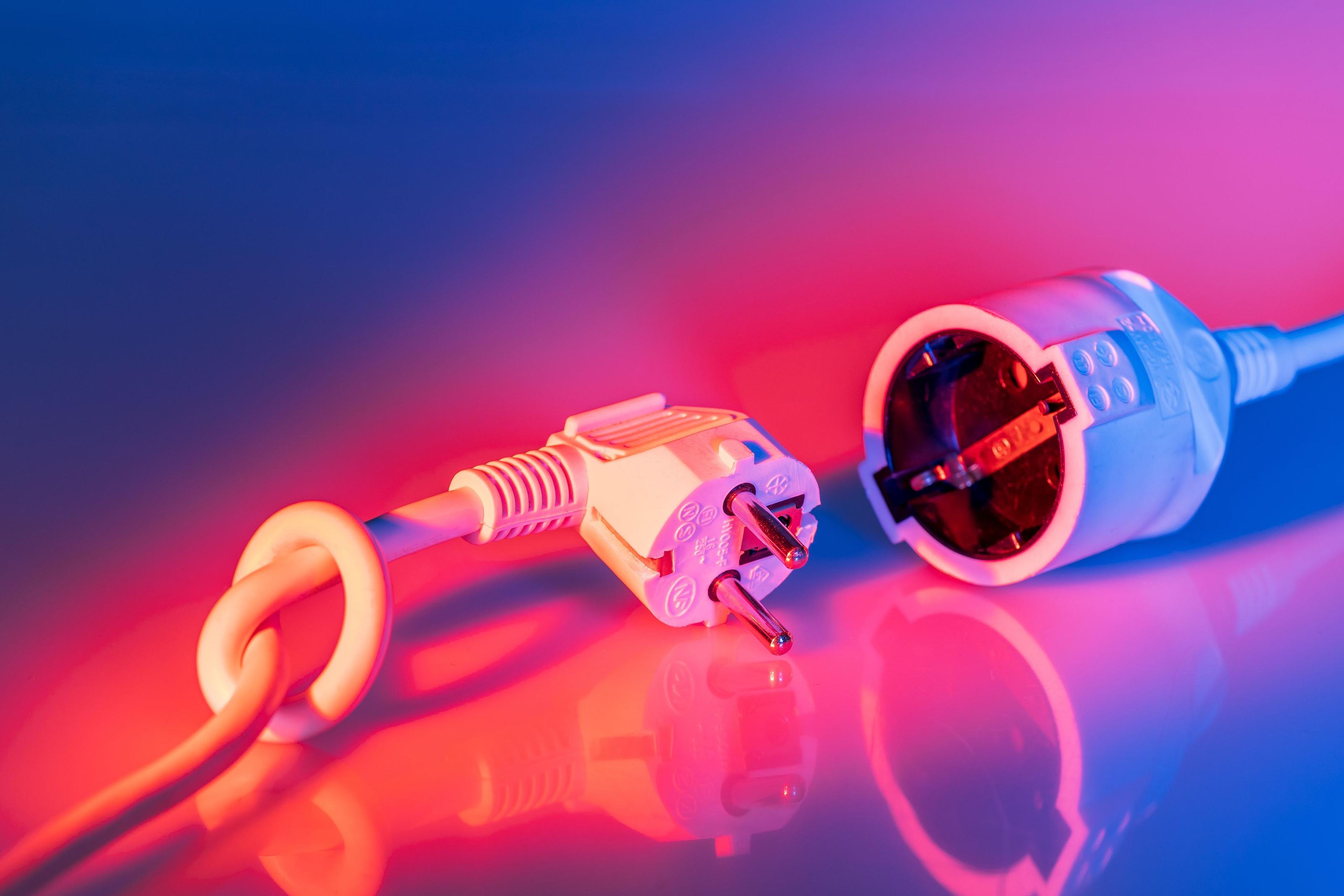
An EcoFlow Delta Pro 3 turns up on a doorstep in Cologne, sold €400 under the German list price on a UK marketplace listing. Same shell, same 4,096Wh battery, same logo. Plug it in with the travel adapter from the box and the screen lights up, the battery charges, everything reads normal — right up until the chest freezer running off it starts humming at a pitch that wasn’t there before, and eight weeks later the compressor is dead. Nothing about the unit was faulty. It shipped configured for a market that runs its power stations at 60Hz by default, and a plug adapter changes a socket shape, not a firmware setting.
Most European buying advice stops at “get the Schuko version.” That’s the visible problem, and the easiest one to get right. Get the plug sorted and three quieter mismatches are still waiting: whether the socket can actually deliver what the unit claims, whether its sine wave is clean enough to be legal, and whether the number printed as “Hz” on the spec sheet matches the appliances you’re about to run. None of the four are complicated once you know to check them. None of them show up if you don’t.
Why a Single 230V Leg Skips America’s Whole Split-Phase Problem
Start with the reframe that matters before any spec sheet. A US home runs on two 120V legs, 180° out of phase, sharing one neutral — ordinary sockets tap a single leg for 120V, and anything bigger — a well pump, an electric dryer, a whole-panel transfer switch — needs both legs combined for 240V. That’s why every serious US power-station buying guide spends a section on “120V vs 240V split-phase” capability: a single-120V-output unit physically cannot run a 240V circuit no matter how large its battery is, and a genuine whole-home unit needs real split-phase inverter hardware or a transfer-switch built around combining two legs.
That entire shopping problem doesn’t exist on a European supply, because it was never split in two to begin with. A standard European household socket already delivers the full 230V on a single leg — there’s no second 120V leg sitting unused, nothing to combine. A power station with one ordinary 230V AC output already matches what’s on the wall for anything that circuit is rated to carry, from a laptop to an induction hob. The European equivalent of needing more than a single leg can supply isn’t a bigger single-phase unit — it’s three-phase, a genuinely different supply geometry covered in the three-phase guide, and it only applies once a property’s own connection already is three-phase. For the single-phase home most European off-gridders are actually powering, the split-phase question a US buyer has to answer before checkout simply isn’t on the form.
Key number
3,680W
What a standard European socket circuit — 230V at 16A — is rated to deliver: 230 × 16 = 3,680W. That’s the ceiling on anything run through one ordinary Schuko outlet or extension lead, regardless of what the power station’s own inverter is rated for. A 4,000W unit spreads that total across several onboard sockets; it doesn’t mean one downstream extension cord can carry all 4,000W at once.
Schuko, CEE and the Sockets You’ll Actually Meet
Roughly 85% of Europe plugs in without thinking about it: Schuko (Type F, round pins with side earth clips) across Germany, Austria, the Netherlands and most of Central and Eastern Europe, and Type E (France, Belgium, Poland, Slovakia), which swaps the side clips for a socket-mounted earth pin. The two aren’t identical, but the hybrid plug almost every manufacturer ships — CEE 7/7 — seats in both, which is why a genuine European-spec unit’s charging cable and output sockets work across most of the continent with no adapter.
| Standard | Where | What’s different | Fits a CEE 7/7 unit? |
|---|---|---|---|
| Schuko / Type F | Germany, Austria, Netherlands, most of C&E Europe | Round pins, side earth clips | Native |
| Type E | France, Belgium, Poland, Slovakia | Socket-mounted earth pin | Native (hybrid plug) |
| Type G (BS 1363) | UK, Ireland | Three rectangular pins, fused plug | UK/IE need the Type G SKU; Ireland is CE; Great Britain recognises CE indefinitely (2023 decision) |
| Type K | Denmark | Earth pin position doesn’t align with Schuko | Usually needs an adapter for earth to seat |
| Type J / Type L | Switzerland / Italy | Different pin spacing or count | Adapter usually required |
For anything past one Schuko circuit’s comfortable limit — a stackable whole-home unit, an EV wallbox, a workshop — European installers reach for the blue CEE 16A/32A commando plug (IEC 60309), the same connector campsites and marinas use, rated well past the 3,680W ceiling above. Expect it on a proper installed system, not a portable unit’s own output socket.
Before you order, confirm three things on the listing itself, not the marketing page:
- Sold and warrantied through the brand’s European storefront — not a grey import off a US or Amazon.com listing with a travel adapter bundled in.
- AC output socket type matches your country: Schuko/Type E covers most of the continent; UK and Ireland need the Type G SKU specifically.
- Your own supply is genuinely single-phase before you shop for a single-leg unit — check the meter cabinet or connection contract, not the size of the house (the three-phase guide covers how to tell in under a minute).
Pure Sine Wave and the CE Mark Aren’t Box-Ticking
Every AC output on a power station is synthesised, not passed through — the battery stores DC, and the inverter builds a sine wave from it. A cheap modified or stepped-wave inverter runs a resistive load like a heater well enough, but it’s a genuinely dirtier waveform, and in Europe that’s not just a performance complaint — it’s a compliance one. Any electrical product placed on the European market needs a CE mark, declaring it meets the Low Voltage Directive (2014/35/EU) and the EMC Directive (2014/30/EU). A dirty waveform risks overheating a compressor or a heat pump’s variable-speed motor, and can push electromagnetic emissions outside what a genuine CE mark certifies. Every reputable European-market unit ships pure sine today, but check the spec sheet for “pure sine wave” and a THD figure (look for ≤3%) rather than assuming it from a CE sticker — the sticker certifies the whole product, not that one spec.
The Failure Mode Nobody Checks: Output Frequency
Voltage gets all the attention because a wrong voltage fails loudly and immediately — a 120V-only unit won’t power up on 230V, or trips its own protection the moment it’s plugged in. Frequency fails the opposite way: silently, on a delay. A power station generates its own AC from scratch at whatever frequency its firmware is set to — a region setting, not a law of physics the unit works out on its own. A unit built for the US market defaults its output to 60Hz; a genuine European-spec unit defaults to 50Hz. Bring the wrong one home on a grey import and the voltage still auto-ranges fine, while the frequency, which doesn’t auto-detect, quietly stays wrong.
The mechanism is the one that cooks a US off-grid kit’s pump motor run backwards on a European grid, just running the other direction: an AC induction motor’s speed is set by RPM = 120 × frequency ÷ poles. Feed a motor built and rated for 50Hz — a fridge or freezer compressor, a well pump, most washing-machine motors — a 60Hz supply instead, and it spins roughly 20% faster than rated, drawing more current and running hotter without tripping anything on day one. It’s the story that opened this guide: nothing broke at the wall or the plug. It broke six to eight weeks later, at the compressor, because a spec sheet’s “Hz” line never got checked.
The check itself takes thirty seconds, not a fresh purchase. Most EcoFlow and Bluetti units expose output frequency as a setting inside their companion app rather than a hardware fixture — open it, find the AC output or system settings, and confirm it reads 50Hz before anything with a motor gets plugged in, including after a firmware update or factory reset, since a wrong default can quietly reassert itself. Jackery instead fixes frequency at the SKU level rather than exposing a toggle, so there the fix is buying the correct regional model in the first place, not a setting to check afterward. Either way, verify — or set — output Hz before a compressor, pump or heat pump ever sees the socket, not after.
Which European Power Station Family Actually Fits
Once phase, plug, waveform and frequency are settled, the model choice is short. Three families cover most European off-grid and backup-power buyers at 2026 spec, each sold as a genuine 230V/50Hz product on the brand’s own European storefront rather than a US SKU with an adapter taped on:
| Family | Usable capacity | Continuous / surge | Best for |
|---|---|---|---|
| EcoFlow Delta Pro 3 (Europe) | 4,096Wh | 4,000W / higher via X-Boost | Large cabin or apartment; stackable toward whole-home range |
| Bluetti AC200L (Europe) | 2,048Wh | 2,400W / 3,600W via Power Lifting | Mid-size cabin, CPAP plus fridge plus electronics |
| Bluetti Elite 200 V2 (Europe) | 2,074Wh | 2,600W / 3,900W via Power Lifting | Mid-size cabin, CPAP plus fridge plus electronics |
| Jackery Explorer 2000 v2 / 3000 v2 (Europe) | 2,042Wh / 3,072Wh | 2,200W / 3,600W (7,200W surge on the 3000 v2) | Van, weekend cabin, or a genuinely portable backup unit |
Every one ships with a Schuko-family output and a CEE 7/7 charging lead as standard on its European storefront, is CE-marked, and defaults to 230V/50Hz output — buying direct from the brand’s European site or an authorised reseller confirms that for you. Specs and European pricing move fast in this category — confirm the current listing before you spec against any number here. Current European-market picks, priced and plugged for where you actually live:
A Box, or a Designed System?
A power station answers a portable question well: run this list of things, off this much battery, with no electrician and no paperwork. It’s also, increasingly, how a European balcony goes solar at all — Germany’s Steckersolar rules, spreading to other member states, let a small plug-in panel feed a normal Schuko socket directly, capped around 800W, no installer required. A lighter use case than backing up a house, but proof of how far one 230V leg stretches before anything bigger is needed.
What a portable unit doesn’t do is qualify for the incentives in the European permits & incentives guide. Spain’s IRPF deduction, Italy’s detrazione, Germany’s 0% VAT on qualifying PV installs are all keyed to a certified, professionally installed system, not a box bought online, however large its battery. Once the list grows past “cover the essentials for a few days” into whole-home backup, a genuinely off-grid property, or anything that should legally touch your consumer unit, that’s the point to stop stacking power stations and price a designed system with an installer who already works in 230V/50Hz and knows what your country actually requires.
Can I just buy the US version and bring it to Europe?
You can, but you’re buying past the safety net, not around it. Voltage usually auto-ranges fine; the output frequency defaults to 60Hz and doesn’t auto-detect, which is the mismatch that overheats a 50Hz-rated compressor or pump motor over weeks instead of failing on day one. A grey import also carries the US warranty network, not the European one, and a plug adapter doesn’t add a CE mark that was never applied for.
Do I need an electrician to use a power station in my home?
Not to plug appliances directly into its own output sockets — that’s what it’s designed for. You need one the moment you want it to back up fixed wiring or a distribution board: never feed a power station into a wall socket backwards with a “suicide cable” — illegal and dangerous everywhere in Europe, the same as in the US, and exactly what a proper transfer-switch installation exists to prevent.
Does a stand-alone power station need CE marking if it never touches the grid?
Yes. CE marking is a baseline product-safety requirement under the Low Voltage and EMC Directives, applying to any electrical product placed on the European market whether or not it’s ever connected to the public grid. A power station that’s never grid-tied still needs it; what it doesn’t need is the extra grid-interconnection layer — EN 50549 and country rules like VDE-AR-N 4105 — reserved for fixed, grid-capable installations.
Will a portable power station qualify for my country’s solar incentive?
Generally no. Country incentives — Spain’s IRPF deduction, Italy’s detrazione, Germany’s 0% VAT on qualifying installs — are keyed to a certified, installed system, not a portable appliance bought online. See the country-by-country breakdown in the European permits & incentives guide for what each one requires.