


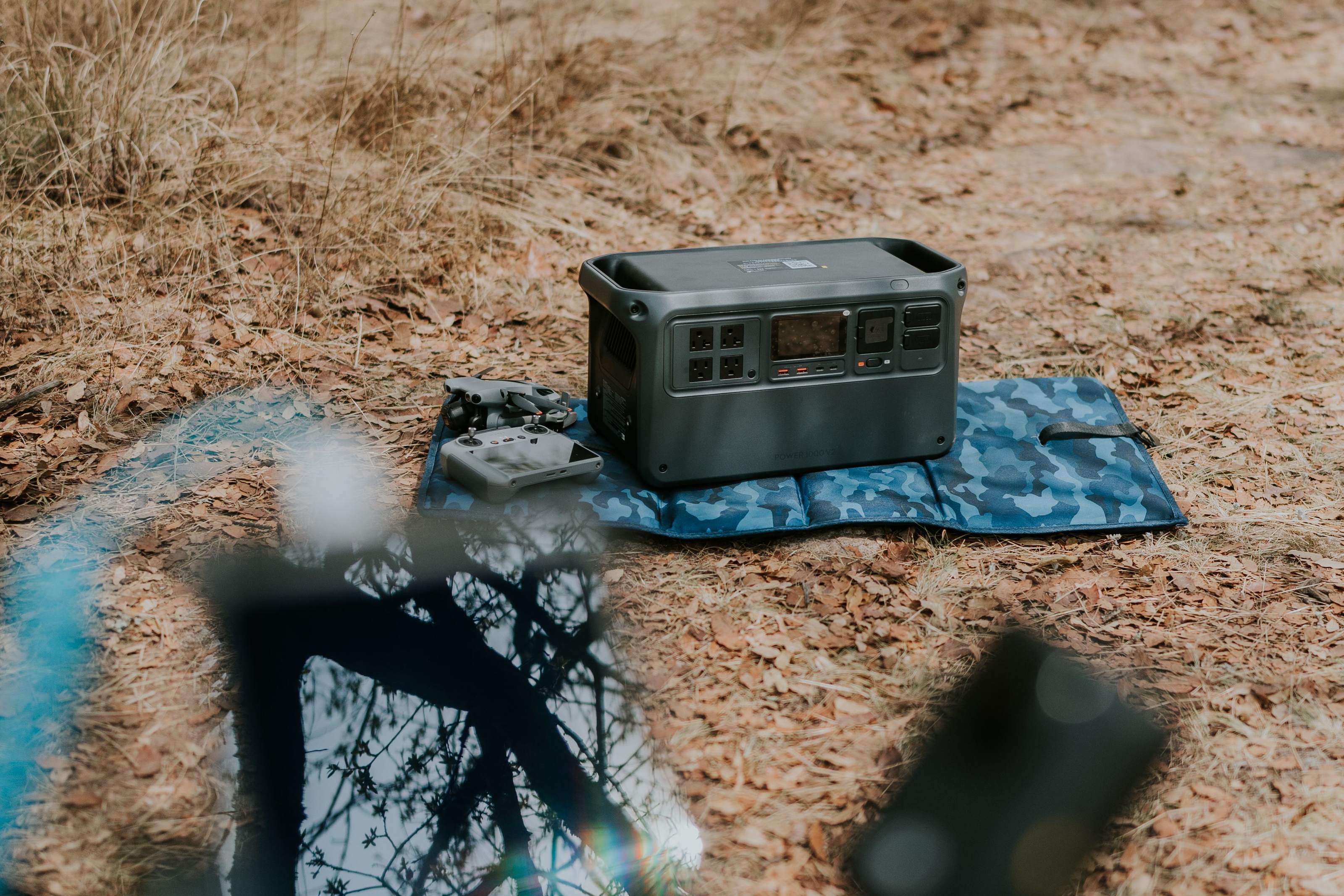
Open the case of the thing everyone at the campsite calls a “solar generator” and trace the wires. Panel cable comes in one side. Household plug goes out the other. In between: a battery, a circuit board, a fan. No fuel tank, no spark plug, no combustion of any kind. It doesn’t generate a single watt — it stores watts somebody else generated, either a solar panel sold separately or, more often, the wall outlet it got charged from the night before. Calling it a generator is a marketing decision from the mid-2010s, not an engineering one, and it works: “generator” borrows decades of trust from the gas-powered box in the garage, while the honest name — battery, or an uninterruptible power supply with a handle — sounds like something that runs out.
That naming gap is where the money gets made. Once a battery is called a generator, buyers stop comparing batteries and start comparing brand reputation, case color, and app polish. None of that decides whether the box runs a CPAP through an outage, keeps a fridge cold for a weekend, or still holds a charge in five years. Three numbers decide that: how many watt-hours you can actually pull back out, how many watts it can push continuously and in a surge, and what chemistry the cells are built from. Everything else on the spec sheet is trim.
What You’re Actually Buying: Four Parts in One Case
Strip the marketing and every “solar generator” on the market is the same four subsystems in a box:
- The battery — a stack of lithium cells (almost always LiFePO4 or NMC/Li-ion today) storing DC energy, rated in watt-hours (Wh).
- The battery management system (BMS) — the safety layer stopping overcharge, over-discharge, short circuits and thermal runaway. Never marketed, always the part actually protecting your house.
- The inverter — converts the battery’s DC into the AC your outlets expect, rated in continuous and surge watts.
- The charge controller — almost always MPPT, regulating whatever’s charging the battery: a solar panel, a wall outlet, a car’s 12V port, sometimes a generator.
That’s the entire product. A car jump-starter is the same four parts at 20Wh. A home battery like a Tesla Powerwall is the same four parts at 13,500Wh, hardwired instead of carried by a handle. Scale and packaging are the only real differences — which is also why the three specs below apply whether you’re buying a $200 weekend unit or spec’ing a $6,000 whole-cabin one.
Why “Generator” Stuck as the Name
“Battery pack” sounds like something that dies at the worst moment. “UPS” sounds like server-room equipment. “Generator” borrows the trust of the thing that already got you through the last outage — even though the box sold under that name has no engine, burns no fuel, and produces zero energy of its own. Solar is an optional charging input here, not the mechanism. The name was built to make a battery feel like a power source, and it works well enough that most buyers now shop the name instead of the numbers underneath it.
Spec 1 — Usable Watt-Hours, Not the Number on the Box
Watt-hours (Wh) measure stored energy, and it’s the first number every listing leads with — but the number on the box is rated capacity, not usable capacity, and the gap between them is where buyers get quietly shorted.
Depth of discharge (DoD) is how much of that rated capacity the BMS actually lets you draw before cutting the unit off. LiFePO4 packs are built to be discharged deep and routinely expose 95–100% of rated Wh as usable; cheaper NMC-based units, built to hit a low sticker price, sometimes reserve more headroom than gets advertised. A “1,000Wh” unit that only surfaces 850Wh before cutoff isn’t broken — it’s just quietly not the number on the box.
Then there’s the inverter itself, which loses roughly 10–15% of whatever it converts from DC to AC as heat — a real loss on every watt-hour you pull, not a one-time tax. The honest math for “how long will this run X” is:
The formula
Runtime (hours) ≈ (rated Wh × usable DoD × 0.85 inverter efficiency) ÷ appliance watts. A 1,000Wh LiFePO4 unit at 95% usable running a 60W CPAP: 1,000 × 0.95 × 0.85 ÷ 60 ≈ 13.5 hours — not the 16.7 hours you get dividing the box number straight through.
Run that formula against a few common loads and the picture gets concrete fast:
| Load | Running watts | Runtime, 1,000Wh unit | Runtime, 2,000Wh unit |
|---|---|---|---|
| CPAP machine | 40–60W | ~13–20 hrs | ~27–40 hrs |
| Mini-fridge (duty-cycle average) | ~60W | ~13.5 hrs | ~27 hrs |
| Laptop + router | 75W | ~11 hrs | ~22 hrs |
| Box fan | 60W | ~13.5 hrs | ~27 hrs |
| Electric kettle | 1,200W | ~40 min | ~1.3 hrs |
| Space heater | 1,500W | ~32 min | ~1.1 hrs |
Estimates assume 95% usable DoD and 85% inverter efficiency; real-world figures vary by brand, load type and ambient temperature.
Spec 2 — Continuous Watts vs Surge Watts
Watt-hours answer “how long.” Watts answer “how hard, right now” — a completely separate spec that a bigger battery does nothing to fix. A 3,000Wh unit with a 500W-continuous inverter still can’t run a 1,500W space heater; it just runs a 500W load for a very long time.
Every unit carries two watt ratings. Continuous watts is what it outputs indefinitely without the inverter overheating. Surge watts is a short burst — a second or two — for the instant a motor starts, before it settles into its running draw. Anything with a compressor or motor (a fridge, a power tool, a well pump, an AC unit) spikes 2–3× its running watts at that instant; anything purely resistive (a heater, a kettle, most hair dryers) draws its full rated watts continuously with no surge at all — the opposite of what most people assume is the riskier load.
| Appliance | Running watts | Surge behavior |
|---|---|---|
| Mini-fridge | 60–150W | 2–3× for <1 sec at compressor start |
| Angle grinder / circular saw | 1,000–1,500W | ~2× at motor start |
| Window AC unit | 500–1,200W | 2–3× at compressor start |
| Coffee maker / kettle | 900–1,500W | none — resistive heating element |
| Hair dryer | 1,200–1,875W | none — resistive element |
| Microwave | 1,000–1,500W | none — the risk is just clearing rated watts |
The trap is real: a 1,500W resistive heater has no start-up spike, but still needs a continuous rating above 1,500W — a common “1,800W surge / 1,200W continuous” unit will brown out trying, even though it handles a 400W fridge and its 3× compressor surge without strain. Buyers who only check the bigger surge number end up with exactly this mismatch on the load that actually mattered. For the same math at whole-house scale, see the inverter/charger sizing guide — identical physics, bigger numbers.
Spec 3 — The Chemistry Inside: LiFePO4 vs NMC
The cells are the part nobody photographs for the marketing page, and they carry the longest consequences of any spec. Two chemistries cover almost the whole market in 2026:
| LiFePO4 (LFP) | NMC / Li-ion | |
|---|---|---|
| Cycle life to 80% capacity | ~2,000–3,500+ | ~500–1,000 |
| Thermal runaway onset | ~270°C+ — hard to ignite | ~150–210°C — more sensitive |
| Energy density | Lower — heavier per Wh | Higher — lighter per Wh |
| Typical 2026 role | Default from ~300Wh up | Common in sub-300Wh ultra-portables |
LiFePO4 became the default past pocket size for a simple reason: it survives roughly three to five times the full charge cycles before dropping to 80% capacity, and resists thermal runaway far better if it’s punctured, overcharged, or left in a hot car. NMC still shows up in the smallest, lightest units because it packs more energy into less weight — a real advantage in a backpack, not much of one under a bed or in a shed. The same trade-off scales up to whole-house banks; see the battery bank sizing guide.
Run the cycle-life gap as a cost-per-use number and the cheaper sticker price stops looking cheap. A $250 NMC-based 300Wh unit rated for 800 cycles runs roughly $0.31 per cycle over its life. A $350 LiFePO4 300Wh unit rated for 3,000 cycles: roughly $0.12 per cycle — under half the running cost, from a battery that also degrades slower and fails less dramatically when something goes wrong.
The Airline Gotcha Almost Nobody Checks Before Buying
Here’s the part nobody puts on the spec sheet: watt-hours are also a legal ceiling on where the unit can travel. Airlines — under the same ICAO/IATA dangerous-goods rule the FAA and European aviation authorities both enforce almost identically — cap passenger lithium batteries at 100Wh unrestricted, 101–160Wh with airline approval and a two-spare limit, and anything over 160Wh banned outright, checked or carry-on, no exceptions. Most units marketed as travel-ready — anything past the smallest 100–150Wh tier — simply cannot fly with you, in the US or in Europe. If the plan involves flying to the cabin or the site, the unit has to ship, drive, or stay under the line — worth knowing before the case is halfway through security.
One Spec That Actually Changes by Region
Watt-hours, watts and chemistry travel the same everywhere. Output voltage doesn’t. In the US, a power station’s AC outlets put out 120V through standard NEMA 5-15 plugs; in Europe, the same class of unit outputs 230V through Schuko or CEE plugs. A travel adapter changes the socket shape, not what’s coming out of the inverter — a US-spec 120V-only unit brought to Europe, or the reverse, won’t run the other region’s appliances no matter what tip goes on the cord, unless the model is built dual-voltage. Check the AC output spec before assuming any unit crosses the Atlantic with you.
Picking a Model Once the Three Specs Are Set
With a target usable-Wh number, a continuous/surge number that clears your worst load, and a chemistry preference, picking an actual model stops being a brand contest and starts being three numbers you already know you need:
- Usable Wh at realistic DoD ≥ the energy your actual loads need, not the number printed on the box.
- Continuous watts clears your single biggest resistive load — a heater or kettle, most often — with headroom, not just the surge number.
- LiFePO4 unless weight is the overriding constraint, for the cycle-life and thermal-safety math above.
Sizing a fixed home system instead of a portable unit runs the same three numbers at a bigger scale — see our off-grid solar sizing guide or run your own loads through the off-grid solar sizing calculator. Matched to your region, here’s where to start looking:
Do solar generators need solar panels to work at all?
No. Every one works as a plain battery, charged from a wall outlet or a car’s 12V port, with zero panels attached — that’s how most owners actually use them day to day. Solar panels are an optional charging input, almost always sold separately.
Why do two 1,000Wh power stations cost $400 apart?
Almost always chemistry and build quality in the inverter and BMS. A cheaper NMC pack with a bare-minimum inverter hits a lower cycle count and narrower safe operating range than a LiFePO4 pack with a well-built one — the price gap mostly buys cycle life and thermal safety margin, not a bigger battery.
Can I bring a power station on a plane?
Only if it’s rated 100Wh or less without asking, or 101–160Wh with airline approval and a two-unit limit. Above 160Wh it’s banned as both checked and carry-on baggage — the same rule FAA and European aviation authorities both enforce, which rules out most units bought for home backup or a cabin.
Is a bigger continuous-watt rating always the safer buy?
Not automatically. Oversizing adds weight, cost and standby draw with no upside if your loads are small. What matters is clearing your single biggest continuous load — usually a resistive heater — with headroom, not the largest number on the shelf.