


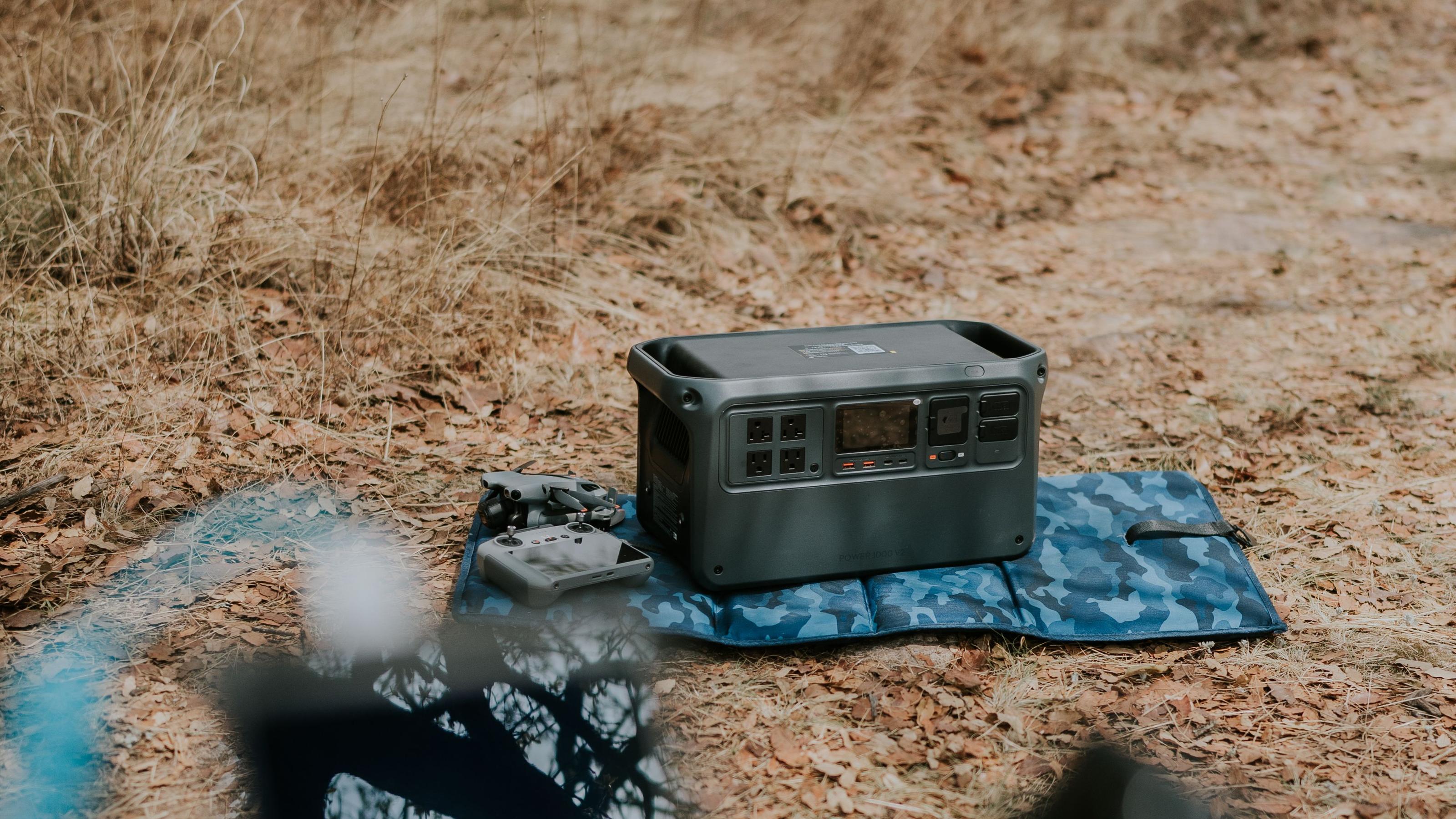
Every portable power station ad leads with one number, stamped huge across the box: 1,000Wh. 2,048Wh. 3,600Wh. Shoppers treat it exactly like a phone’s storage tier — bigger number, better unit — buy the biggest one the budget clears, and find out during the first real test whether they guessed right. Two people can own the identical 2,048Wh station and get opposite outcomes: one runs a fridge, a laptop and a Starlink dish for four easy days off a small panel; the other is dead by lunch on day two running a space heater. Same battery. Different math, done or skipped.
Sizing a power station correctly is four numbers, not one — and the number on the box is only the first of them, rarely the one that causes the return. Here’s the method, in the order it has to happen.
Step 1 — Build the Load List First
Every sizing exercise starts the same way an electrician starts a bid: watts × hours = watt-hours, added up device by device until there’s a real daily number instead of a guess. Skip this step and every later number — capacity, surge rating, panel size — is being fitted to a fiction.
Take a realistic day off-grid — a cabin, a van, or a home riding out an outage — and it adds up faster than most people expect:
| Load | Draw | Runtime/day | Wh/day |
|---|---|---|---|
| Compressor fridge/cooler (cycling average) | 50W avg | 24h | 1,200Wh |
| Laptop + monitor | 70W | 5h | 350Wh |
| CPAP with heated humidifier | 40W | 8h | 320Wh |
| LED lighting (several fixtures) | 40W | 5h | 200Wh |
| Starlink Mini | 40W | 10h | 400Wh |
| Coffee maker | 1,000W | 6 min | 100Wh |
| Phone + small electronics | 15W | 3h | 45Wh |
That’s roughly 2,600Wh a day — and nothing on that list is exotic. A fridge, a laptop, a CPAP, some lights, a satellite dish, one cup of coffee. Most over- or under-buying happens right here, before anyone opens a spec sheet, because the list either never gets built or gets built optimistically.
Step 2 — Nameplate vs. Usable: The 15% Nobody Puts on the Box
The Wh number on the box is measured at the battery, not the wall socket you’re plugging into. Getting that stored energy out as usable AC power means pushing it through an inverter, and inverters aren’t free — a well-built pure-sine unit converts DC to AC at roughly 85–92% efficiency, and the station’s own screen, fans, WiFi radio and standby electronics keep drawing a small idle load (often 10–40W) the whole time it’s on. None of that shows up on the spec sheet as a subtraction; it shows up later as the unit dying earlier than the box implied.
Key number
Budget on roughly 85% of the nameplate Wh as real, usable AC power. A “2,048Wh” station realistically delivers something like 1,700–1,850Wh of stuff-that-actually-runs before it shuts off — and the gap gets worse, not better, on units left connected to WiFi with a bright status screen running around the clock.
Run that the other direction and it becomes the genuinely useful number: to get 2,600Wh of usable power out — the full load list from Step 1, covered for one day with zero recharge — divide by 0.85, don’t multiply. That’s roughly 3,060Wh of nameplate capacity needed to deliver 2,600Wh of real output. Buy a station rated at exactly 2,600Wh, the number that felt precisely right, and it’s already about 400Wh short before a single device gets plugged in.
Step 3 — Surge Watts: Why “Enough Capacity” Still Trips the Breaker
Watt-hours measure energy: how long something runs. Watts measure power: whether it turns on at all. A station can hold days of stored capacity and still throw an overload fault the instant a compressor kicks in — the fault has nothing to do with how full the battery is, it’s the continuous and surge rating being asked for more instantaneous power than the inverter can deliver, full battery or not.
Every AC output carries two power ratings: continuous (rated) watts it can sustain, and surge (peak) watts it can deliver for a second or two to get a motor through locked-rotor start-up. Resistive loads — heaters, kettles, toasters, hair dryers — barely surge at all; their danger is pure continuous wattage, often enough by itself to eat most of a compact unit’s rating with nothing else running. Anything with a compressor or motor is the opposite problem: modest running watts, a sharp multiple of that at start-up.
| Load | Running watts | Typical surge | Surge watts |
|---|---|---|---|
| Compressor fridge/cooler | 60–150W | ~3× | 200–450W |
| Box fan | 60–100W | ~2–3× | 150–300W |
| Small mini-split (soft-start) | 800–1,200W | ~1.5–2× | 1,500–2,200W |
| Circular saw / angle grinder | 1,200–1,500W | ~2–3× | 2,500–4,000W |
| Microwave | 1,000–1,200W | ~1× | negligible extra |
| Coffee maker / electric kettle | 1,000–1,500W | ~1× | negligible extra |
| Hair dryer | 1,200–1,800W | ~1× | negligible extra |
The fix is stacking loads correctly, not just buying a bigger box: a running fridge (60–150W) plus a coffee maker switching on (1,000–1,500W) is a continuous-watts problem — add them, don’t check the coffee maker alone. Most brands now ship a firmware overdrive mode — EcoFlow’s X-Boost, Bluetti’s Power Lifting — that lets a smaller continuous rating push a bigger resistive load by trimming voltage regulation and briefly disabling other outputs. Useful for a hair dryer or space heater. It does not manufacture real surge capacity for a motor start, and treating it like it does is how an “adequate” unit trips the moment two things run at once.
Step 4 — Autonomy Is a Balance, Not a Countdown Timer
This is the step almost every buying guide skips, and it’s the one that actually decides whether the trip, the outage or the season works out: capacity alone only tells you how long the battery lasts with zero recharge. The moment there’s a panel, a wall outlet before departure, or a generator top-up in the plan — which is nearly always — autonomy stops being a bucket you empty and becomes a bucket you’re filling and draining at the same time. What determines whether you run dry isn’t the size of the bucket. It’s whether the fill rate beats the drain rate.
The actual formula: days of true reserve = usable Wh ÷ (daily Wh out − daily Wh in). If daily input ever matches or beats daily output, that number stops meaning days-until-empty and starts meaning days-of-buffer against a bad stretch of weather — a completely different, much better problem to have.
Take a 3,000Wh-nameplate station — about 2,550Wh usable by the Step 2 rule — against the 2,600Wh/day load list from Step 1. Zero recharge, grid-down and cloudy: 2,550 ÷ 2,600 ≈ 0.98 days — under 24 hours, not the “three days of backup” the nameplate number felt like it promised. Add a realistic 300W panel — 4 peak-sun-hours, real-world losses from angle, cable and temperature, netting roughly 950–1,000Wh/day — and net daily drain drops to about 1,600Wh. Same battery, same load list, now closer to a day and a half of true reserve, refreshed most of the way back every clear afternoon instead of counting to zero once.
That 1.5-day number, not the 2,550Wh on the spec sheet, is what survives a three-day cloudy stretch. Closing the gap means moving one of two levers — more usable capacity, or less net daily drain, from a bigger panel or a shorter load list — and every one of the four steps pulls on the other three. That’s the reframe: sizing a power station isn’t picking one big number off a shelf. It’s balancing a small system.
Run your numbers
Skip the spreadsheet
Enter your own load list, target autonomy and available panel wattage, and the calculator runs all four steps — usable Wh, surge check, and net daily drain — and returns a matched capacity tier for your region.
Four Ways This Goes Wrong at the Checkout
- Shopping the nameplate Wh like it’s usable Wh, then getting the real number on hour one instead of at the register.
- Sizing for capacity alone and skipping the surge check, so a “plenty big enough” unit trips overload the first time a compressor and a kettle overlap.
- Multiplying daily draw by “days I want” with zero recharge input, when the real plan almost always includes a panel, an outlet, or a generator.
- Undersizing the panel relative to the load list, so a “three-day” battery quietly becomes a one-day battery the first overcast afternoon of the trip.
Matching a Tier to Your Number
Once the daily Wh, the surge check and the recharge math are done, the actual shopping is short — four real tiers cover nearly every off-grid use case:
| Tier | Usable capacity | Continuous / surge | Good for |
|---|---|---|---|
| Compact | 300–600Wh | 300–600W / 600–1,200W | Phones, laptops, camp lighting, one CPAP night |
| Mid | 1,000–2,000Wh | 1,000–2,000W / 2,000–4,000W | Weekend cabin or van, small fridge plus electronics, short outage |
| Large | 2,500–4,000Wh | 2,000–6,000W / 4,000–12,000W | Full-time van or cabin, CPAP + fridge + Starlink together, multi-day outage |
| Stackable / whole-home | 6,000Wh+ (expandable) | 6,000W+ / 12,000W+ | Whole-panel circuits, a well pump, a mini-split — where “portable” becomes “home battery” |
At the Large tier, current flagship units land in a tight band: the EcoFlow Delta Pro 3 ships 4,096Wh on a 4,000W inverter, the Anker SOLIX F3800 trades a little capacity (3,840Wh) for a genuinely bigger 6,000W split-phase inverter, and Bluetti’s Apex 300 starts smaller (2,764Wh) but stacks past 50kWh with add-on packs. Specs move fast here — confirm the current listing before you spec against any of these numbers.
Voltage changes what “the right unit” means by region: in the US, outlets are 120V/60Hz, and the Large-and-up tier is where genuine 120/240V split-phase output starts to matter for a well pump or dryer circuit. Across most of Europe, sockets are 230V/50Hz and a single-leg output already matches the panel, so split-phase mostly disappears — the trade-off becomes plug standard and European certification.
Current picks by tier, priced and plugged for wherever you are:
One flag worth catching early: if the daily number from Step 1 keeps creeping past roughly 5,000Wh, or the shopping keeps landing on the stackable tier, that’s usually a sign the real need is a designed, installed system, not a bigger box — worth reading the full 7-step sizing guide, or going straight to get matched with an installersee the recommended gear.
How much bigger should the nameplate rating be than my calculated number?
Divide your target usable Wh by 0.85 to get the nameplate figure to shop for, then round up to the next real product size — capacities cluster around fixed tiers (roughly 300, 600, 1,000, 1,500, 2,000, 3,000, 4,000Wh and up), so the honest number rarely lands exactly on one.
Does a bigger power station always mean more days of backup?
Only if nothing is recharging it. Capacity alone sets how long a battery lasts with zero input; the moment a panel, generator or outlet is part of the plan, actual autonomy depends on daily input beating daily output, not the Wh number alone. A smaller station paired with a correctly sized panel routinely outlasts a bigger one paired with an undersized panel.
Can a power station run a 240V or 230V well pump or dryer?
Most portable units output a single 120V or 230V leg, the same limit as a single-phase home inverter. A genuine 240V circuit in the US needs true split-phase output (a handful of large-tier models now ship this), not just a high wattage rating on one leg; in most of Europe circuits are already single-phase 230V, so the question doesn’t arise, though three-phase homes need the multi-unit approach covered in the inverter/charger sizing guide.
How long does a full recharge from solar actually take?
Roughly: usable Wh ÷ (panel watts × a realistic derate, about 0.7–0.8 for angle, temperature and cable loss). A 2,550Wh station on a 300W panel netting 210–240W in real conditions needs on the order of 11–12 hours of daylight to fully refill — rarely one calendar day, which is why the recharge math in Step 4 matters more than the capacity number alone.