


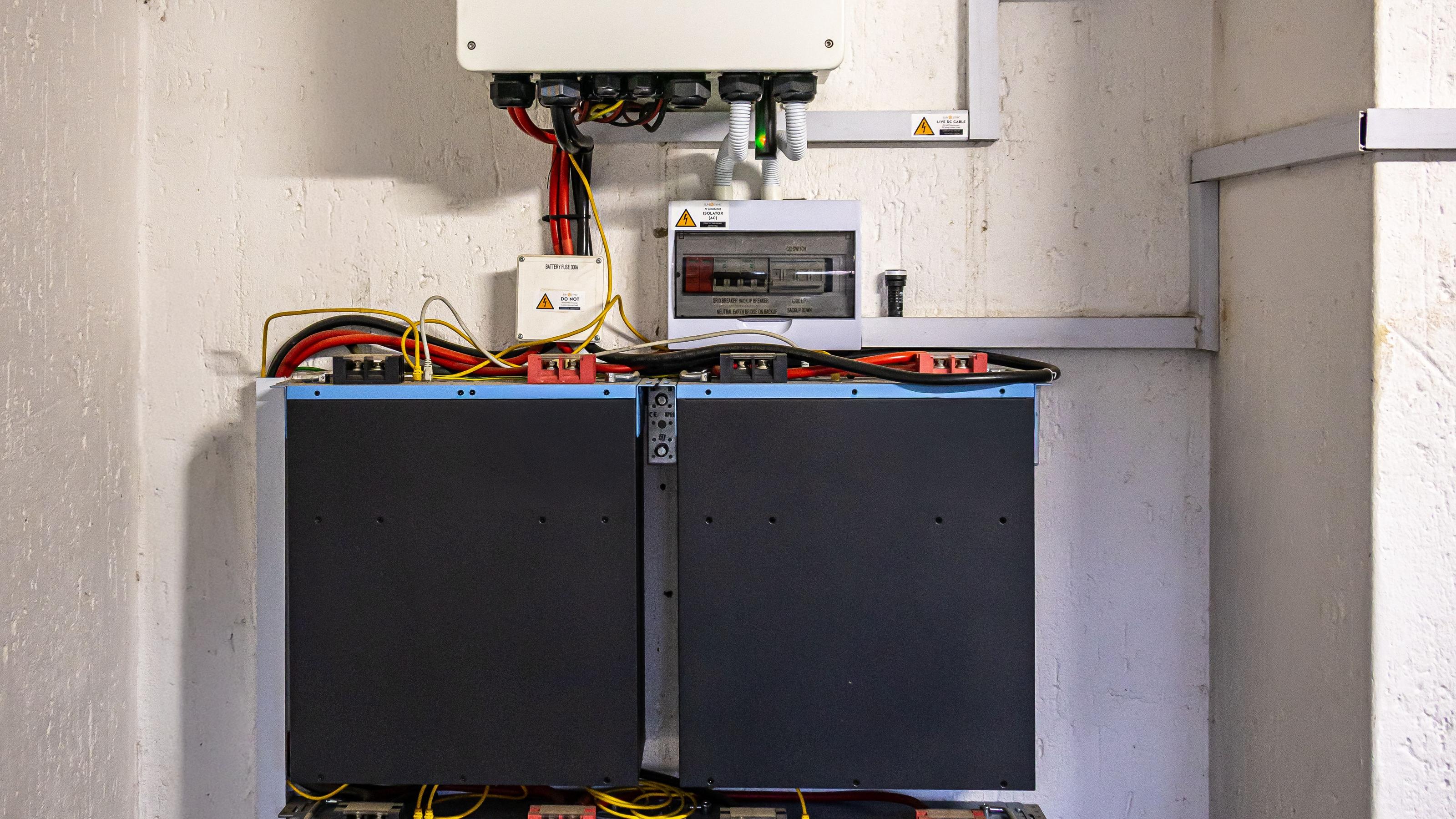
At some point tonight — call it 6:47, a lot earlier in December — the sun drops behind whatever you have for a horizon and your solar array becomes an expensive roof ornament until morning. In a well-designed off-grid home, nothing happens. The fridge keeps humming, the router keeps routing, the well pump kicks on at 3am and nobody stirs. That non-event is the entire product, and it isn’t the panels delivering it. It’s the battery.
Here’s the reframe that makes every other storage decision easier: solar panels don’t power an off-grid house. The battery powers the house; panels are just the fuel truck. The grid, for that matter, was never really selling you electrons either — it was selling buffering, the illusion that supply always equals demand at the exact millisecond you flip a switch. Go off-grid and that job doesn’t disappear. It lands on a box of chemistry in your utility room, and how well you choose and size that box decides whether off-grid life feels like a superpower or a camping trip that never ends.
On this page
- What storage actually does
- Chemistry at a glance: LiFePO4 vs lead-acid vs NMC
- Usable energy and the half-a-battery trap
- Days of autonomy: sizing for darkness
- Round-trip losses: the toll booth
- The BMS and safe integration
- Why 48V won
- Where a Powerwall-class battery fits
- Get a storage design
- Go deeper
The load should never notice the sun went down
Strip away the brand names and a battery bank does exactly three jobs:
- Time-shifting. Solar production peaks at noon; your household peaks at 7pm. The bank moves the middle of the day to the evening, every day, forever.
- Surge duty. A well pump that draws 1,000W running can demand 3,000W+ for the half-second it starts. The bank (through the inverter) supplies that violence without flinching — something a panel alone could never do, even at high noon.
- Autonomy. When a weather front parks overhead for two days, the bank is the power company.
Generation — the solar side of the system — gets all the glamour shots. But when owners say their system “just works,” what they’re actually describing is storage doing all three jobs so smoothly the household forgot the grid exists. That’s the design target: the load never notices.
Chemistry at a glance: LiFePO4, lead-acid, NMC
Ask anyone who’s lived off-grid for twenty years to show you the battery shed. Somewhere in a corner there’s a graveyard — a row of swollen, sulfated lead-acid units, each one a semester of tuition in what happens when you discharge lead too deep, leave it half-charged for a week, or skip a watering. That education used to be mandatory. Since lithium iron phosphate (LiFePO4, or LFP) collapsed in price, it’s optional — and the numbers explain why.
| LiFePO4 (LFP) | Lead-acid (flooded/AGM) | NMC lithium | |
|---|---|---|---|
| Usable depth of discharge | 80–100% (design at 90%) | 50% | 80–90% |
| Cycle life to 80% capacity | 3,500–8,000+ | 500–1,200 | 1,000–2,500 |
| Round-trip efficiency (cells) | 96–99% | 75–85% | 92–96% |
| Weight per usable kWh | ≈9–11 kg | ≈45–55 kg | ≈5–7 kg |
| Charging below 0°C / 32°F | Blocked without heating | Allowed (slowly) | Blocked without heating |
| Thermal runaway risk | Very low | None (vents hydrogen instead) | Real; needs containment |
| Maintenance | None | Watering, equalising (flooded) | None |
| Stationary role in 2026 | The default | Legacy & cold niches | Power stations, EVs |
The short version: LFP won stationary storage. It cycles deeper, lasts five to ten times longer, wastes less of every stored kilowatt-hour, and its worst-case failure mode is dramatically tamer than NMC’s. NMC still earns its keep where energy density matters — anything that drives, flies or gets carried, which is why it shows up in EVs and some portable power stations. Lead-acid survives in two honest niches: dirt-cheap starter systems you expect to replace, and installs that must accept charge well below freezing without battery heaters. Everywhere else it’s nostalgia.
Usable energy: the half-a-battery trap
The spec-sheet number that misleads more buyers than any other is nameplate capacity. A “10 kWh” lead-acid bank is not 10 kWh you can spend — drain lead past 50% routinely and its cycle life falls off a cliff, so an honest designer treats half the bank as untouchable ballast. The same 10 kWh in LFP gives you 8 to 9 kWh, day after day, without shortening its life in any way you’ll notice inside a decade.
Run the lifetime arithmetic and the “cheap” option inverts. Price a 10 kWh flooded bank at roughly $1,600 (euro pricing lands in the same band, and the ratio below survives any exchange rate): 5 usable kWh × ~1,000 cycles ≈ 5,000 kWh delivered over its life. An LFP bank at roughly $2,800 for the same nameplate: 9 usable kWh × ~4,000 cycles ≈ 36,000 kWh. Divide it out:
Key number
Cost per stored kilowatt-hour over the bank’s life: LiFePO4 ≈ $0.08. Lead-acid ≈ $0.32. The chemistry that costs nearly twice as much up front delivers stored energy at a quarter of the price — before counting lead’s extra charging losses, watering labor, and the weekend you’ll spend replacing it in year four.
Days of autonomy: sizing for darkness
Since the battery is the actual power company, size it the way a utility would: not for the sunny average, but for the dark tail. “Days of autonomy” is how long the bank alone carries the house with zero solar input. The method takes three numbers:
Bank size (kWh) = daily load × autonomy days ÷ (usable DoD × inverter efficiency)
Worked example: a modest, efficient off-grid home drawing 8 kWh/day, designed for 2 days of autonomy on LFP (0.9 usable) through an inverter averaging 92% efficiency:
Key number
8 × 2 ÷ (0.9 × 0.92) ≈ 19.3 kWh → four 5 kWh 48V rack modules (20.5 kWh). The same house on lead-acid at 50% DoD needs a ~39 kWh nameplate bank weighing close to a tonne.
How many days is right? That’s a climate decision, not a formula constant. Southern Spain or Arizona, 1.5–2 days covers almost every stretch of weather you’ll meet. Scotland, the Pacific Northwest or an Alpine north slope in November is a different planet — and here’s the part that saves five figures: the last day of autonomy is the most expensive electricity you will ever buy. Stretching a bank from 3 to 5 days nearly doubles its cost to cover weather that happens twice a year. Past day two or three, a small generator that runs twenty hours a year beats another $6,000 of batteries every time — the full trade-off lives in our generator vs home battery guide.
Size my battery bank → Read the full sizing math
The calculator turns your loads, autonomy and chemistry into usable kWh, amp-hours at 48V and a string layout — members can save the result and turn it straight into installer quotes— members can save the result and take it straight to the exact gear we recommend.
Round-trip losses: every stored kilowatt-hour pays a toll
No battery gives back everything you feed it. Energy pays a conversion fee going in, a chemistry fee sitting there, and an inverter fee coming out. LFP cells themselves are gloriously efficient — 96–99% — but the whole chain is what matters: a DC-coupled system typically lands at 88–94% round trip, an AC-coupled one in the mid-to-high 80s, and lead-acid drags the chain down to 70–80%.
Two design consequences. First, the solar array must be sized 10–15% larger than the naive math suggests, because a slice of every harvested kilowatt-hour evaporates in transit — we account for this on the generation side. Second, and almost nobody tells you this: loads you run while the sun is up skip most of the toll. Electrons flowing panel-to-washing-machine at 1pm never pay the storage tax. Off-grid veterans don’t run dishwashers at midnight like time-of-use suburbanites; they run them at solar noon. Free efficiency, no hardware required.
The BMS: the adult in the room
Every lithium bank worth buying has a battery management system watching each cell group: balancing them, cutting charge on over-voltage, cutting load on under-voltage or overcurrent, and — critically for cold climates — refusing charge below 0°C/32°F, because charging frozen lithium plates metal onto the anode and quietly ruins the cell. Heated or self-heating packs solve this; so does mounting the bank inside the building’s insulated envelope.
But understand the BMS’s real role: it’s the airbag, not the driver. A BMS disconnect at 2am isn’t “the system working” — it’s the last line of defense deploying because something upstream was configured wrong. A properly integrated bank talks to the inverter/charger over CAN or RS485 (“closed-loop”), telling it exactly what current it wants at what voltage, so the BMS never has to slam the door. Beyond the electronics, safe integration is refreshingly old-fashioned: a properly rated DC fuse (Class T or NH-type) directly at the bank, cable sized to the actual current, torqued lugs, and a disconnect you can reach. Our inverter/charger sizing guide covers the pairing in detail — the battery and the inverter are one machine and must be chosen together.
Why 48V won
Watts are volts times amps, and amps are what cost money and start fires. Pull 5,000W from a 12V bank and you’re moving 417 amps — welding-cable territory, with every connection a potential hot spot. The same 5,000W at 24V is 208A. At 48V it’s a civilised 104A: normal lugs, affordable breakers, cable you can actually bend.
48V has a second, quieter virtue: it stays under the ~60V DC threshold that both North American and European electrical codes treat as touch-safe low voltage, which keeps installation rules, hardware and labor dramatically simpler on either side of the Atlantic. That’s why the industry converged on the 51.2V-nominal (16-cell LFP) standard, and why the modern off-grid bank is a stack of 5 kWh rack-mount modules paralleled on a busbar — start with three, add a fourth when the workshop grows. Rule of thumb: 12V belongs in vans, 24V in sheds and small cabins, 48V in anything with a well pump. The high-voltage (200–500V) packs live inside appliance batteries — which brings us to the box everyone asks about.
Where a Powerwall-class battery fits
Tesla’s Powerwall 3 (13.5 kWh, integrated 11.5 kW hybrid inverter), FranklinWH’s aPower 2 (15 kWh, 10 kW), and their European counterparts from BYD, Sungrow and sonnen are genuinely good machines: certified, ten-year-warrantied, seamless at backup, tidy on a garage wall. In the US they arrive configured for 120/240V split-phase; in Europe, for 230V single- or three-phase — one of the few places the two editions of “off-grid” genuinely diverge.
Appliance battery or modular bank? The rule of thumb
If you have a grid connection and want to survive outages (and arbitrage time-of-use rates), the appliance battery is the right product. It’s engineered around the grid as its reference and safety net, installs in a day, and the tidy, neighborhood-friendly package is the point — expect roughly $12,000–$16,000 installed in the US, or €9,000–€14,000 in Europe depending on country and VAT treatment.
If you’re cutting the cord entirely, the modular 48V bank usually wins. True off-grid life rewards exactly what appliance batteries deprioritise: cheap expansion (rack modules run a third to a half the per-kWh price of an appliance install), generator integration for the dark week, black-start behavior you control, and repair by module instead of by warranty claim. One 13.5 kWh wall unit is barely a single day of autonomy for a modest home — fine with a grid behind it, thin ice without one. Plenty of our designs still hang an appliance battery in a hybrid role; the point isn’t tribal. The two products answer different questions, and the wrong one costs five figures.
Appliance or modular — price both
This is the fork where real money moves: a Powerwall-class appliance installed against a modular 48 V bank for the same loads. Have both written up against your load sheet and compare line items, not brochures.
Go deeper
Storage is one leg of the systems we design — the overview of everything we do shows how it locks into generation upstream and, for the genuinely cautious, the survival-gear layer that takes over if the electrons ever stop entirely. On storage itself, these four guides carry the detail this page deliberately skips:
Guide
Sizing an Off-Grid Battery Bank
LiFePO4 vs lead-acid vs Powerwall, with the full worked math.
Guide
LiFePO4 vs NMC
Which chemistry belongs in your power station — and why density cuts both ways.
Guide
Standby Generator vs Home Battery
The backup decision: fuel vs chemistry, and where each one wins.
Guide
Inverter/Charger Sizing
The battery’s other half: surge ratings, pass-through and pairing done right.
How long does a LiFePO4 bank actually last?
Quality LFP is rated for 3,500–8,000 cycles to 80% of original capacity. At one deep cycle a day that’s 10–20 years — and “80% capacity” isn’t death, it’s a slightly smaller battery. Calendar aging typically caps real-world life somewhere in the 15–20 year range. Plan for the inverter to wear out first.
Can I start small and add batteries later?
With LFP at 48V, yes — paralleling additional rack modules of the same voltage and similar age is normal practice, especially with closed-loop BMS communication. Lead-acid can’t do this gracefully: new cells get dragged down to the oldest string’s condition, so lead is a buy-everything-on-day-one chemistry. Growability is one of the quiet reasons LFP took over.
Will my batteries charge in freezing weather?
LFP must not accept charge below 0°C/32°F, and any competent BMS blocks it. The fixes are routine: self-heating packs, a heating pad wired to spare solar, or simply mounting the bank inside the insulated envelope of the building. Lead-acid will charge in the cold — slowly, with reduced capacity — which is its one remaining technical advantage.
Is one Powerwall enough to go fully off-grid?
Rarely. A 13.5 kWh unit is about one day of autonomy for a modest, efficient home — comfortable with a grid behind it, marginal without one. Fully off-grid designs usually want 15–25+ kWh plus generator integration and cheap expansion, which is where modular 48V banks earn their keep. We design both kinds; the load numbers decide.
The battery is the one component your household will lean on every hour of every day for the next fifteen years — and the one where a sizing mistake costs five figures to fix. If you’d rather get it right the first time, tell us what you’re running.