


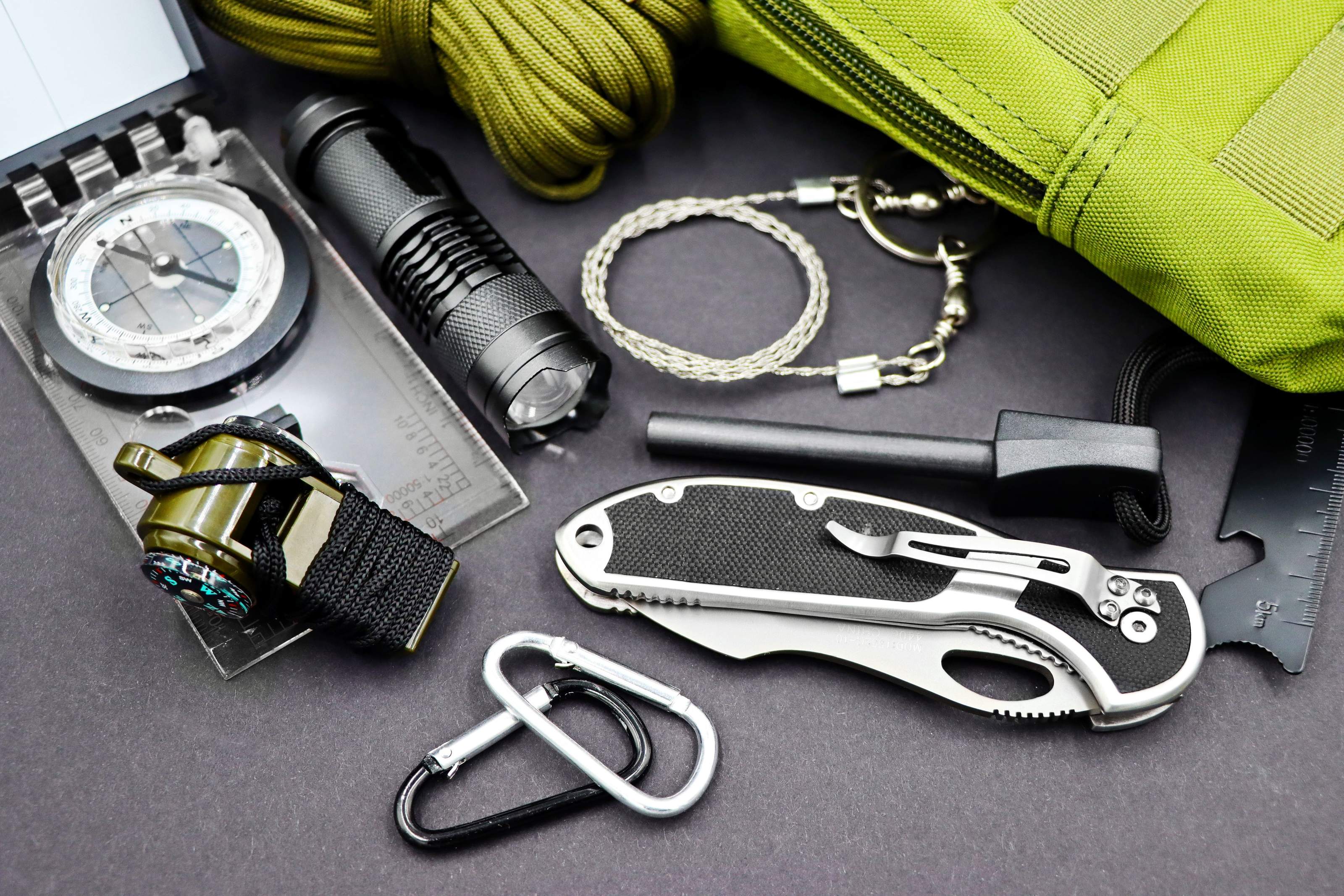
Every gear forum has him. Six hundred dollars of knives, a tactical tomahawk thrown exactly twice, eleven independent ways to start a fire — and a phone that died on night one of the storm, because nobody has yet figured out how to make electrons look heroic. He can shave with an axe. He cannot send his location, keep insulin cold, or run the CPAP that his wife would tell you is the actual survival gear in the house.
One sentence sorts out almost every gear list ever written: every piece of kit you will ever own is a producer (it makes energy), a store (it holds energy, water or heat), or a load (it spends what the other two provide). Most survival lists are ninety-five percent loads — and a load with no producer behind it is just weight. This page is the tour of the gear that turns a powered site into a base you can live and work from: what belongs in each layer, the watt numbers most lists never mention, and the order the money should be spent in. Each section ends where a deep guide begins.
On this page
One Rule Sorts Every Gear List
Producers, stores, loads. A solar panel produces. A power station, a water tank, a full propane bottle and a well-insulated room all store. Everything else — the fridge, the router, the pump, the lights, the laptop that lets you keep your job while living somewhere with more elk than neighbors — is a load. Buy loads last. It feels backwards, because loads are the fun part, which is exactly why the forum guy owns eleven fire-starters and zero watts.
The second rule is less obvious, and it is the one worth the price of admission: electronics are cheap to run; temperature is expensive. A full day of civilisation — two phones, a working laptop, satellite internet, generous evening light — costs about 700 watt-hours. One hour of a plug-in electric heater costs 1,500–2,000. One hour. The entire day’s work, comms and light, spent before the room is even warm. So the doctrine writes itself: spend electrons on information and motors, never on temperature. Make heat and cold from fuel, sun and insulation, and a modest battery starts feeling enormous.
Key number
About 1.2 kWh a day runs a live-and-work base — phones, laptop, satellite internet, LED light and a compressor fridge — before heating or cooling ever touches the budget. Every purchase on this page either serves that number or feeds it.
Layer 1 — Portable Power, the Keystone
The power station replaced the little suitcase generator at the heart of the portable kit because it fixed everything wrong with the generator. It is silent. It makes no exhaust, so it lives indoors next to the people using it. It holds charge for months, starts in any weather, and accepts energy from anything: folding solar panels, a wall socket while the grid still works, a vehicle’s 12 V port on the drive up. Every other layer on this page eventually plugs into this one — which is why it takes the biggest share of the budget and deserves the most homework.
The 2026 buying signals, in order: LiFePO4 chemistry (3,000–4,000 charge cycles — a decade of daily use — against roughly 500–1,000 for older NMC cells); usable watt-hours, not the sticker number; surge headroom for anything with a motor; and expandability, so capacity can grow without replacing the original box. Street prices for LiFePO4 units have settled around $0.35–$0.60 per watt-hour in the US, with a broadly similar figure per watt-hour in euros — and this market runs on sales, so a third off list price is patience, not luck. One regional trap: a 120 V US unit and a 230 V European unit are different machines. Buy the one built for your sockets.
“Solar generator,” while we are here, is a marketing word — the panels are almost always sold separately, and the panel watts you actually get deserve their own guide.
Sizing first, shopping second is the right order — the sizing guide walks the method, or jump to the 72-hour test below and do it in one table.
Layer 2 — Light
Light is where the physics is most on your side. A modern LED throws 100–150 lumens per watt, so a genuinely bright 300-lumen lantern draws about 3 watts. Light two rooms generously for a five-hour evening and the bill is 40–60 watt-hours — a rounding error against the day budget. Light is the cheapest morale in the entire kit, and the first thing that separates a base from a bivouac.
The working list is short: one USB-C rechargeable headlamp per person, because tasks happen where your hands are; two area lanterns per room actually lived in; and a string of warm-white LEDs, which sounds decorative until the third night, when it is the difference between camping in a building and living in one. Standardize everything on USB-C, and skip the 9,000-lumen tactical obelisk that doubles as a window-breaker — it runs for forty minutes and charges from a cable nobody else brought.
Layer 3 — Comms
Off-grid internet stopped being an oxymoron the moment satellite dishes learned to fold. A Starlink Mini draws 25–40 W in use; the larger Standard dish, 50–75 W. The trick is duty cycle: run the Mini through a ten-hour workday and it costs 300–400 watt-hours, comfortably inside the budget — but leave it on around the clock and it quietly becomes the biggest load on site, 0.7 kWh a day spent mostly on nobody. A switch is the cheapest comms upgrade there is. The dish-by-dish power math, cold-weather heater draw included, is in the Starlink off-grid power guide; the wider stack — boosters, failovers, routing — lives in connectivity.
Below the dish, this layer goes analogue on purpose. A pair of handheld radios — FRS (license-free) or GMRS (cheap no-exam FCC license) in the US, PMR446 (license-free) in Europe, the same job either side of the Atlantic — covers property-scale comms when phones have no bars and the dish is packed away. And a wind-up or battery AM/FM receiver earns its shelf space the old way: official emergency broadcasts are engineered to outlive cell coverage, and a radio that needs no infrastructure at all is the one line that cannot go down with the rest.
Layer 4 — Water, Heat and Cold
Water first, because the numbers are non-negotiable: 3–4 liters (about a gallon) per person per day for drinking, north of ten once cooking and basic washing join in — so stored water matters as much as treatment. The treatment workhorse is a 0.1-micron hollow-fiber filter: it strips bacteria and protozoa (not viruses or dissolved chemicals — know your source), costs about $40/€40, and the gravity-fed versions clean water by the bagful with zero effort. And here is the producers-and-loads rule hiding in a water bottle: boiling one liter costs roughly 0.1 kWh. Purify by kettle and a family of four burns over a kilowatt-hour a day making water safe that a forty-dollar filter handles for free.
Heat, same doctrine, with feeling: never make temperature out of electrons. A diesel parking heater delivers around 2 kW of warmth while its fan and fuel pump draw 10–25 W of electricity — roughly a hundred units of heat per unit of battery. Wood does it with zero. Propane is fine with ventilation. The plug-in heater, as established, eats the whole day before breakfast.
Cold is the one temperature worth paying watts for, because food and medicine give you no choice. A 45-liter 12 V compressor fridge draws about 45 W while its compressor cycles and totals 300–500 watt-hours a day in mild weather — the single biggest line in most base budgets. Chest-style keeps its cold when opened; shade and a full box (bottles of water count) shave real watt-hours off the bill.
Layer 5 — The Unglamorous Kit That Closes the Loop
None of this layer photographs well, and all of it is the difference between an incident and an anecdote:
- A repair kit for the power system itself — spare fuses, cable, connectors, crimps. The cheapest insurance per gram in the whole kit.
- Spare USB-C cables and a 12 V car adapter — the most survival-critical cables of the decade, and the first things to walk off.
- A first-aid kit built for tools, burns and falls, plus two weeks of any prescription that matters.
- Paper: printed maps, key documents, a written contact list — and cash, because card terminals die with the grid.
- Three boring ways to make fire — lighter, matches, ferro rod — rather than one exciting way.
- Work gloves, duct tape, zip ties and a real multi-tool.
- A 20-liter water container per person: a store, which outranks almost any load.
Check it twice a year. Rotation discipline beats shelf-life optimism on batteries, fuel, food and medication alike, and the calendar reminder costs less than anything else on this page.
The 72-Hour Test: Do the Math, Then the Drill
Here is the whole sizing method in four moves. List what genuinely has to run. Multiply each item’s watts by its hours to get watt-hours per day. Add twenty percent for inverter losses and bad luck. Then compare the three-day total against the usable — not sticker — capacity of your store. A realistic live-and-work base:
| Load | Draw | Use per day | Wh/day |
|---|---|---|---|
| Starlink Mini | 30 W | 10 h workday | 300 |
| Laptop | 50 W | 6 h | 300 |
| Two phones | — | 1 charge each | 40 |
| LED lighting | 10 W | 5 h | 50 |
| 45 L compressor fridge | 45 W, cycling | 24 h | 400 |
| Diesel heater (fan + pump) | 15 W | 10 h | 150 |
| Daily total | ≈1,240 | ||
| 72 hours, +20% buffer | ≈4.5 kWh |
There are two ways to buy 4.5 kWh. The store-only route: one big expandable station in the 4–5 kWh class — the simplest possible system, and it works through a week of storm cloud. The producer route: a 2 kWh-class unit plus 400 W of folding panels, which harvest 1.2–1.8 kWh on a decent day and turn “72 hours” into “indefinitely, weather permitting” — usually for less money. Cloud is the catch, and the cabin-scale answer to cloud is a designed solar system, where the panels do the heavy lifting and the gear on this page becomes the backup.
Then run the drill. Pick a quiet weekend, walk to the panel, and turn the main breaker off for 72 hours. You will discover your real loads (nobody remembers the well pump until it doesn’t run), your real habits (every household has a secret religion, and it is usually the kettle), and every hole in the list above — while the hardware store is still open and the stakes are exactly zero. It is the cheapest stress test in self-sufficiency, and more educational than any spreadsheet.
Prefer the spreadsheet anyway? The calculator runs the whole method — loads, surge check, buffer, matched capacity tier for your region — in about two minutes:
Go Deeper
This page is the map; the guides below are the territories. Start with power, then follow your use-case. To zoom out instead, everything we do shows where portable gear ends and installed systems begin.
Is a “solar generator” different from a power station?
Same box, better marketing. A “solar generator” is a power station photographed next to solar panels that are almost always sold separately. The specs that decide what you are actually buying are usable watt-hours, inverter and surge watts, and battery chemistry — the full decoding is in the solar-generator guide above.
How big a power station do I need to live and work off-grid?
A realistic live-and-work load — phones, laptop, satellite internet, LED light and a compressor fridge — lands around 1–1.5 kWh a day before heating or cooling. Cover 72 hours with a 4–5 kWh store alone, or with a 2 kWh unit plus roughly 400 W of solar. Your own numbers take about two minutes in the power-station calculator.
Can I run an electric heater off a power station?
Technically, briefly, regretfully. Resistive heaters draw 1,500–2,000 W, so a single hour costs more than a full day of everything else and empties even a large station overnight. Make heat from fuel — a diesel heater delivers about 2 kW of warmth for a 10–25 W electrical draw — and save the battery for electronics, where each watt-hour does the most work.
LiFePO4 or NMC?
For a base, LiFePO4, and it is not close: 3,000–4,000 charge cycles against roughly 500–1,000, plus far better thermal stability in a hot vehicle or cabin. NMC’s one real argument is weight, which matters in a backpack more than at a base. The chemistry guide above has the full comparison.