


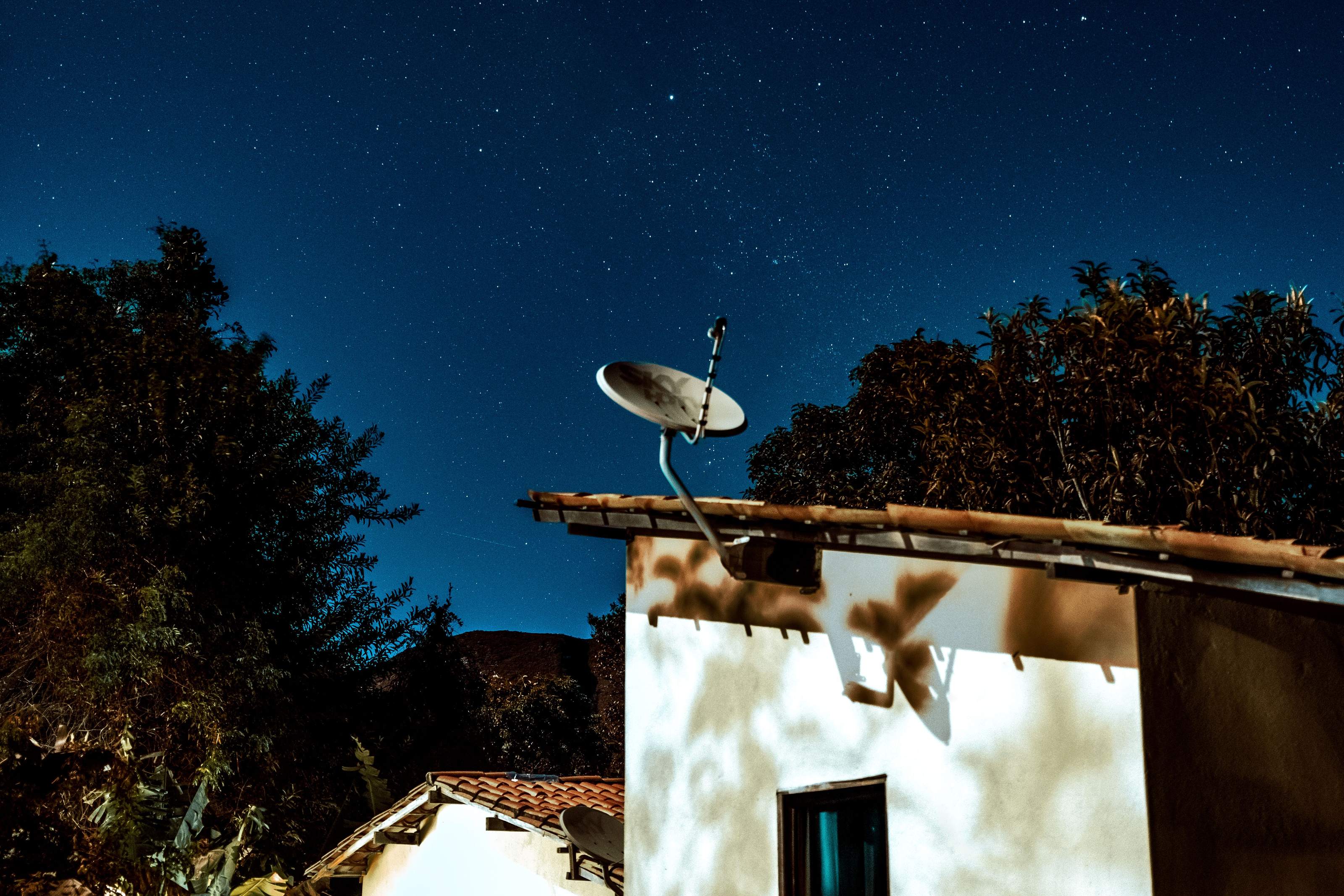
A software contractor we know sized her smallholding’s power system the way everyone does: fridge, lights, well pump, a generous margin, done. The satellite dish arrived eight months later and got plugged in like a table lamp — it’s just internet, how much can it eat? All through December it answered that question quietly, every night, until a Thursday at 05:50 when the low-voltage disconnect did its job and dropped the bank offline. Her 08:30 client call happened from a parked car forty minutes away, tethered to one bar of phone signal. The dish had clear sky the whole time. It was the battery underneath it that lost signal.
That’s the first distinction this page is built around: a lit site and a working site are two different projects. Lights, fridge and a pump make a property survivable — a camping trip with better furniture. Connectivity is what makes it an address: income, school, banking, weather warnings, the call for help. And here’s what almost nobody budgets for — a full-size satellite dish is one of the largest 24/7 appliances you will ever own. It eats like a refrigerator, it never defrosts, and in winter it eats more.
The second distinction cuts deeper, because for a lot of people it is the whole reason the word “off-grid” entered their vocabulary. A dish is rented connectivity: an account, a monthly bill, terms of service, and a company that can close your cell of sky from an office you will never visit. There is nothing wrong with renting bandwidth — nothing else moves video calls to a ridge — but a property that goes silent the day a subscription lapses was never really off the grid; it just changed landlords. So this page covers both halves and keeps them apart: the layers you rent (satellite, cellular), the network you own outright — mesh radios, repeaters, point-to-point links that answer to no billing system — and the panel-and-battery math that keeps all of it alive in the darkest week of the year.
On this page
The Dish Is the New Refrigerator
Off-grid load lists still get written as if the internet were a phone charger — a 5W rounding error somewhere below the toaster. The current numbers: a Starlink Standard (Gen 3) averages 75–100W around the clock, which at a sensible 100W design figure is about 2.4kWh a day — more than a modern full-size refrigerator. The Starlink Mini runs 20–40W and idles near 15W, call it 0.7kWh a day. Neither number takes a night off.
Key number
A Standard dish costs about 2.4kWh every day — and a hard winter night with the de-ice heater running can add another 20% to that day’s bill. On a small 4–6kWh/day system, the internet is your #1 or #2 load. Size for it deliberately, or it will size your battery for you — at 5am, without asking.
The fridge gets all the sizing attention; the dish out-eats it while looking like a plastic dinner plate. Everything below follows from taking that seriously.
Satellite: Standard, Mini or Roam
First, a labeling problem that generates most of the confusion: Standard and Mini are hardware; Roam is a service plan that runs on either. A Mini on a Roam plan draws exactly what a Mini on a fixed Residential plan draws — the plan is a billing decision, not a power decision.
| Hardware | Kit price (US, mid-2026) | Typical draw | Energy/day | Best fit |
|---|---|---|---|---|
| Starlink Mini | $199–$249 | 20–40W (15W idle) | ~0.7kWh | Vans, boats, cabins, anything mobile or small |
| Starlink Standard (Gen 3) | ~$349 | 75–100W | ~2.4kWh | Fixed homestead; steadier speeds, more weather margin |
On service: a fixed property wants a Residential plan, priced by how congested your cell of sky is; in Europe pricing is set per country in euros and often lands cheaper. Roam scales from a single capped data tier up to unlimited for full-time travel — and in Europe the trick is genuinely good: one Roam plan follows a camper across borders from Portugal to Norway. Starlink moves these dollar figures and data caps more than once a year, so treat any price you read — here or anywhere else — as a ballpark and check current plans before you budget. Alternatives exist — geostationary services (Viasat, Hughes) carry latency that makes calls miserable, and Amazon’s Leo constellation is arriving — but for an off-grid household in 2026, low-Earth-orbit won, and Starlink is the default for a reason.
One siting note before you buy anything: a dish needs the same thing an array needs — open sky. Tree lines and horizon obstructions that cost you solar hours also cost you satellite lock, and both are far cheaper to check before you close on a property than after; that’s part of land & site selection.
Full disclosure on the money, because it shapes what you’ll read everywhere: Starlink’s official referral program pays service credits, not cash — so that’s not why it’s recommended here; nothing else simply covers a remote site as well.
The Real Power Bill: Running Comms 24/7 on Solar
Now the part every buying guide skips: the dish is not the whole stack. A working rural site typically runs a dish plus the gear that spreads and backs up the connection, and all of it draws around the clock. A realistic fixed-site rack:
| Device | Job | Continuous draw |
|---|---|---|
| Starlink Standard + router | Primary bandwidth | 100W |
| Dual-WAN failover router | Auto-switch to cellular when satellite drops | 10W |
| 2× mesh Wi-Fi nodes | Reach the barn and the workshop | 12W |
| Cellular booster | Turn one flickering bar into working calls | 10W |
| PoE switch + 2 cameras | Site monitoring | 15W |
| Total | 147W ≈ 3.5kWh/day |
Run that through the two formulas this site uses for every load. Panel watts ≈ daily Wh ÷ peak sun hours ÷ 0.77 (system losses); battery Wh ≈ daily Wh × days of autonomy ÷ 0.8 (usable LiFePO4 depth). At a middling 4.5 peak sun hours, 3,500Wh needs about 1kW of panel; with two days of autonomy it needs about 8.8kWh of battery — a serious slice of a whole-property system, spent on comms alone. Run your own gear list and sun hours through the solar sizing calculator rather than borrowing these.
And latitude is merciless about it. The same Standard dish that gets by on 600-odd watts of panel in a Tucson December wants roughly 3.5kW of panel in a Hamburg or Manchester December, where a short gray day delivers under one peak sun hour. Read that twice: a Mini in Manchester needs more December panel than a Standard in Tucson. In the northern half of Europe — or Vermont, or coastal Washington — a comms budget is a winter budget, and the honest answers are a bigger array, a bigger bank, or scheduled generator hours in the dark weeks. The month-by-month version, including what the de-ice heater does to a battery night, is in the Starlink off-grid power guide.
Two Tricks That Shrink the Bill
First: get the rack off the inverter. A 24/7 AC load pays the inverter’s idle overhead — often 10–30W by itself — plus ~10% conversion loss, every night. The Mini takes DC natively; a Standard runs happily on a third-party DC-DC conversion kit; failover routers and mesh gear come in 12/24V versions. A pure-DC comms bus means the inverter can sleep at night and the internet doesn’t care. Second: buy watts you’ll actually use. For a van, boat or one-room cabin, a Mini plus a mid-size portable power station is the entire system — work out the capacity with what size power station you need, then see which units hold up under a comms load in the RV & van-life power station comparison.
Cellular: Boosters, Antennas and Failover
A cellular booster is an amplifier, not a magician: it takes whatever fraction of a bar reaches an outdoor antenna and rebroadcasts it indoors. On a true zero-signal site it does nothing; on a one-flickering-bar site it’s often the difference between “no service” and calls that hold. Building-class kits draw 5–15W and cost $350–$700 in the US.
Here the two regions genuinely diverge. In the US, consumer boosters are FCC-certified, sold openly, and legal to run once registered with your carrier — a formality. In Europe there is no single rule: some countries allow specific license-exempt repeaters that meet a national spec (the UK is the liberal end), while others treat any repeater without operator consent as an illegal transmitter. Check your national regulator before buying. The everywhere-legal alternative — and often the better one for data — is a directional outdoor 4G/5G antenna feeding a router: the radio does its listening outside where the signal is, no rebroadcast, nothing to license.
That router is the quiet hero of the stack. A dual-WAN failover unit (12V-native, 5–15W, Teltonika and Peplink class) watches the satellite link and flips to a cellular SIM within seconds of a drop — the difference between owning two connections and actually having two. Feed it a cheap prepaid data SIM, and your video call survives the dish rebooting for a firmware update it decided to install at noon.
The Network You Own: Mesh, Radio and Private LTE
Everything above rents capacity from somebody. Everything below is yours: bought once, licensed trivially or not at all, working identically on the day a bill goes unpaid, a constellation changes its terms, or a county-wide outage takes the towers with it. This is the layer people picture when they say the word independence — and it is cheaper than one year of the dish’s subscription.
| Layer | What it does | Cost to own | Draw | Paperwork |
|---|---|---|---|---|
| LoRa mesh (Meshtastic) | Text + GPS between phones, property to neighborhood | $20–60 per node; solar hilltop repeater $80–180 | milliwatts | None (915 MHz US / 868 MHz Europe) |
| GMRS + repeater (US) | Family voice across the property and the valley | Handhelds $30–170; repeater ~$350 | Repeater is solar-class | $35, 10 years, whole family, no exam |
| MURS (US) | Voice + driveway/perimeter sensors on one channel plan | Radios $20–45; sensor kits $85–250 | negligible | None |
| PMR446 (Europe) | License-free voice, 1–2 km wooded, 5 km open | €25–130 per handheld | negligible | None (0.5 W cap, no repeaters) |
| Point-to-point bridge | One dish’s internet to the barn, gate or workshop | $65–99 per end (5 GHz); ~$200/pair (60 GHz) | 5–8.5 W/end | None |
| Private LTE | Real phone bars on your own land, your own core | DIY from ~$1k; vendor kits $10k+ | tens of watts | US: free shared spectrum via SAS · UK: £80/yr |
| Amateur (ham) | Regional and continental reach, no infrastructure | Radios from $30 | varies | Exam: ~$50 US; under £100 UK, license free |
LoRa mesh: the property’s nervous system
A Meshtastic node is a matchbox radio that turns phones into an off-grid texting network: pair over Bluetooth, and messages hop node to node with no tower, no SIM, no account — 915 MHz in the US, 868 MHz in Europe, both license-exempt. Hardware is pocket money: a Heltec V3 board runs about $18, the card-size SenseCAP T1000-E tracker $40, a RAK starter kit $25–60. Be equally clear about both halves of the reality. Range through dense wet forest with the stock antenna can drop to 400 m, a wooded hollow will eat the signal, and summer foliage is worse than winter — while the same radios span kilometres over open ground and absurd distances with true line of sight. The fix is the whole design pattern: one solar repeater node on the high point ($80–180 in parts, a 10 W panel and a 10,000 mAh cell that coasts for months) and the mesh suddenly covers the property, the neighbors, sometimes the valley. Know its limits going in — 228 characters per message, no voice, no pictures, a few hundred bytes a second — and mind Europe’s 10 percent duty-cycle rule, which the firmware respects by default. What it buys is precise: position and short text between every member of the household, on milliwatts, forever.
Voice: repeaters, family licenses and driveway sensors
For actual conversations, US properties get a gift called GMRS: $35 buys the whole family ten years of license with no exam, and — the part FRS bubble-pack radios can’t touch — it allows repeaters at up to 50 W. A Retevis RT97S-class repeater (~$350, runs from 12–24 V, happy on solar) lifted onto the barn roof or the ridge turns $30 Baofeng and $90 Midland handhelds into reliable voice across 4–15 km of real terrain — a private radio network for less than a Standard dish kit. Quieter and stranger is MURS: five VHF channels, no license, no repeaters — and an ecosystem of license-free perimeter gear built on it, so a Dakota Alert probe buried by the gate ($85–250 a kit, rated to a couple of miles) calls “vehicle, driveway” into the same handheld clipped to your belt. Europe’s equivalent is PMR446 — license-free across the continent, 48 channels, half a watt, fixed antennas and formally no repeaters, which in practice means honest coverage of 1–2 km wooded and 5 km open: household-scale, chosen deliberately. Reach past any of these caps and it’s time for the amateur license — about $50 all-in for the US Technician exam, under £100 for a UK Foundation pass with the license itself free, recognized across European borders under the CEPT framework — the deepest and oldest of the no-subscription networks.
Point-to-point: one subscription, whole property
The cheapest sovereignty win on this page is refusing to buy bandwidth twice. A pair of 5 GHz bridges — Ubiquiti LiteBeam at $65 an end, NanoBeam at $99, each sipping 7–8 W — carries the main house’s internet to a barn, a gate camera or a workshop kilometres away; the hardware is rated for 15 km-plus, so a farmyard link runs with contemptuous margin. Where a full gigabit matters, 60 GHz gear (Ubiquiti GigaBeam ~$219, or MikroTik’s ~$200 Wireless Wire pair at 5 W an end) replaces trenching cable, with the GigaBeam falling back to 5 GHz when fog or heavy rain blunts the millimetre wave. And a newer tool fits underneath: Wi-Fi HaLow (802.11ah) — ordinary IP networking pushed down into sub-GHz spectrum — now ships in real products (a $70 Raspberry Pi HAT, $129 gateway modules) and moves sensor and camera traffic a kilometre through trees that would silence 5 GHz. None of it carries a monthly fee; all of it runs on single-digit watts from the same DC bus as the router.
Private LTE: your own bars, the deep end
The peak of the owned stack is running your own cellular network — real LTE, your SIMs, your core, phones showing bars that exist because you put them there. In the US this rides the CBRS band (3.5 GHz): the General Authorized Access tier costs nothing to use, requiring only that each radio register through a certified Spectrum Access System — note that Google is exiting that business (its SAS closes June 2027) and Federated Wireless now administers most of the band’s devices. One outdoor small cell covers phones out to roughly 750–1,500 m — and fixed antennas at several kilometres — though the band shares 5 GHz’s dislike of dense timber. Cost is the honest gatekeeper: vendor-supported kits start around $5,000–11,000 and typical professional sites run $10,000–30,000, while the do-it-yourself route (srsRAN or Magma open-source core, a software-defined radio or a used eNodeB) lands nearer $1,000 plus a real appetite for RF and Linux. In Europe the picture is country-by-country: the UK’s Ofcom Shared Access license is genuinely individual-scale at £80 a year per site, Germany prices local 3.7–3.8 GHz spectrum from a €1,000 base fee upward by area and years, and most other countries’ local-spectrum schemes still assume a factory rather than a farm. For a large ranch with working dead zones — or anyone whose answer to “why?” is “because then it’s mine” — it is a real, shipping option in 2026, and the rest of this section covers everyone else.
Key number
A complete owned comms layer — four mesh nodes, a solar repeater on the hill, a GMRS repeater and a family’s handhelds, plus a point-to-point bridge to the outbuildings — lands around $1,000–1,300 once, then costs milliwatts and $3.50 a year in license fees. The dish costs more than that every year, forever. Run both; know which one is yours.
Comms are a load line, not an afterthought
The dish, the backhaul and the repeater on the hill all draw from the same bank as the fridge. If the whole property is getting a power system anyway, fold the comms layer into that spec and have it quoted as one build.
When Everything Rented Is Down
Regional events take the rented layers down together — a wildfire, an ice storm, a flood that kills mains power across a county; cell towers carry hours of battery backup, not days. What answers on that day:
- The network you own. Everything in the section above — the mesh, the repeater, the handhelds — doesn’t register that the county went dark. That indifference is the feature you paid for.
- The phone you already own. Recent iPhones and flagship Androids can text emergency services via satellite with no plan, in the US and most of Europe. In the US, T-Mobile’s T-Satellite (Starlink direct-to-cell) sells everywhere-texting for about $10 a month, even to other carriers’ customers; European carriers’ direct-to-satellite launches are just beginning in 2026.
- A dedicated satellite messenger (Garmin inReach, Zoleo class): two-way text and SOS on its own network, from about $15/month, weeks of standby on a charge. Lives in the go-bag with the rest of your survival gear.
None of these replaces bandwidth. Their job is the one day everything rented shares a failure — and on that day a $30 handheld on your own repeater outperforms a $30,000 power system that can’t call for help.
Design Rules for a Site That Stays Up
Four rules turn the gear above into uptime. One: put the comms rack on the protected load-shed tier, beside the fridge and the well pump — the moment a system is stressed enough to shed load is exactly when you need to reach someone. Two: run the rack on its own fused DC bus, so an inverter fault can’t black it out. Three: give the dish a watchdog relay that power-cycles a hung unit automatically — the outage that matters most starts after you’ve driven away. Four: size for December, not June. Connectivity is one subsystem of a property that also has to make power, store it and pump water — see how the pieces fold into one build across what we do.
Go deeper
- Starlink off-grid: the complete power & sizing guide
- What size power station do you actually need?
- The best power stations for RV & van life
How much power does Starlink really use off-grid?
A Standard (Gen 3) dish averages 75–100W — about 2.4kWh a day — and a winter night with the de-ice heater running can add roughly 20% to that day. A Mini averages 20–40W (about 0.7kWh a day) and idles near 15W. Budget the design number, not the clear-sky average: the battery has to survive the worst night.
Can I run Starlink from a portable power station?
Yes — it’s the right architecture for vans, boats and small cabins. A 1kWh station runs a Mini for roughly a day and a Standard for around 8 hours, so pair the station with enough solar input to refill what the dish eats. Size it with the power-station sizing guide and shortlist models in the RV & van-life comparison.
Are cellular boosters legal in Europe?
Country by country. Some states permit specific license-exempt repeater models that meet a national spec; many others require the mobile operator’s consent, and an unauthorized repeater is an illegal transmitter. Check your national regulator before importing US-market hardware. A directional outdoor 4G/5G antenna feeding a router is legal everywhere and often works better for data anyway.
Do I need a Roam plan, or is Residential enough?
Roam is a mobility decision, not a hardware one — it changes what you pay, never what the dish draws. A fixed property is almost always better on Residential; Roam earns its premium the moment the dish travels, and in Europe one plan crosses borders with you. Buy the plan for how you move; do the power math separately.
Can a property have working comms with zero subscriptions?
Yes — voice, text, position and property telemetry, all owned outright. A LoRa mesh handles texting and GPS between phones, GMRS (US) or PMR446 (Europe) handhelds carry voice — with a ~$350 solar-fed repeater stretching GMRS across a valley — and point-to-point bridges move data between buildings for a one-time $65–99 per end. What no owned layer provides is bandwidth to the outside world: for video calls and cloud backups you are renting a dish or a SIM, which is why the working pattern is both stacks — rented for reach, owned for everything that must survive a lapsed bill.