


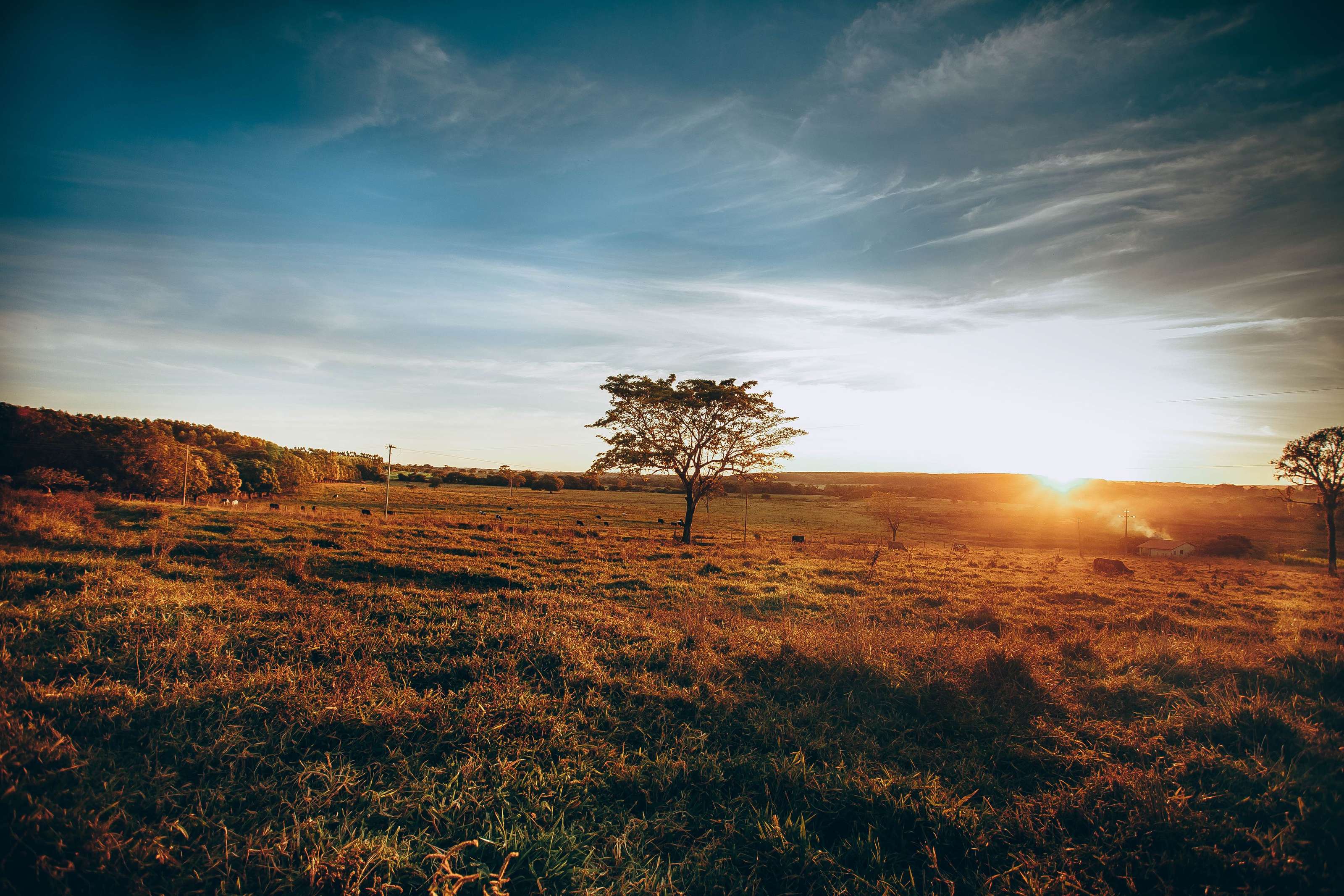
Every parcel photographs beautifully from a drone in June, at about four in the afternoon. The listing shows a gold-lit clearing, a tree line that reads as a windbreak instead of a shadow, and a creek carrying just enough spring melt to look permanent. None of that is dishonest, exactly — it’s simply the one version of the land that ever gets photographed. The version that decides whether your off-grid system works is the one at nine in the morning on the winter solstice, when the same clearing sits inside the tree line’s shadow for four extra hours, or the one after six dry weeks in August, when the creek is a rumor with rocks in it.
Off-grid systems take the blame for a great deal the land actually caused. An array that never quite covers December, a well that costs three times the driller’s first guess, a permit that stalls for a year over a covenant nobody read — these get filed under equipment failure or bad luck, and they are almost always a land decision made before anyone ran a number. This page is the site-selection tour: the four factors that decide whether a build is straightforward or a decade-long argument with a planning office, the due diligence that stops a dream dying at closing, and where the two-property split — cleanz.one for where, Grid CEO for how — divides the work.
On this page
The Land Is the First Component of Your System
Here is the mental switch that separates working homesteads from expensive campsites: you are not buying scenery, you are buying the first component of your power and water system — and it is the only component you can never upgrade. Inverters get swapped. Battery banks get expanded. Panels get added. But no budget moves the sun higher in December, drops the water table eighty meters, or rezones the countryside around you. The parcel sets the operating envelope for every machine you will ever put on it.
Once you see it that way, the strangest fact about rural land pricing starts working for you. Remote land is cheap largely because the grid isn’t there — and a grid connection is precisely the thing you weren’t going to buy. In the US, utilities run a first allowance of line for free and then charge per foot; a rural extension routinely lands between $25,000 and $100,000 per mile once poles, trenching and terrain are priced. In Europe, the DNO’s quote for a few hundred meters of new rural spur commonly reaches five figures in euros. Ordinary buyers read that as a defect and discount the land accordingly. An off-grid buyer pockets the discount and spends it on the solar-and-storage system they were building anyway. The market is, in effect, paying you to be the person who doesn’t need the wire.
The same logic runs in reverse on everything else, though: a parcel priced suspiciously below its neighbors is usually cheap because something hasn’t been proven — access, water, buildability. That discount is unpriced risk, not a bargain; your job before closing is to find out which kind you’re looking at.
Key number
~1 mile / 1.5 km
Roughly the length of new utility line at which a full off-grid solar-plus-battery system starts beating the grid connection on raw cost, at typical 2026 extension pricing. Past that distance you were going off-grid either way — the only question left is whether the land itself can carry the system. Everything below is how you check.
The Four-Part Site Scorecard
Every off-grid site question collapses into four categories: sun, water, access, and the legal envelope. Run them in this order on any parcel you’re seriously considering — each one can disqualify the land before you spend money confirming the next.
| Factor | What “buildable” looks like | What kills it | Cost to verify |
|---|---|---|---|
| Sun | Clear winter-solstice arc; south-facing or flat | Tree line or ridge shading the site past mid-morning in December | Free (sun-path tools + one visit) |
| Water | Documented well yields nearby, or a legal, registered right | No logged wells within a mile; a closed or over-allocated basin | Free–$400 (records; hydro study more in Europe) |
| Access | Recorded easement or public-road frontage, passable year-round | Unrecorded “handshake” access; a legally landlocked parcel | $0–$1,000 (title search) |
| Legal envelope | Zoning, dwelling-size and septic rules match your plan, in writing | Non-constructible land; covenants banning off-grid systems | Free (one letter to the authority) |
Sun: size the winter, ignore the summer
The number that matters is December’s, because that is the month your battery bank has to survive. The physics is unforgiving and easy to check: at solar noon on the winter solstice the sun stands at roughly 90° minus your latitude minus 23.4°. At 40°N — Denver, Madrid — that’s about 27° above the horizon, and every obstacle to your south throws a shadow twice its own height. At 50°N — Frankfurt, Prague — the sun scrapes along at 17° and the same tree throws a shadow more than three times its height. A 20-meter conifer line that looks charmingly distant in July can need 60–70 meters of clearance to stay off a mid-latitude European array in December.
Resource matters as much as shading: December peak-sun-hours run 4–5 in Arizona, near 3 in the US South and southern Spain, and 1 or below in the Pacific Northwest, Germany and the Baltics. Same house, same loads: the northern parcel needs an array three to four times larger and materially more storage. Run any candidate’s coordinates through NREL’s PVWatts in the US or PVGIS in Europe — both free — then walk the actual building spot as close to midwinter as you can manage. When you have the real exposure, our solar overview turns it into an array size.
Water: proof, then permission, then price
Check in that order. Proof: in most US states, well-completion logs are public — look up wells within a half-mile and read real depths and yields in gallons per minute before any driller quotes you. Drilling runs roughly $25–$65 per foot complete, paid whether or not you hit water, so neighbors at 120 feet versus 500 feet is a $15,000–$25,000 difference hiding in a free database. In Europe, budget €150–€300 per meter for a complete cased-and-pumped system (drilling alone runs lower) and expect the constraint to flip from depth to permission: small domestic abstraction is usually exempt or registration-only, but several southern basins are formally over-allocated and closed to new permits — a hydrogeological study can be required just to apply. In the western US, prior-appropriation law means the creek crossing your land may legally belong to someone downstream; surface water rights do not automatically convey with the deed.
Rain is the quiet backup plan, and the math takes one line: roof area in m² × annual rainfall in mm = liters per year. A 120 m² roof under 700 mm of rain yields 84,000 liters — call it 67,000 after collection losses, about 180 liters a day averaged across the year, which runs a frugal two-person household. Storage bridges the dry season; sizing it is covered in our water overview, along with treatment for whichever source wins.
Access: legal first, physical second
A road you drove in on is not a road you have a right to use. The two ugliest words in rural conveyancing are “unrecorded easement” — access that exists by neighborly habit and evaporates when the neighbor sells. In the US, a “paper road” that exists only on a county plat can leave a parcel legally landlocked; in Europe, farm tracks crossing someone else’s field carry the same trap under different names. Fixing it after closing means negotiating with a party under no obligation to say yes. Make recorded access a condition of purchase, always.
Then price the physical version. A proper gravel drive with grading, base and culverts runs about $10–$25 per linear foot in the US and €30–€80 per meter in Europe — so the “private, set well back from the road” feature is an $8,000–$20,000 line item for an 800-foot run, spent before a single panel goes up. Add mud season, snow clearance, and whether a concrete truck and a well rig can physically make the turns. It’s the same money whether you spend it on driveway or on another 5–6 kW of array; decide which one you’re buying before you close.
The legal envelope: what you may build, decided before you ask
Two questions hide under “zoning.” First: is your plan legal today? In the US this is county-by-county — minimum dwelling sizes (600–1,000 sq ft floors are common), septic mandates that apply even if you compost, and a genuine spectrum from permissive, code-light counties to counties that effectively outlaw small off-grid dwellings. In Europe the line is drawn on the parcel itself: German land is either Innenbereich (buildable) or Außenbereich (open country, reserved for working farms); France’s PLU maps each commune into constructible and non-constructible zones; Spanish and Portuguese rustic land carries minimum parcel sizes and slow, uncertain change-of-use. A gorgeous agricultural hectare you cannot legally sleep on is a garden, not a homestead.
Second: what binds the land privately? Covenants and CC&Rs can ban solar arrays, outbuildings or full-time living outright, even where the county has no objection — and they survive every sale. Get the zoning answer in writing before you offer, and read the deed restrictions before you sign. The polite version of this rule: never buy land on what the listing agent believes you can do with it.
Due Diligence: Cheap Insurance, Bought Before the Deadline
Everything above turns into a short, unglamorous ritual conducted between offer and closing, while your money can still walk away. The whole package — title search, records requests, a perc test, one winter-angle site visit — typically costs $1,500–$3,000 and two to six weeks of patience. The projects that die expensively are almost never the ones that ran these checks and got bad news; they’re the ones that found the bad news after recording the deed.
- Title search with easements read, not skimmed — access in, utilities across, and any covenant that touches dwellings or solar.
- Water proven on paper — neighboring well logs (US) or abstraction rules for the basin (Europe) before a driller is ever called.
- Perc test on the actual building envelope — $150–$1,500, and a failed one can veto the dwelling permit entirely; a €5,000–€15,000 packaged treatment plant is the common European fallback.
- Flood and wildfire maps, then an insurance quote — in 2026 the insurer is the silent zoning board; a parcel no carrier will touch is a parcel no lender will touch.
- Mineral and timber rights (US) or standing use rights (Europe) — find out who else holds a legal key to your land.
- The December visit — or at minimum a sun-path check for the solstice, because no listing photo was ever taken then.
The field version of this — every check, in order, with the phone-call scripts — is the off-grid land buying checklist. The cautionary version, told through parcels that skipped a step and paid for it, is the land-buying mistakes guide. Read one before you fall in love; read both before you sign. And remember the cheapest number in the entire game: $0, the cost of walking away from a parcel that failed its checks.
Before you close
The scorecard and the checklist are free to run yourself. The step most buyers skip is the second opinion: well, septic, access and winter sun scored by pros who already work that county — before the earnest money goes hard.
The cleanz.one Bridge: WHERE Is a Different Question From HOW
Relocation tangles two questions that need different tools. Where should I go? is an environmental-quality question — clean air, quiet skies, dark nights, room to breathe — and it’s answered with data layers, not listing photos. cleanz.one, our sister property, screens Europe and the US for exactly that: overflight and flight-path exposure, signal coverage, light pollution and population pressure, mapped down to areas you can shortlist — the cleanest, quietest, darkest land, found before an agent enters the picture. How do I live there? is a systems question — sun, water, access, permits, hardware — and that is Grid CEO’s entire job, from the scorecard above through every system on the solutions floor.
Use them in order. Still choosing a region or comparing counties? Screen at cleanz.one first — there’s no point sizing an array for land you haven’t decided to want. Already holding coordinates or a short list? Run the four-part scorecard, then the due-diligence checklist, and the parcel will tell you what it needs. Not sure which question you’re on? Eight quick questions will sort it:
Run the Relocation Matchmaker Holding a parcel? Get it scored
Sun, water, distance-from-town, quiet and budget — it scores your priorities and points you at the regions, and the guides, that fit them.
Land & Relocation FAQ
How much land do I actually need to go off-grid?
Less than most buyers assume — acreage isn’t the number that matters. A single off-grid home needs roughly a quarter-acre of unshaded ground for the array, a septic drainfield sized to the perc result, and the required well-to-septic separation (commonly 15–30 m / 50–100 ft). Buyers routinely pay a premium for 40 acres when 5 well-chosen, buildable ones would run the identical system with lower land tax. Buy buildability, then privacy — in that order.
Is it actually legal to live off-grid?
Being disconnected from the grid is legal almost everywhere in the US and Europe. What’s regulated is everything around it: the dwelling itself (codes, minimum sizes), sanitation (septic or approved treatment, the most common hard requirement), and in Europe whether the parcel is constructible at all. The question to ask an authority is never “can I live off-grid?” — it’s “can I build this dwelling, with this sanitation, on this parcel?”
Should I buy the land first or design the system first?
Treat them as one decision. Get a rough load number before you offer — even a one-page load audit — so you know whether the parcel’s winter sun, water and access can carry it. Buying land on its own charms and hoping the system fits afterward is the most common way a $50,000 build quietly becomes an $80,000 one.
Is raw land with no utilities really cheaper than a serviced lot?
Cheaper to buy, not automatically cheaper to build. Price the full stack — well, septic, access road, power system — and compare against the serviced lot’s premium. The twist cuts in the off-grid buyer’s favor: the grid extension that scares other buyers off a remote parcel is a cost you were never going to pay, so the market’s discount lands in your system budget. Just make sure the discount isn’t also hiding a dry aquifer or a non-constructible zoning class.
Guides for Your Parcel and Your Region
The scorecard above is the tour. These go deep on one piece each — pick the one that matches where you are in the process.
Land is the component everything else stands on — see how it connects to power, water and storage in the full solutions overview.