


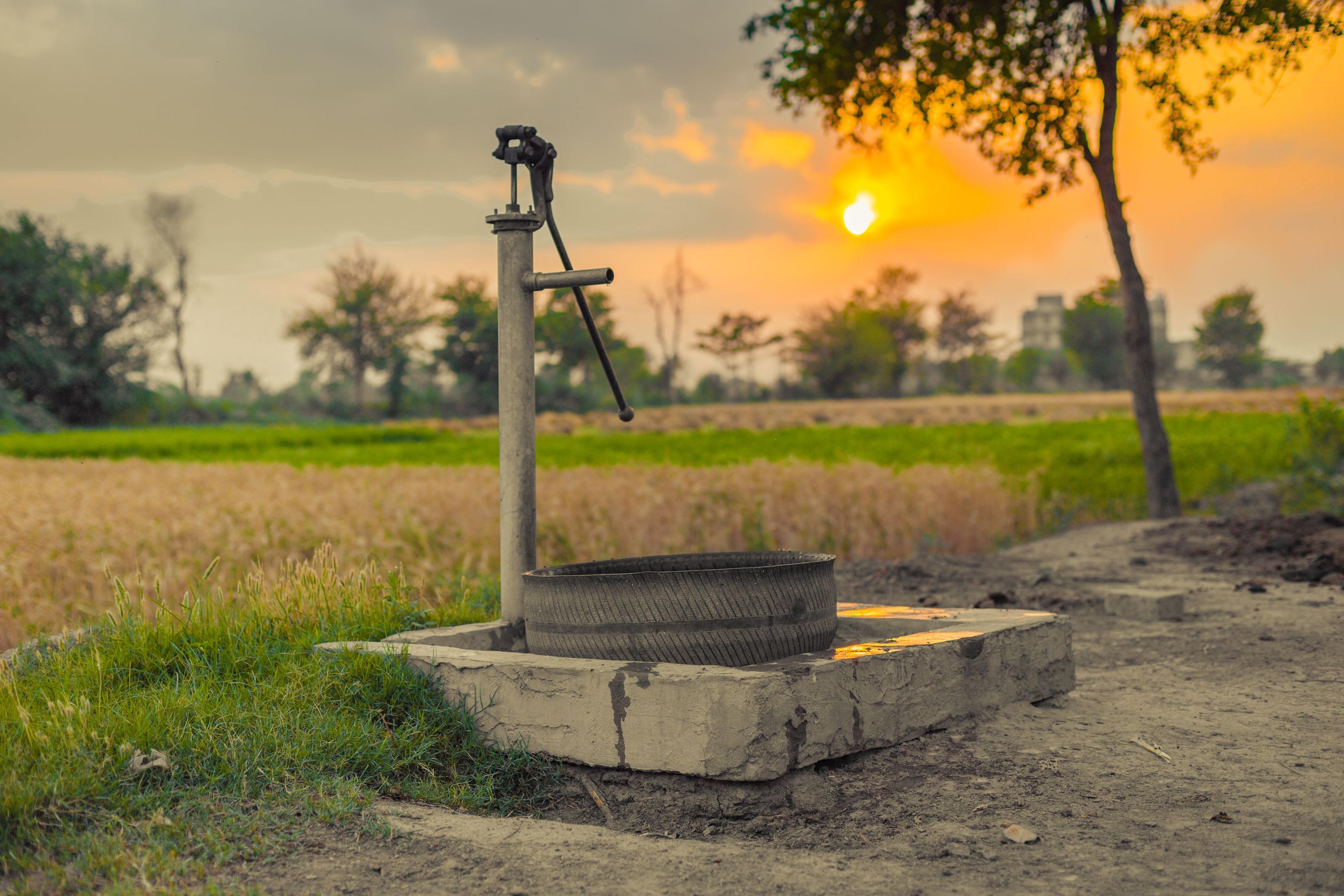
There is a certain kind of off-grid build we see over and over. The power system is immaculate — panels aimed within a degree of true south, a battery wall with its own spreadsheet, an inverter chosen after three weeks of forum combat. And behind the house sits a pickup with two 1,000-liter totes strapped in the bed, because four years in, the water plan is still “drive to town.”
Energy gets the spreadsheet; water gets an afterthought. It should be closer to the other way around, for one uncomfortable reason: an undersized power system is fixable with money in a week — add panels, add a generator. A failed water source can be unfixable at any price on the land you already bought.
Here is the good news, and the single most useful reframe in off-grid design: water is the cheapest thing you will ever store. A day of stored electricity for an ordinary household is $3,000–$5,000 of battery. A day of stored household water is roughly $40 of polyethylene tank. That hundred-to-one asymmetry means generosity in water storage costs almost nothing — and buys you slack everywhere else in the build. This page is the tour of how to spend that generosity well: where water comes from, how much to hold, how to make it safe, how to move it — and where each choice quietly lands on your power budget. Water is energy’s quieter twin. The two systems only work when they are designed as one.
On this page
Start with the number nobody measures
Ask a grid-connected household how many liters they use a day and you get a shrug. The meter knows: a typical US household runs 300–380 liters (80–100 gallons) per person per day; most of Europe sits near 120–140 liters. Almost none of that is drinking — it is showers, laundry, toilets and the hose.
Off-grid households, once they can see their tank level, land dramatically lower without feeling deprived. A frugal but comfortable setup — low-flow fixtures, a sensible shower culture, an efficient front-load washer — runs on 75–115 liters (20–30 gallons) per person per day. Keep near-normal habits and you are at about 190 liters (50 gallons). Gardens and animals are a separate line item and a serious one: a modest vegetable plot in a dry July can drink 150–300 liters a day on its own, and a horse takes 30–50.
Key number
Plan domestic demand at 190 liters (50 gallons) per person per day for a no-compromise household, or 75–115 liters (20–30 gallons) if you are deliberately lean. Every tank, pump and treatment decision downstream is a multiple of this number — get it wrong here and you get it wrong everywhere, in the same direction.
Where the water comes from: well, spring or rain
For a permanent off-grid home there are only three real answers, plus two honorable mentions (surface water from a lake or creek, which is a treatment project more than a source, and hauling, which is a bridge, not a plan). Most properties get exactly one good option, and the land decides which — one more reason source questions belong in the land-buying stage, not after closing.
| Source | Typical cost to develop | Ongoing energy | How it fails | Treatment burden |
|---|---|---|---|---|
| Drilled well | In the US, $25–$65 per foot — most homes land at $5,000–$25,000 drilled, cased and pumped. In Europe, €60–€120 per meter plus permitting, so a 60 m bore runs €6,000–€12,000 before the pump. | 400–1,100 W while pumping | Dropping water table; pump failure (a week’s wait for a deep-well replacement) | Usually light: annual lab test, sometimes iron or hardness media |
| Developed spring | $500–$5,000 for a spring box, collection pipe and fencing — if you are lucky enough to have one | Zero, if it sits above the house | Seasonal flow collapse; surface contamination after storms | Moderate: bacteria testing, especially after heavy rain |
| Rain catchment | $1,000–$10,000 for gutters, first-flush diverter, storage and treatment, scaling with tank size | Near zero — a small transfer pump | The long dry spell you didn’t size for | High for drinking water: sediment, then filtration, then disinfection |
Rain deserves its arithmetic, because it surprises people in the generous direction. Every millimetre of rain on a square meter of roof is one liter; harvest efficiency is about 0.9 after splash and first-flush losses. A 150 m² roof under a modest 700 mm annual rainfall yields around 94,000 liters a year. In US units: inches of rain × roof square footage × 0.62 = gallons, so a 2,000 sq ft roof in a 30-inch town catches roughly 37,000 gallons annually — more than a lean family uses.
The paperwork is where the regions part ways. In Europe, rain harvesting is broadly encouraged — several countries discount stormwater fees for it — while private wells generally need registration and sometimes an abstraction permit. In the US, rain collection is legal in nearly every state with a handful regulating storage volumes or use, wells run on state drilling permits — and spring rights in parts of the American West are a genuine legal minefield, where the deer can drink from your spring with less paperwork than you can.
Run your roof through the catchment calculator
Storage: tanks are cheap, empty tanks are expensive
The sizing rule is one sentence: store for the longest realistic gap, not the average. On rain, the gap is your longest dry spell — pull twenty years of local records, not the brochure average. On a well, it is the pump-failure window: a week of stored water turns a dead submersible from a crisis into an errand. On a spring, it is the worst month of seasonal low flow.
Worked example. A family of three at a comfortable-lean 150 liters per person per day draws 450 liters daily. On catchment in a summer-dry climate with a 60-day rainless stretch, that is 27,000 liters of bridge — call it 30,000 with the tomatoes. Three 10,000-liter poly tanks cost roughly $3,500–$5,000 installed on gravel pads. Now price sixty days of electrical autonomy for the same family and you understand the asymmetry from the top of this page: nobody builds it, at any budget. Oversizing water storage is the cheapest insurance in the entire off-grid catalog.
Materials, quickly: UV-stabilized polyethylene is the default (cheap, food-safe, twenty-plus years); galvanised steel with a liner wins at very large sizes and shrugs off wildfire embers; concrete runs cool and steadies pH but costs real money; and secondhand IBC totes are fine for irrigation but a poor potable plan — translucent walls grow algae, and you rarely know the first cargo.
The headroom nobody plans: dead storage and freeze
A tank’s usable volume is smaller than its nameplate. The outlet sits above the floor, below it lives the sediment zone, and in wildfire country many rural US counties require a dedicated fire reserve — commonly around 9,000 liters (2,500 gallons) with a fire-brigade fitting — that your household plumbing must never touch. Knock 10–15% off nominal capacity before you size, and more where fire rules apply.
Cold is the other tax. Big, full tanks largely protect themselves — thermal mass means a 10,000-liter tank barely notices a −15 °C night that kills an exposed 25 mm pipe in an hour. The pipes die first, so bury lines below frost depth (anywhere from 30 cm in mild climates to 1.5 m and beyond in the northern US, inland Europe and Scandinavia), slope exposed runs to drain, and treat heat-trace cable with suspicion: at 10–30 W per meter it is a silent load that lands on your battery in exactly the darkest week of the year. The quieter twin, again: every lazy water decision gets billed to the power system.
Making it safe: buy treatment, not “a filter”
The filter aisle sells boxes. Water chemistry doesn’t care about boxes — it cares about named contaminants, and no single stage handles them all. The professional habit worth stealing: test first, then treat what the lab report actually says. An accredited test costs $30–$150 in the US (state health labs are the bargain) or €50–€150 in Europe, and it converts you from buying reassurance to buying chemistry. Wells get retested annually; rain systems after any roof change.
| Contaminant | What works | What doesn’t |
|---|---|---|
| Sediment, turbidity | Spin-down strainer, then 5-micron cartridge | UV on cloudy water — particles shadow the microbes |
| Bacteria & protozoa | Ceramic gravity elements, ultrafiltration, UV, chlorination | Carbon-only pitcher filters |
| Viruses | UV, reverse osmosis, chlorine | Most gravity ceramics on their own |
| Nitrates, salts, arsenic, lead | Reverse osmosis or distillation | Boiling — it concentrates them |
| Pesticides, tastes, odours | Activated carbon | Sediment stages |
| Iron, manganese, hardness | Oxidising media, softeners | Hope |
In practice, off-grid households converge on three architectures — and each one is also a power decision. Gravity systems (the classic counter-top ceramic tower) need no electricity at all, purify a kitchen’s worth per day, and are unbeatable per watt. Whole-house UV disinfects everything at every tap but draws 30–40 W whenever water flows, demands pre-filtered, clear water, and fails silently in a blackout — so it belongs on a system with dependable power. Reverse osmosis is the only practical answer to dissolved nasties, but classic units reject three liters for every liter made — a real cost on catchment — so off-grid it lives under the kitchen sink as a point-of-use stage (modern pumped units approach 1:1, and the reject line can water the garden). The full comparison, with flow rates and failure modes, is in our gravity vs RO vs UV guide.
Where a licensed pro earns the fee
Treatment trains and tank plumbing are honest DIY. The well itself, the pressure system and anything the county wants stamped are licensed trades — and a driller quoting against a written site score beats one quoting against hope. Get the water side designed with the power side, priced before you buy a single part.
Moving it: pumps, pressure and the water battery
Pressure is just height wearing different units: every vertical meter of water is 0.1 bar; every vertical foot is 0.433 psi. Modern fixtures want 2–3.5 bar (30–50 psi), which is 20–35 meters of elevation — a luxury few sites have. A tank on a 10-meter stand delivers about 1 bar: fine for a rustic cabin, enough to make a tankless water heater sulk.
So most builds pressurise mechanically, and here is the move that makes water the best battery you already own: pump when the sun shines, deliver by gravity or stored pressure whenever you like. A pump that runs only in midday surplus — filling an elevated or pressure tank — turns spare solar into stored work and decouples your shower from your battery’s state of charge. A steel pressure tank is, in effect, a battery that never degrades and costs $300.
Budget numbers for the power side of the twin: surface and shallow-well pumps draw 250–800 W; deep-well submersibles 400–1,100 W running with a 2–3× starting surge your inverter must survive — a classic reason otherwise-healthy systems brown out. The elegant alternative on deep wells is a slow solar-direct helical pump, which sips a few hundred watts straight from panels all daylight long and quietly moves 3,000–8,000 liters a day with no battery in the loop.
Where water sits in the whole build
A right-sized water system is boring in the best way. You will know yours is designed, not accumulated, when:
- You know your household’s daily liters the way you know your daily kilowatt-hours.
- Storage covers your longest gap — dry spell, pump lead-time or low-flow season — not the average.
- Every treatment stage answers a named line on a lab report.
- Pressure survives a cloudy week, because pumping happens in surplus hours.
- Nothing above ground holds still water in January.
Water is one system of several that have to agree with each other: it draws on the power plant, it feeds sanitation and wastewater downstream, and the whole question is easiest when it is asked before you buy the land. The full picture of how we approach these systems together is on the What We Do page.
Go deeper
Is Rainwater Harvesting Legal in Your State? — the 2026 state-by-state rules, worth five minutes before you size a catchment system.
Water & filtration FAQ
How much water storage do I need off-grid?
Multiply your daily household demand (plan 190 liters / 50 gallons per person for normal habits, 75–115 liters / 20–30 gallons lean) by the longest gap your source can leave you dry — the longest local dry spell on catchment, a one-to-two-week pump-replacement window on a well. For most households that lands between 10,000 and 30,000 liters (roughly 2,500–8,000 gallons), then add 10–15% for dead storage and any required fire reserve.
Is rainwater safe to drink?
Yes, with a proper chain: a clean roof (no lead flashing or treated-timber runoff), a first-flush diverter that dumps the first fraction of every storm, sediment filtration, and then disinfection — UV, chlorination or a certified purifier. Rain is soft and low in dissolved minerals, which makes it one of the easier sources to treat; the risk is biological, from the roof and gutters, not the rain itself.
Doesn’t reverse osmosis waste too much water for off-grid use?
Classic under-sink RO rejects three to four liters per liter produced, which stings on rain catchment. Off-grid, the fix is to use RO only at the kitchen tap rather than whole-house, choose a modern pumped unit (close to 1:1), and route the reject line to the garden — the “waste” is simply slightly-concentrated feed water, fine for irrigation.
How much power does a well pump really need?
A typical deep-well submersible draws 400–1,100 W while running — the catch is the 2–3× starting surge, which is what actually sizes your inverter. Two clean workarounds: run the pump on a timer or controller so it only fills storage during midday solar surplus, or fit a slow solar-direct pump that works panel-to-pump all daylight with no inverter or battery in the loop.