


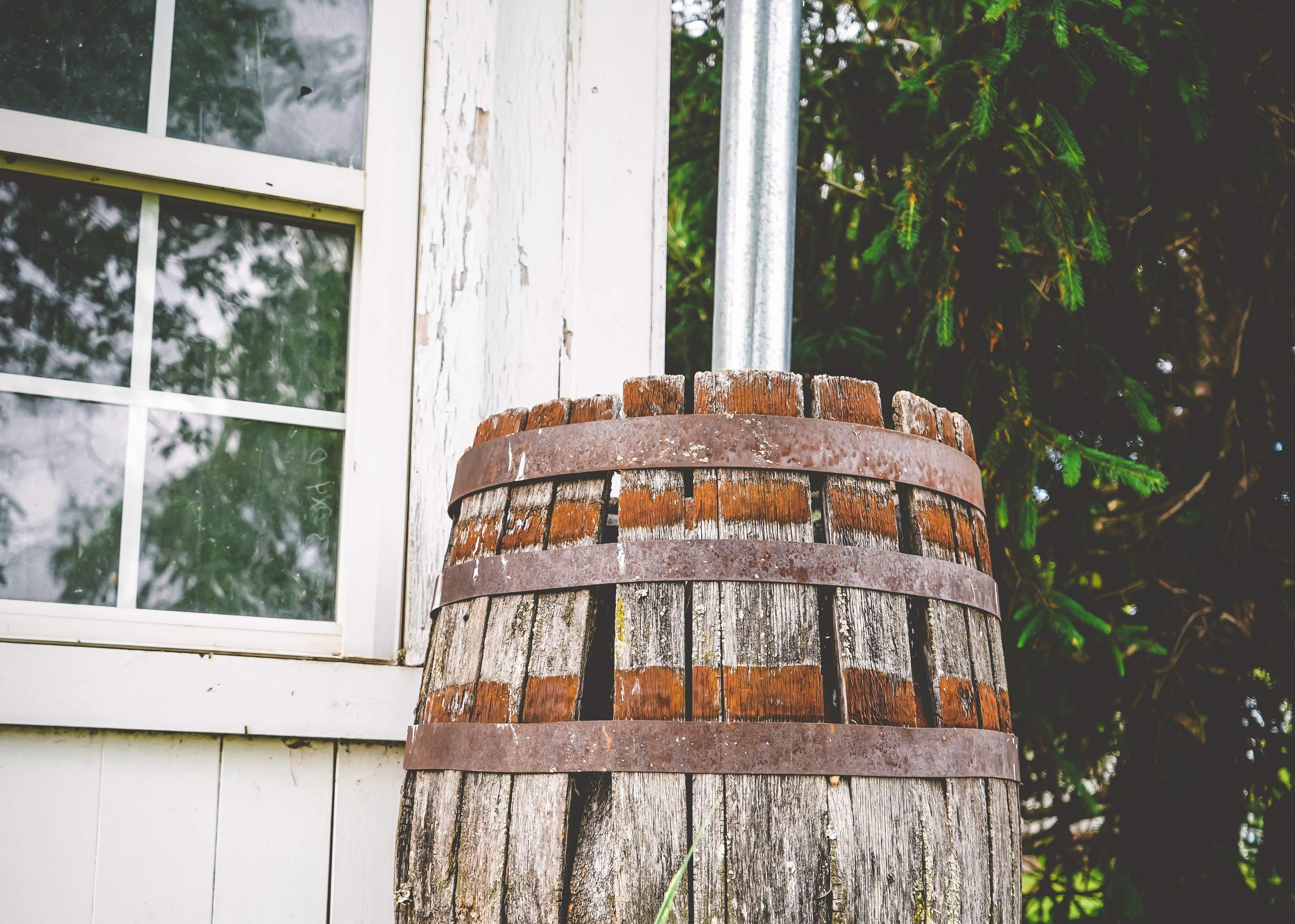
For most of Colorado's history, the rain that landed on your own roof was not, legally, yours. Water law in the state ran on prior appropriation — first come, first served, dating back to 1860s mining claims — and every drop that fell on a rooftop was treated as part of the same river system that fed water rights held by someone who might be a hundred miles downstream. State engineers spent decades enforcing that rule against ordinary property owners, in some cases ordering stock ponds drained because the water in them had already been promised to someone else, decades before it fell as rain. It took until 2016 for an ordinary Colorado homeowner to legally collect rainwater in a barrel.
That's the part almost nobody searching "is rainwater harvesting legal" expects to find: this was never a simple yes/no question, and treating it like one is exactly why people get the wrong answer for their own address. The real question has three layers — is it legal at all, is there a volume cap or registration step, and does your state treat you as something to encourage or a resource to police — and which layer applies to you depends less on your specific state and more on a 160-year-old fork in American water law you've probably never heard of.
The Fork in the Road: Two Water Doctrines, One Map
Every US state inherited one of two water-law traditions. East of roughly the 100th meridian — where rain is reliable enough that water rights historically attach to the land itself — states run on riparian doctrine: if you own the property, the water that falls or flows across it is presumptively yours to use, rainwater harvesting included, and it was never treated as a regulated resource to begin with. West of that line, in the states settled around mining claims and irrigation ditches, water law runs on prior appropriation: rights belong to whoever claimed a water source first, regardless of whose land it's on, and that claim can predate the current owner by a century. In several of those states, the letter of old law made every raindrop on your roof someone else's, on paper, long after nobody was actually enforcing it that way against a single rain barrel.
That fork explains nearly the entire map, even for states not named below. Every genuinely restrictive rainwater law left in the US — Colorado, Utah, historically Nevada — sits inside prior-appropriation country, roughly the arid third of the country west of the Great Plains. Every state offering an actual financial incentive instead sits outside it, or has simply decided catching roof runoff isn't worth defending against.
| Category | What it means | Example states |
|---|---|---|
| Unregulated | No permit, no volume cap, no registration for ordinary residential collection | Most of the country — California, Florida, New York, Ohio, and most of the Midwest and South |
| Restricted / registered | Legal, but capped by volume or gated behind a registration step | Colorado (110-gallon cap), Utah (register above 100 gal, two containers), Nevada (single-family only, since 2017) |
| Actively incentivized | Tax breaks, HOA protections or utility rebates specifically for harvesting | Texas (sales-tax exempt, HOA-protected), Rhode Island (cistern tax credit), assorted municipal rebates |
Key number
0 US states ban catching rain in a barrel outright in 2026. 2 — Colorado and Utah — cap or register it. 1 — Texas — exempts your equipment from sales tax and makes it illegal for your own HOA to stop you installing it.
The 3 States Everyone Actually Asks About
These are the states that generate the search traffic and the kitchen-table arguments, and each restricts rainwater harvesting in a genuinely different way — a cap, a registration step, and a use restriction, respectively.
Colorado — Two Barrels, 110 Gallons, Nothing Else
Colorado is the state that built the meme. House Bill 16-1005, signed in 2016, is the reason an ordinary homeowner can legally do this at all — before it, residential rainwater collection sat in roughly the same legal category as diverting a creek. The rule it created is specific and still tight: up to two rain barrels with a combined storage capacity of 110 gallons, collecting only from a rooftop catchment, used only on the same property where it fell, for outdoor non-potable purposes like lawn and garden irrigation. No registration, no permit — but also no legal way to add a third barrel or a 300-gallon tote and stay compliant. If you're in Colorado, the equipment decision is made for you: two 55-gallon barrels, full stop. Anything larger requires a well-augmentation plan filed with the state engineer, a step most homeowners never need for anything else on their property.
Utah — Two Containers, 100 Gallons Total, Then Register
Utah (Utah Code §73-3-1.5) takes the opposite approach to a similar problem: instead of a hard ceiling, it uses a free paperwork step. Collect into up to two covered containers, combined no more than 100 gallons, tops — and you don't have to tell anyone. Want to scale up to a real cistern — Utah allows storage up to 2,500 gallons — and you register once, online, with the Division of Water Rights: no fee, no inspection, typically done in minutes. In practice it's less restrictive than Colorado (2,500 gallons covers a serious garden or a small orchard), but it's the state people get wrong most often, because they assume "legal" means "no paperwork" and skip the one registration step that actually keeps a larger system compliant.
Nevada — Legal Since 2017, Not Before
Nevada is the newest addition to the "legal" column — and until recently, it had the clearest ban of the three. Under the state's prior-appropriation doctrine, rooftop runoff legally belonged to existing water-rights holders for decades — full stop, no barrel-sized exception. Assembly Bill 138, effective in 2017, carved out the first real allowance: single-family homes may collect rooftop runoff for non-potable domestic use, provided the water is used on the same property where it's collected (NRS 533). It's a narrower allowance than Colorado's or Utah's — there's no explicit statewide gallon cap, but the "single-family, on-site, non-potable" conditions do the same job — and it's a reminder that "always been fine here" and "fine since a specific year" can look identical from a search result.
The Other End of the Map: States That Pay You To Do This
Texas runs the whole map in reverse. Rainwater harvesting equipment — tanks, first-flush diverters, filtration, all of it — is exempt from Texas state sales tax under Tax Code §151.355 (claim it with a Form 01-339 exemption certificate at checkout). The Texas Property Code goes further: §202.007 makes it illegal for a homeowners association to prohibit a rainwater harvesting system outright, though it can still regulate the system's appearance and placement — screening, siting, and the like. Layer on municipal rebate programs — San Antonio and Austin both run cash-back programs for barrels and cisterns through their water utilities — and Texas isn't just permissive. It's actively subsidizing the exact thing Colorado spent a century restricting.
Texas isn't alone. Rhode Island runs a state income-tax credit toward installing a qualifying cistern system. A growing list of cities — several in Arizona and New Mexico among them — go past "allowed" into "required," mandating rainwater capture for new commercial or large-lot residential construction as part of their water-conservation codes. The pattern across all of it: states that never treated rain as a claimed resource in the first place are now the ones actively competing for you to catch more of it.
How to Actually Check Your Own State Before You Buy Anything
None of the three restricted states above is probably your state — which is good news, but it doesn't mean skip this section. Four things determine your real answer, and none of them show up in an "is it legal" headline:
- What you're using it for. Non-potable outdoor use — irrigation, garden beds, a livestock trough — is unrestricted in the large majority of states and only capped in the handful above. Potable, drink-it-from-the-tap use is a separate legal question everywhere, restricted state or not.
- Potable use always means treatment, regardless of state. Piping harvested rainwater to an indoor tap almost always triggers your state or county plumbing code — filtration, disinfection (usually UV), periodic testing — the same way any private well does. A handful of states, Ohio among them, have explicit code provisions for rainwater as a household's primary water supply; most simply fold it into general private-water-system rules.
- Your HOA is a separate question from state law. Texas explicitly bars HOAs from blocking rain barrels; most states say nothing either way, which means your covenant — not the state — is the real limiting document. Read it before you install anything visible from the street.
- Size is the actual trigger, not the state. A barrel or two clears almost every threshold in the country without paperwork. The rules above start applying once you cross into cistern territory — roughly 100–2,500 gallons — because at that scale, several states start treating it as a water system rather than a rain barrel.
Once you know your actual ceiling, the equipment decision gets simple. In Colorado, buying anything past two 55-gallon barrels is pointless — you can't legally use the extra capacity. Everywhere else, a first-flush diverter (it dumps the dirty initial runoff before it reaches storage, which helps both water quality and keeping debris out of a tank you paid for) and a food-safe cistern once you outgrow barrel scale are the two upgrades that actually pay for themselves. Current picks, sized to both ends of the map:
Is it illegal to collect rainwater anywhere in the US in 2026?
No state currently bans it outright. Colorado and Utah cap or register larger systems, and Nevada only opened collection to single-family homes in 2017 — but a barrel-scale system under those states' thresholds, and unrestricted collection everywhere else, is legal.
Can I drink water I collect in a rain barrel?
Not without treatment, in any state. Outdoor, non-potable use is what the barrel-scale rules above cover; piping rainwater to an indoor tap for drinking triggers your state or county's private-water-system and plumbing code, which typically requires filtration, disinfection and testing regardless of how permissive your state is about outdoor collection.
Can my HOA stop me from installing a rain barrel?
It depends on your state and your covenant. Texas explicitly prohibits HOAs from banning rainwater harvesting systems outright, though it can still regulate appearance and placement; most states have no such protection, which means a restrictive covenant can outrank a permissive state law. Check the covenant before you install anything visible from the street.
What actually happens if I go over Colorado's 110-gallon limit?
For a backyard barrel, real-world enforcement is essentially nonexistent — nobody is out measuring rain barrels. The real exposure is at cistern scale: an unregistered, unpermitted larger system is what actually draws state engineer attention, not a homeowner a few gallons over on two barrels.
Four More States People Search Next
These don't pull the search volume Colorado, Utah and Nevada do, but they're the next cluster of "is it legal in ___" questions — and the short answer for all four is the same shape: fully legal, no permit for ordinary rooftop collection, some of it actively rewarded.
| State | Status | Worth knowing |
|---|---|---|
| Washington | Fully legal, no permit | Department of Ecology confirmed rooftop collection needs no water right; several utilities run rain-barrel rebates. |
| Oregon | Fully legal, no permit | Rooftop catchment is permit-exempt statewide; a handful of cities layer rebates on top. |
| California | Fully legal, no permit | The Rainwater Capture Act exempts most residential systems from permitting; several water agencies offer cash-back for barrels and cisterns. |
| Arizona | Fully legal, actively encouraged | Tucson requires rainwater harvesting on some new commercial landscaping and runs its own rebate program; collection is unrestricted statewide. |
The state-by-state specifics change roughly as often as legislatures meet, and the three restricted states above are exactly the ones most likely to move next — Colorado already loosened its rule once, in 2016, and there's active pressure to raise the cap again. Below is the full current map, state by state, kept current as laws change.
Keep reading
- Well, Spring, or Rain Catchment? How to Choose Your Off-Grid Water Source — how catchment stacks up against a well or a spring.
- How Much Water Storage Do You Really Need Off-Grid? Gallons Per Person, Autonomy & Tank Math — how big the tanks need to be once you can legally collect.
- The 12 Best States to Live Off-Grid in 2026: Ranked by Zoning, Land Price, Water Law & Sun — water law is one of the factors behind the state rankings.