


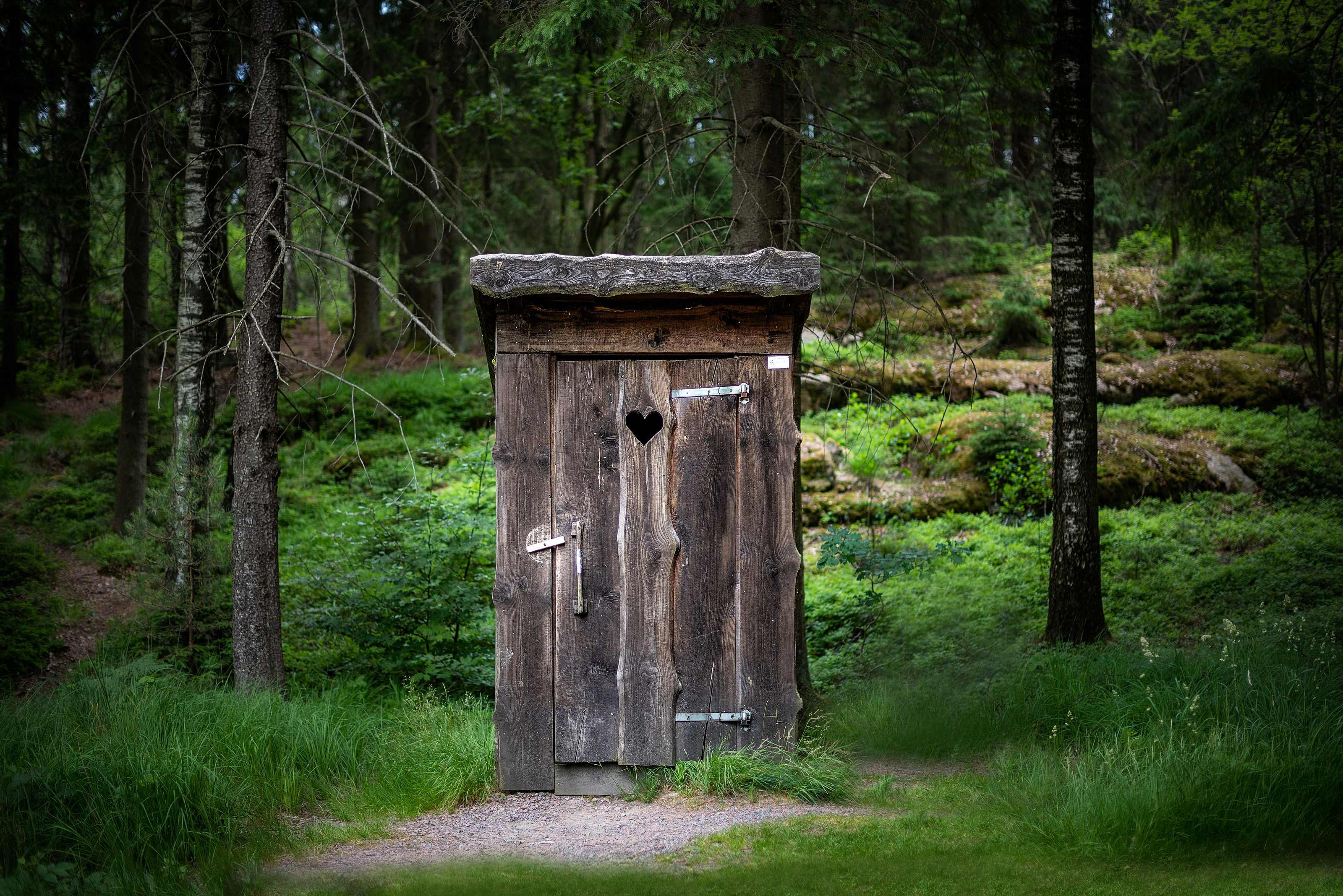
Every off-grid house tour ends the same way. Guests admire the array, nod politely through the battery specs, and then — one hand already on the bathroom door — ask the question they actually came with: so what do you do about… you know. Fair. Here is the whole answer, including the parts owners tend to skip: how often you really empty things, what it smells like when you get it wrong, and what the fan costs you in watt-hours.
Start with the reframe that makes the entire category simple. Off-grid, you do not have a sewage problem — you have a dilution problem. A flush toilet takes roughly 150 grams of solids per person per day, material every forest floor on the planet processes quietly and for free, and stirs it into 25–35 liters (7–9 US gallons) of drinking-grade water. Run that for a family of four and you have manufactured over 40,000 liters of hazardous liquid a year — blackwater — which is the only reason sewers and septic tanks exist. Withhold the water, and the “sewage problem” shrinks to a lidded bucket of carbon, a urine container, and a two-watt fan.
On this page
Three Streams, Three Completely Different Problems
A sewer earns its keep by letting you mix three waste streams and forget them. Take the sewer away and the winning move is the opposite: keep them apart at the source, because separated, each one is cheap and boring to handle.
- Urine — about 1–1.5 liters per adult per day. Nearly pathogen-free in a healthy household, and carrying most of the fertiliser value that leaves it (around 85 percent of the nitrogen). Easiest to manage; handled most often.
- Solids — 100–200 grams per person per day. The stream everyone worries about is by far the smallest, and composted properly it exits the system as soil, not sewage.
- Greywater — showers, sinks and laundry, typically 40–80 liters (11–21 US gallons) per person per day. Roughly ninety percent of your outflow by volume, and the stream that actually gets remote sites cited.
Mix those three and you need a treatment plant. Separate them and you need a toilet with two compartments, a patch of mulch, and a compost bay. That is the entire strategy; the rest of this page is execution.
Choosing the Toilet: Occupancy, Power, Paperwork
Ignore the brand wars. There are five mechanisms, and the right one falls out of three questions: is the site lived in full-time or in weekends? How many watt-hours can you spare? And what will the local permit office actually stamp?
| System | Water | Power | Emptying rhythm | Typical cost (2026) |
|---|---|---|---|---|
| Urine-diverting composting (self-contained) | None | 1.5–2.5 W fan, continuous | Urine every 2–3 days; solids every 3–6 weeks (two adults, full-time) | $900–$1,600 / €800–€1,500 |
| Central / batch composter (chute to large chamber) | None | 2–5 W fan | Solids once or twice a year | $1,800–$5,000 / €1,700–€4,500 plus install |
| Incinerating (electric or gas) | None | 1.5–2 kWh per burn, or propane | Ash cup weekly; no composting at all | $2,300–$5,000 / €3,000–€5,500 |
| Cassette / portable | Minimal | Negligible | Every 2–4 days, at a disposal point | $130–$1,200 / €130–€1,100 |
| Septic + low-flush (conventional fallback) | 3–6 L per flush | 0–500 W if pumped | Tank pump-out every 2–4 years | $6,000–$25,000 / €7,000–€15,000 |
Paperwork deserves more respect than it gets. In the US, NSF/ANSI 41-certified composting toilets are accepted in many counties — yet some will still refuse a certificate of occupancy without an approved septic design, even if you never flush once, which makes sanitation a land-purchase question to settle before you sign. The short list worth knowing by heart: Massachusetts, Arkansas, Colorado, Florida and Idaho explicitly accept a certified manufactured unit in lieu of a septic connection at state level (greywater still needs an approved route, and the county keeps the last word). If a parcel you love just failed its perc test, that list — not a bigger drain field quote — is often the way through. In Europe the logic inverts: dry toilets are cottage-normal across the Nordics with municipal sign-off, and regulatory attention attaches to greywater instead — France’s SPANC and Germany’s water authorities care far more about where the shower drains than what the toilet does.
The county question, answered before you sign
Perc test, septic design, greywater route, the certificate of occupancy — this is exactly the paperwork a vetted septic or composting-toilet installer navigates weekly in your county. A $6,000–$25,000 decision deserves a written quote against your parcel, not a forum guess.
The Plain Reality: Buckets, Smell and a Two-Watt Fan
Marketing photos show the toilet. They never show the Tuesday-evening walk to the compost bay, so here it is in numbers.
The emptying rhythm
Urine is the frequent chore. An adult produces 1–1.5 liters a day, so the 7.5–8.5 liter container in a typical urine-diverting unit means every two to three days for a full-time couple. It becomes recycling-bin routine within a month — a two-minute carry you stop registering. Solids move on a different clock: the same couple fills a 20-liter solids bin in three to six weeks, and since the fan dries the contents continuously, the level barely rises after week two. A weekend-only cabin stretches that to once or twice a season; central-chamber composters push it to once or twice a year.
The emptying itself? Ten minutes. What goes out is dry, dark, coir-covered, and smells like a pine forest floor after rain. The horror you are imagining is a festival portaloo — the mixed anaerobic soup this system exists never to create.
Smell is a gauge, not a fate
A correctly running composting toilet is the only toilet in your life with its own 24/7 extractor fan. It holds the chamber at slight negative pressure, so bathroom air is constantly pulled in through the bowl and out above the roofline — owners routinely report the bathroom smelling more neutral than the plumbed one they left behind. When something does smell, your nose is the diagnostic: ammonia means urine reached the solids bin or the bottle is overdue; rotten egg means the pile went wet and airless. A few cups of media and a check of the vent hose for sags clears either within a day.
Bulking media, the consumable nobody budgets
Every dry toilet runs on a carbon cover material — it keeps air channels open, buffers moisture and feeds the compost. Coco coir is the default: a compressed brick costs $3–5 / €3–4 and swells to 8–9 liters with water. Fine untreated wood shavings are cheapest per liter; hemp hurd works beautifully where it is sold. Peat performs too, but draining bogs to flush-proof a cabin is a poor trade. Budget roughly a liter per person per week including the 5 cm base charge you lay in each fresh bin — call it $40–70 / €40–65 a year for two people, full-time. Keep it dry and keep a spare brick: running out mid-winter is the classic self-inflicted smell incident.
The fan, in watt-hours
The 12 V fan in a urine-diverting unit draws 1.5–2.5 W continuously: 40–60 watt-hours a day, 15–22 kWh a year — around a third of what a Wi-Fi router burns. Trivial, with one caveat: it runs around the clock, including the December week your panels produce almost nothing, so it belongs in the non-negotiable floor of your load audit, not in the rounding error. Incineration flips the arithmetic: an electric unit pulls 1.5–2 kWh per burn, and a full-time family can stack 6–10 kWh a day — more than many complete cabins consume. On a generous system or a propane-fired model that is a fine trade for zero compost handling; on a 2 kW array it is disqualifying.
Key number
A composting toilet’s fan uses about 50 Wh a day. One incinerating burn uses about 1,500–2,000 Wh. A month of the fan costs the same electricity as a single push of the incinerator’s button — size your battery bank around whichever of those two numbers you chose.
Greywater: The Ninety Percent Nobody Photographs
Go waterless at the toilet and everything else your house drains — shower, basins, laundry, kitchen — is greywater: 40–80 liters per person per day with normal habits, 20–40 if you are frugal. Nobody reviews a mulch basin on camera, but this is the stream inspectors actually look for, and it obeys three rules:
- Never store it. Greywater turns septic in about 24 hours — producing exactly the smell composting toilets get wrongly blamed for. Move it to soil the day it is made.
- Release it under mulch, not onto the surface. A branched gravity drain feeding wood-chip basins at trees and shrubs disposes of it invisibly; standing gray pools are the citation-writer’s favorite photograph.
- Choose soaps for the garden. Low-sodium, boron-free products keep the receiving soil alive; the kitchen sink line — the greasiest stream — earns a simple grease trap first.
Sizing is honest arithmetic: on average loam, plan roughly one square meter of mulch basin per 25 liters per day; sandy ground takes about twice that loading, heavy clay barely a third — the same soil truth that decides septic viability, which is why the perc test belongs on the land-buying checklist. Legally, US rules run state by state — Arizona’s tiered code (under roughly 1,500 liters / 400 gallons a day, follow the standard practices, no permit) is the template its neighbors copied, while other counties still define greywater as sewage outright. In much of Europe the isolated-house route is a small approved treatment stage — a planted reed bed or EN 12566-3 package unit — signed off by the commune or water authority. Either side of the Atlantic, one phone call before you dig beats any paperwork after.
Greywater is also half of a bigger budget — every liter you plan to disperse is a liter your source and tanks must supply first, so size it together with your water system.
Closing the Loop: The Bucket’s Second Life
The solids bin does not end at the compost bay; it ends in an orchard. Run a pair of sealed compost bays: tip, cap with straw, and let biology finish the job — a hot pile holding 55–65 °C sanitises in weeks, a cold pile simply needs one to two years of patience. The conservative rule everywhere: finished humanure compost goes to fruit trees and ornamentals, not the salad bed. Urine is simpler still — diluted 1:8 with water it is a fast nitrogen feed, and one adult’s yearly output carries enough fertility for roughly 300 square meters of growing space. Where rules forbid land application, the fallback is a sealed holding tank with licensed pump-out — the cassette user’s answer, and often the cleanest option for a part-time site.
That garden connection is the point of the whole exercise: sanitation done properly is not waste disposal, it is the nutrient half of your food system — one leg of the same self-sufficient stack as power and water. See how the pieces fit together in the full systems overview.
Go deeper
Do I still need a septic system if I install a composting toilet?
Sometimes, on paper. Some US counties require an approved septic design before granting occupancy regardless of the toilet you use; others accept NSF/ANSI 41-certified units outright — and Massachusetts, Arkansas, Colorado, Florida and Idaho explicitly allow a certified unit in place of septic at state level, with greywater still routed through an approved system. In Europe the toilet is rarely the issue — approval effort attaches to greywater treatment instead. Confirm the local position before buying land; it is the cheapest possible moment to find out.
What does an off-grid toilet cost to run per year?
For a full-time couple on a urine-diverting composting unit: roughly $40–70 / €40–65 of bulking media, 15–22 kWh of fan electricity, and perhaps $20 in seals or filters — well under $100 a year. Compare a septic pump-out at $300–600 (a €150–300 vidange in France) every few years, or an incinerating unit’s energy bill at every single use.
Does composting stop in winter?
Below about 10 °C the biology pauses — and it does not matter. The toilet keeps working as a dry, ventilated store; keep the fan running so contents stay dry, and the outdoor pile simply resumes composting in spring. Cassette and incinerating units are unaffected by temperature, which is part of their appeal at harsh-winter sites.
Can compost and urine really go on a vegetable garden?
Diluted urine on fruiting and ornamental plants is common practice and agronomically excellent. For humanure compost, the conservative rule is fruit trees and non-food beds only, unless the pile verifiably held hot-composting temperatures and then cured for a year or more. Some jurisdictions restrict or forbid land application entirely — check before you spread, and when in doubt, the orchard is always the right answer.