


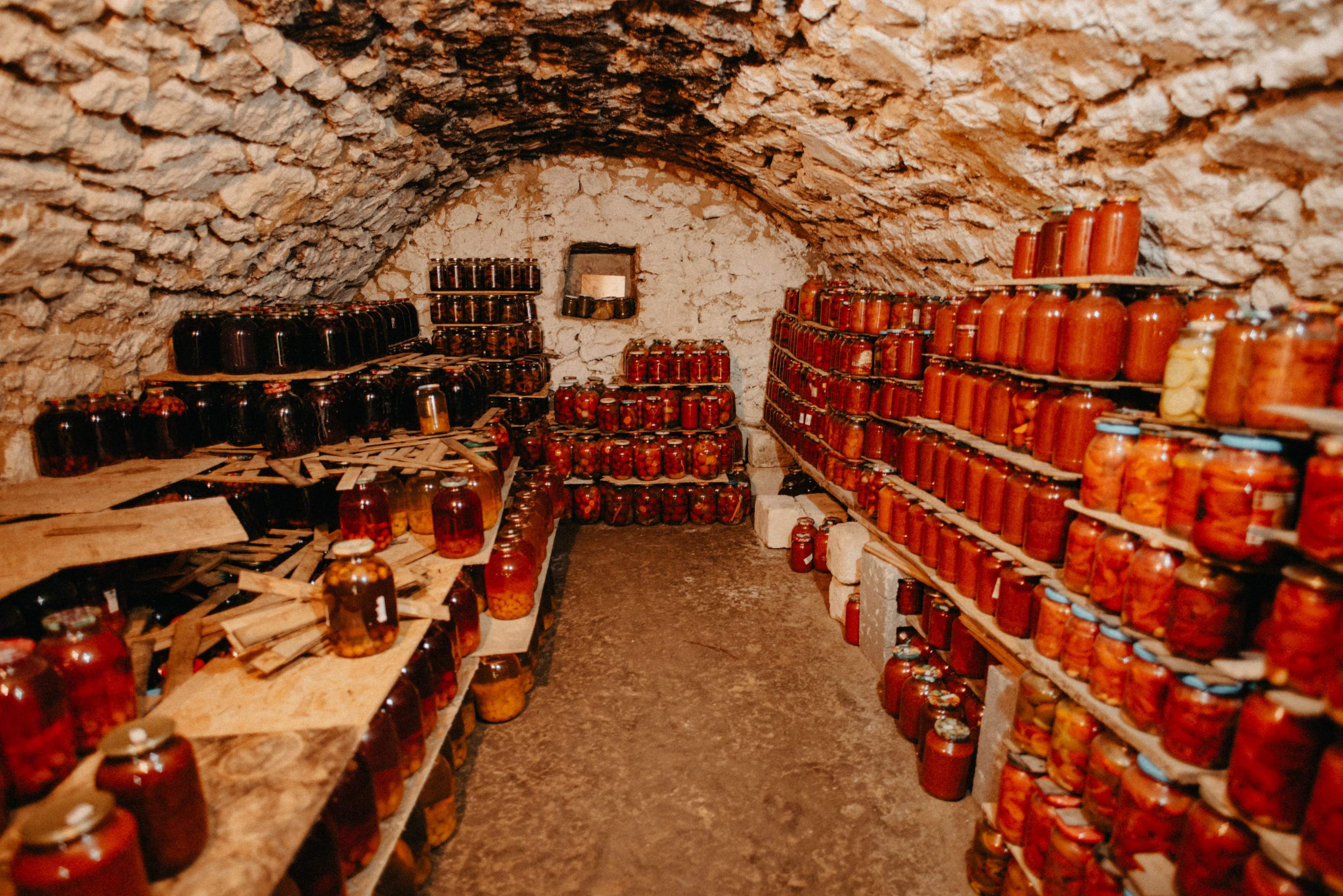
The chest freezer died on a Tuesday in late October — the worst possible month for it, too warm to stack the meat on the porch, too far from spring to shrug it off. By the time anyone noticed the inverter fault, a season of meat and a garden’s worth of vegetables had been thawing for two days. Ask around any off-grid community and someone owns a version of this story, told flat and quiet, the way people describe standing in front of an open freezer at 2 a.m. doing calorie math by flashlight.
The lesson is not “buy a better freezer.” A freezer was never a preservation strategy to begin with — it’s a wager that your power system will never have a bad week, with everything inside it as the stake. Real food resilience — provisioning that outlasts the trip, the season, and the occasional equipment failure — gets judged the way this site judges everything: by the numbers.
And it has two halves this page treats as equals. The first is production: what the ground grows, because a pantry nothing refills is only a countdown timer with shelves. The second is preservation: how you keep the calories the garden hands over in a rush and dole them back across the year. Most off-grid food writing opens at the jars and the freezer — the middle of the story. We open where the calories start: in the dirt.
Two numbers judge the keeping half. Calories preserved per dollar — is the method worth your money? And energy per batch — is it worth your system’s capacity? Every preservation method here answers to both. The growing half answers to a number of its own, kilocalories per square meter of ground; we’ll get there. First, the target all of it aims at.
The Two Numbers That Run a Pantry
Start with the target, because food planning without a calorie target is just shopping. An adult doing real physical work runs on roughly 2,200 kilocalories a day:
Key number
One adult-year of food is roughly 800,000 kcal (2,200 kcal × 365 days). A 90-day resilience floor for a household of four is the same number compressed: ~790,000 kcal.
That is the demand the garden fills and the pantry holds. On the keeping side, calories preserved per dollar counts the preservation cost alone — amortized gear, consumables, energy; the food costs the same either way, so it stays out of the math. Energy per batch is separate because off-grid energy isn’t priced like grid energy: a kilowatt-hour of July surplus is nearly free, and a kilowatt-hour in a dark December week is the most expensive thing your system makes.
Start With the Garden: Grow the Calories First
Every method further down this page keeps calories. Only one thing makes them: the ground. A pantry is a battery — it discharges. A garden is the charger, the single line item in an off-grid food plan that refills itself, and the cheapest calorie you will ever store is the one you didn’t have to buy before you preserved it. So the plan starts in the dirt, and it starts with a decision most first gardens get backwards: what to grow.
The instinct is a salad bed — lettuce, a few tomatoes, herbs. It’s rewarding, and it’s nearly weightless in calories. A square meter of mixed salad greens might return 50–150 kcal a day in season and nothing you can store. The same square meter in potatoes banks 1,500–2,500 kcal that walk into the cellar as dug. That gap — fifteen or twenty to one — is the whole difference between a garden that’s a pleasure and a garden that’s a food supply. A salad bed is a hobby; a potato patch is policy.
The calorie heavyweights, by yield per square meter of decent ground:
- Potatoes — the kcal-per-square-meter champion: 100 m² of decent ground yields 150–300 kg — 115,000–230,000 kcal, or 1,500–2,500 kcal/m², walking into the cellar as dug.
- Winter squash & pumpkins — 600–1,200 kcal/m², and they cure on a shelf at room temperature to hold three to six months with no cellar at all.
- Dry beans — protein at 700–1,000 kcal/m² that dries on the vine to a decade of shelf life, preserved by sunshine for free.
- Grain corn (and small-plot wheat) — 500–1,500 kcal/m², self-drying like the beans; the catch is threshing, which is hand labor at garden scale.
The Cheapest Preservation Is a Crop That Preserves Itself
Notice what the last three share: they hand you the harvest already shelf-stable — zero kilowatt-hours, zero jars. That is the quiet trick of staple gardening. Squash cures, beans and grain dry on the plant, potatoes hold for months in the dark at zero watts. Weight the ground toward crops that preserve themselves and you shrink the preservation problem before you’ve bought a single canner. The methods lower down are for everything the garden can’t self-store — the tomatoes, the meat, the glut that arrives all at once — not for the staples that were quietly solving the problem out in the field.
The Garden as a System
Growing calories at scale is a system, not a row of plants — five subsystems, and each one ties to a decision made elsewhere on the property.
Beds and Ground: In-Ground vs Raised
In-ground rows are the cheapest square meters you will ever plant and the only sane way to grow staples: a potato or bean plot is measured in tens of square meters, and raised beds at $10–30 a square meter would price it into absurdity. Raised beds earn their keep on the intensive kitchen crops — salads, roots, greens — where poor or rocky native soil, drainage, and a few weeks’ earlier warmth in spring matter more than area. The usual mistake is building beautiful raised beds, growing lettuce in them, and never planting the calories that would actually feed you. Rule of thumb: staples in the ground, kitchen crops in the beds.
Season Extension: Greenhouses & Polytunnels
A polytunnel or greenhouse buys time at both ends of the year — typically four to eight weeks earlier in spring and later in autumn, and in a cold climate it is the difference between “can’t ripen tomatoes” and “can.” An unheated polytunnel is the best value in the garden: a 3×6 m hoop tunnel runs a few hundred dollars to ~$1,500 and adds a whole shoulder-season of production on zero energy. Heat it and the math flips — a winter greenhouse heater is a base load, and base loads bill you every day (see below). Most off-grid growers extend the season with glazing and thermal mass, not a heater.
Water: Drip From the Catchment
A productive garden is thirsty: in peak summer it transpires several millimeters a day, which for a 100 m² plot is hundreds of liters a week. Overhead watering throws half of that to evaporation; drip irrigation lays it at the root at ~90% efficiency, and on a gravity feed from the rainwater catchment it runs on no pump at all. This is why the garden and the water system are one design problem, not two — size the tanks with the garden’s peak draw included, on the same page that sizes the household’s: water & rainwater.
Soil: The Fertility Loop
Every harvest is fertility leaving the property in a wheelbarrow, and it has to come back or the yields above decay to nothing in a few seasons. The off-grid answer isn’t a bag of fertilizer trucked up the mountain; it’s a loop — compost, cover crops, animal bedding, and a composting sanitation system that returns nutrients to the beds instead of flushing them into a tank. Fertility is a cycle you close, not a product you buy. Build soil, and the kcal/m² numbers above hold year after year instead of sliding.
Perennials, Orchard and a Few Hens
Annual beds are the loud part; the quiet part pays better. Perennials — asparagus, rhubarb, berries, and a small orchard of fruit and nut trees — cost labor once and yield for a decade or three, the lowest work per calorie on the property once established. The catch is lead time: a fruit tree planted this season is a calorie that arrives in year four or five, which is exactly why you plant it the first season, not the fifth. And where the site and the local rules allow, a handful of hens turns garden and kitchen scraps into protein that arrives daily and needs no preservation at all — five or six eggs a day at ~75 kcal each, a self-delivering breakfast the pantry never has to hold.
It Starts as a Land Decision
Sun, soil, water and space aren’t gardening problems — they’re the reasons one piece of land grows food and the one next to it never will. Six-plus hours of summer sun, soil with depth and drainage, a water source you have the right to use, and enough flat-enough ground for the staple plots: these get decided when you buy the land, and no amount of clever gardening buys them back later. Choose the ground for the garden before you choose it for the view — land & relocation.
One mobilisation, one quote
Clearing, grading, the irrigation trench and the well are one machine-on-site mobilisation if you plan them together — and three separate call-out fees if you don’t. Have the groundwork quoted as one package against your site.
Now Keep What the Garden Gives You
A garden doesn’t hand you calories evenly. It hands them over in a flood — a hundred kilos of potatoes in a single week of digging, a wall of tomatoes ripening faster than anyone can eat them, eggs in June you’d kill for in January. Preservation is the machinery that spreads that pulse across twelve months, and off-grid it gets judged by the same lens as everything else: calories preserved per dollar, and energy per batch. The freezer — the grid world’s reflex — is where that judgment goes wrong first.
Batch Loads Beat Base Loads
That dark-December kilowatt-hour — the most expensive thing an off-grid system makes — is why the freezer, the grid world’s default preservation appliance, is quietly the worst citizen on an off-grid system. Not because it draws much; an efficient chest freezer sips about 1 kWh a day. Because it never stops. A base load has to survive your worst week, and across the northern US and most of Europe a December array produces a fifth to a third of its July output. Carrying that “small” kilowatt-hour through a dark stretch means permanently dedicating panel and battery headroom to it — easily four figures of installed capacity. And one inverter fault still takes the whole inventory down.
A freeze-dryer is the opposite animal. Per batch it’s a monster — 20 to 40 kWh, several days of a frugal cabin’s entire consumption — but it’s a batch. You choose when it runs. Point it at high summer, when the array makes surplus the charge controller would otherwise throw away, and its appetite costs almost nothing in capacity. That is the most useful reframe in off-grid food planning: methods don’t just differ in how much energy they use — they differ in when they’re allowed to use it. Batch loads bend to your solar calendar; base loads bill you every day, including the days you can least afford. Put plainly: a freezer doesn’t preserve food. It postpones a decision, and it charges rent while you decide.
The Methods, Judged
The whole toolkit against both numbers — gear amortized over five years of steady use, energy at typical 2026 grid rates (about $0.17/kWh in the US, €0.25–0.40 across much of Europe); batch into solar surplus and the energy line falls toward zero.
| Method | Gear (typical) | Energy per batch | True shelf life | Preservation cost / 1,000 kcal |
|---|---|---|---|---|
| Root cellar & cold store | $0–600 DIY | 0 kWh | 3–8 months | under $0.10 |
| Water-bath canning | $50–150 | 1.5–3 kWh | 12–18 months at peak quality | $0.60–1.20 (high-acid foods only) |
| Pressure canning | $150–450 | 2–4 kWh | 2–3+ years | $0.40–0.90 |
| Dehydrating | $80–300 | 4–10 kWh | 12–24 months sealed | $0.30–0.90 |
| Freeze-drying | $2,000–3,500 | 20–40 kWh | 15–25 years | $1.50–5.00, falling with throughput |
| Chest freezer (for contrast) | $250–700 | ~1 kWh every day | only while the power holds | — (rent, not preservation) |
Preservation cost only. The freezer has no per-batch entry; its cost never stops.
Canning energy above assumes a full canner-load run (7–9 quart jars, ~60–90 minutes) on an electric coil burner; a lighter load or a different stove prices lower — see the full teardown for a worked per-jar example.
One more cut flips the ranking. Divide preservation cost by shelf life and you get cost per calorie-year — the price of holding a calorie safe for one year. Pressure canning at ~$0.85 per 1,000 kcal over a two-to-three-year life: about $0.34 per thousand calorie-years. Freeze-drying at $2.40 over twenty years: about $0.12. The “expensive” method is the cheapest insurance on the shelf — but only for the layer you hope never to eat. Food in rotation still belongs to the cellar and the canner, which is why a resilient pantry runs all three horizons at once (below).
Root-Cellaring and Cold Storage: The Free Tier
Every other method here spends energy to stop biology; a root cellar borrows the planet’s. Below about 1.2 m (4 ft), soil holds 10–13°C (50–55°F) year-round, and a well-built cellar rides that down to the 0–4°C (32–40°F), 85–95% humidity window where roots and brassicas simply stop. Potatoes hold four to eight months; carrots and beets in damp sand, four to six; cabbage three to four; apples most of the winter — stored apart, because their ethylene wakes everything else up. Onions and garlic break the rule: cool-dry, not cold-damp.
The numbers are absurd: a 25 kg (55 lb) sack of potatoes is roughly 19,000 kcal held at zero watts for the amortized cost of shelving. No basement? A buried barrel or straw-covered clamp on a north slope does most of the job for a couple hundred dollars. On calories preserved per dollar, nothing else comes within an order of magnitude. Its weakness is the clock: 3-to-8 months, not decades.
Canning: The Method That Works When Nothing Else Does
Canning’s quiet superpower has nothing to do with jars: it is the only method here that runs on any steady heat source. Propane ring, wood cookstove, induction plate — the week the batteries are down is precisely the week a canner still works. The safety rule is binary: high-acid foods (fruit, pickles, tomatoes with added acid) may be water-bathed; everything else takes a pressure canner, full stop, because botulism doesn’t negotiate. Stick to tested recipes — the USDA’s National Center for Home Food Preservation in the US, national food-safety guidance in Europe.
The economics split by region. American canning runs on Mason jars with single-use lids at $0.35–0.50 each — a real per-batch consumable. Europe grew up on Weck- and Le Parfait-style reusable glass-lid-and-ring systems: pricier jars, near-zero per-batch cost. Either way a batch costs 2–4 kWh on an electric burner or a few hundred grams of propane, and a liter jar of dense stew — 800 to 1,000 kcal — goes on the shelf for fifty to ninety cents. Peak quality holds two to three years; the calories stay safe well beyond.
Freeze-Drying: The Shelf-Life King, Priced Straight
A Harvest Right–class home freeze-dryer is the largest discretionary load most off-grid households will ever consider: $2,000–3,500 in the US depending on size and sale season (landed in Europe with VAT and freight, closer to €2,500–4,500), pulling 1–1.5 kW for 24 to 40 hours per run — 20 to 40 kWh a batch, so plan on 30. It wants a pure-sine inverter with 2 kW of continuous headroom for the vacuum-pump and compressor surges (see storage & inverters); the US needs a dedicated 20 A circuit, European 230 V wiring shrugs it off.
What the energy buys is a different category of food. A mid-size machine takes 3–4.5 kg of fresh or cooked food per run and hands it back at a 15-to-25-year shelf life in a mylar bag, indifferent to your power system from that day on. Marginal cost: about $5 of grid energy (or nearly free summer surplus) plus $5 of bags and oxygen absorbers, against a batch of dense cooked food carrying 7,000–9,000 kcal. Retail pouches sell at $1.50–2.00 per 100 kcal; your marginal cost lands nearer $0.15. If the alternative is buying pouches, the machine covers itself in 25–40 full batches — one enthusiastic season. If the alternative is canning, it never wins on cost; it wins on horizon. One discipline matters more than any setting: run-time is the scarce resource, so feed it dense calories — stews, meats, eggs — and never spend a 30 kWh cycle on zucchini slices that dry to nothing.
Dehydrating: The Gateway Tier
For first steps: an $80–300 dehydrator running 300–800 W over an 8-to-12-hour cycle (call it 4–10 kWh) turns out jerky, dried fruit and soup mixes at $0.30–0.90 per 1,000 kcal — the one preservation appliance a small solar rig runs without noticing. Vacuum-sealed, the output holds 12–24 months — it removes less water than a freeze-dryer, which is the entire difference: a pantry tier, not a decades tier.
The Three-Horizon Pantry
Everything above — garden and preservation both — snaps into one framework: split stored calories across three horizons and let each method do the one job it’s best at.
- Horizon 1 — eating now (0–6 months), ~60% of stored calories. Cellar, garden, cold store — plus the freezer, if you accept its rent. Cheapest per calorie, shortest clock.
- Horizon 2 — the working reserve (6 months–3 years), ~30%. Pressure-canned meals, dehydrated goods, bulk dry staples. Survives power failures by definition.
- Horizon 3 — the insurance layer (3–25 years), ~10%. Freeze-dried food and properly packed staples. Batched once in summer surplus, then ignored for a decade.
Four adults, 90-day floor — the ~790,000 kcal above: roughly 475,000 kcal in the cellar and cold store (about 300 kg of roots plus squash, apples and cabbage: one good garden year), 240,000 in jars and sacks (a hundred-odd liters of home-canned meals plus a 25 kg sack each of rice and beans), and 80,000 freeze-dried (ten-ish batches). Scale the quantities; keep the ratios — and notice that the biggest slice is simply a garden that grew.
One dependency bites late: the pantry has a water bill — liters per canner batch, plus 0.3–0.5 L to rehydrate every dried meal, on top of everything the garden drank. Size it in from the start with how much water storage you really need.
How much garden do I actually need to feed a household?
Think in the potato number: ~1,500–2,500 kcal per square meter for staples. Feeding one adult’s full 800,000 kcal from the garden alone would take 350–500 m² of well-worked ground in mixed staples — but almost nobody grows 100% of their calories. A realistic off-grid target is to grow the bulk of your fresh vegetables plus a serious staple block — say 200–400 m² for a household of four — and buy bulk grain and beans to fill the rest. Start with the potato and squash beds; they return the most calories for the least skill.
How many calories should I store per person?
Budget 2,200 kcal per adult per day — roughly 800,000 kcal per adult-year. Start with a 90-day floor of ~200,000 kcal per adult, split ~60/30/10 across the horizons, and count the growing garden as the front of that floor.
Can I run a freeze-dryer on off-grid solar?
Yes — as a schedulable batch load, not an appliance. Budget ~30 kWh per run at 1–1.5 kW with surges, behind a pure-sine inverter with 2 kW of headroom. Batch in the high-sun months when the array makes surplus; skip mid-winter, where one run can equal several days of total production.
Is home canning actually safe?
With tested recipes, yes. High-acid foods (fruit, pickles, tomatoes with added acid) can be water-bath canned; all low-acid foods require a pressure canner at the tested time and pressure, no exceptions, because botulism spores survive boiling. Use USDA-tested recipes in the US or national food-safety guidance in Europe, and have dial gauges checked yearly.
Do I need a basement for a root cellar?
No. A buried barrel, a culvert section on a north slope, or a straw-covered clamp delivers most of a cellar’s performance for a few hundred dollars anywhere with a real winter. Get ventilation right — a high vent and a low vent — before worrying about depth.
Go Deeper
Provisioning is one leg of the stool — see how power, water, sanitation and food fold into one build on what we do.