


Off-grid gear
Power Stations & Expansion
Portable power and the accessories that stretch it. Every link goes straight to the maker — no marketplace middlemen.
Rated for the United States: 120/240V split phase, UL listing and a dealer network you can reach. Europe runs a separate list.
Size it first
Power Station Sizing Calculator
Devices and days in — usable Wh, surge watts, recharge wattage and a matched size tier. Buy against your own numbers, not a guess.
EcoFlow
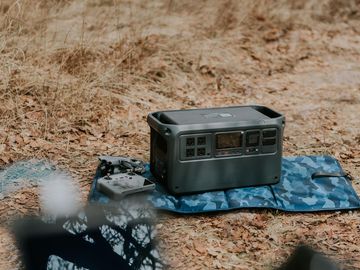
DELTA Pro 3, DELTA 3, River 3 & extra batteries
The densest hardware in the class: 4kWh and 4,000W with real 120/240V split-phase from one box, the fastest AC recharge here, and the highest expansion ceiling of any portable station.
Watch: Expansion is locked per generation — a DELTA Pro 3 pack will not fit a DELTA Pro, Pro Ultra or DELTA 2, so today's batteries are a dead asset the day you upgrade. The cell-to-chassis pack is the case, so it is not serviceable, and there is no aftermarket for its power semiconductors.
Visit EcoFlow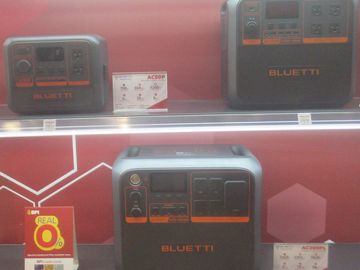
Bluetti
AC200L, AC300/AC500 heads, Apex 300 & B300K packs
The only modular topology on this page: AC300 and AC500 are battery-less heads, so a dead inverter does not strand your batteries and a dead pack does not strand the inverter. Cheapest expansion per kWh, and lifting mode carries motor surge.
Watch: Check the pack against the head before you buy — B300K fits Apex 300, AC500, AC300, AC200MAX and AC200L, but not the AC180, Elite 200 V2 or EB3A. The pack itself is bare: one 12W USB-A, no solar or AC input of its own.
Visit Bluetti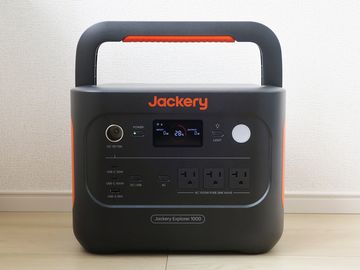
Jackery
Explorer 2000 v2 / 3000 v2 & SolarSaga panels
Genuinely the lightest 2kWh unit you can buy — about 37 lb, roughly 18 lb per kWh, half the carrying weight of the big split-phase boxes. The 2000 v2 finally takes XT60 solar input, so any third-party panel works.
Watch: Plastic-first construction: fine in a van, not on a job site. No native 240V, so it cannot carry a well pump or a dryer at any price. Its cycle rating is quoted to 70% capacity where rivals quote 80%, and the SolarSaga panels cost well above generic ETFE per watt.
Visit Jackery
Anker SOLIX
F3800 / F3800 Plus & BP3800 expansion
The only unit under $4,000 doing 6,000W AND true 120/240V split-phase from a single box — it carries a well pump or a dryer where the others need a second unit. Five-year warranty, and the best-behaved app of the five.
Watch: At 132 lb (plus 95 lb per expansion pack) this is a wheeled appliance, not a portable. The station line is only about 18 months old, so there is no long-run warranty-claim record behind that warranty length.
Visit Anker SOLIX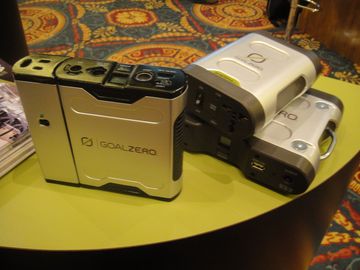
Goal Zero
Yeti PRO 4000, Yeti Link & mounting kits
Vehicle-integration and mounting accessories nobody else makes, on the most rugged case here — plus the best surge behavior and the lowest idle draw of the flagships, which is what decides a long quiet outage.
Watch: You pay roughly $1,000–1,500 over equal specs for it, there is no 240V output at all, and the solar cabling is proprietary — the exact lock-in Jackery just dropped.
Visit Goal ZeroBeyond the brochure
What none of the spec sheets tell you
- None of these are weather-rated. No flagship on this page carries a sealed-enclosure rating. They are covered-porch and in-vehicle appliances; rain on the vents ends the unit, not the warranty argument.
- Cycle ratings are not comparable as printed. EcoFlow quotes 4,000 cycles to 80% of capacity; Jackery quotes 4,000 to 70%, and hits 80% at roughly 2,000. Same headline number, different finish line.
- Weight per usable kWh is the portability number, and it spans two-to-one here: about 18 lb/kWh for the Jackery 2000 v2, 27 for the DELTA Pro 3, 34 for the F3800. One of these you carry; one you wheel.
- Native 120/240V split-phase decides what actually runs. A well pump, a dryer or a deep-well submersible needs it. The F3800 and the DELTA Pro 3 have it from one box; the Jackery and the Yeti do not, at any price. Size it in the well pump calculator before you buy either.
- Expansion batteries are proprietary to their own generation, everywhere. Every 'expandable' claim on this page means expandable with that maker's current pack, on that maker's connector, until the next model year. Budget the bank you want within one generation.
- They are line-interactive, not online UPSs. Transfer is roughly 10–20ms on all of them: fine for a fridge or a router, not for gear that trips on a 15ms gap.
- Past about 8kWh a rack is cheaper. Server-rack LiFePO4 with a separate inverter runs near $265/kWh against $500–700 in a portable case. If the answer is a cabin bank rather than a carry unit, the solar electrical list is where it gets built.
The picks
The exact models the calculators name
Run the numbers first — the Power Station Sizing Calculator filters these to your result. Street-price bands, checked recently, not list prices.
- EcoFlow River 3 — 245Wh pocket tier — lights, laptop and phone territory. $180–240 · View
- Bluetti AC70 — 768Wh / 1,000W — the value mid-tier for weekends and small loads. $430–550 · View
- EcoFlow DELTA Pro 3 — 4kWh large tier, expandable to 12kWh. $2,700–3,000 · View
- Anker SOLIX F3800 — the stackable top tier — 240V split-phase for the loads this calculator flags as “stack 2+”. $1,999–2,400 · View
Other lists: Backup Power & Transfer · Solar Electrical & Monitoring · Water, Filtration & Sanitation · Connectivity & Comms
Links go direct to the maker. Some may earn Grid CEO a commission at no cost to you; nothing here was placed for pay, and no maker saw this list before you did.