


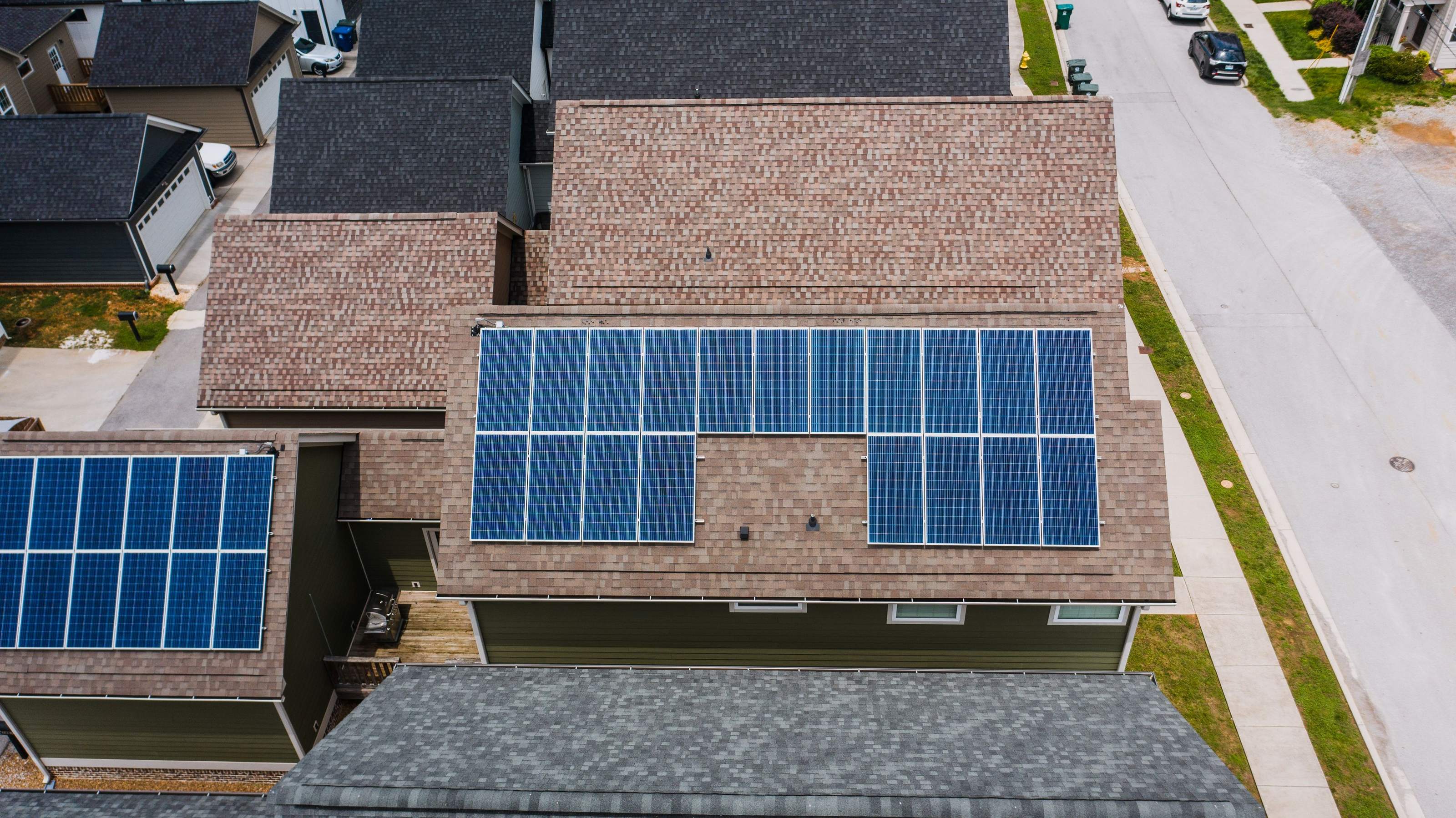
Ask five off-grid solar companies how many panels a house needs, and you'll get five different numbers before anyone thinks to ask where the house actually sits. That's backwards. A lean two-bedroom cabin in a high-sun climate can run comfortably on four panels. A four-bedroom family home in a cloudier climate — same country, or a continent away — can need more than four times that many. Not because it's bigger. Because the sky above it is doing roughly half the work. House size is the question everyone asks first. Daily load and local sun-hours are the two numbers that actually decide it. Run the real math below, twice, and you'll see exactly where your own number lands.
The Formula Behind Every Off-Grid Solar Quote
Every legitimate off-grid sizing job — a $400 kit for a garden shed or a $60,000 whole-home system — runs through the same three numbers:
- Daily load — how many kilowatt-hours (kWh) the house actually draws in a day.
- Peak sun-hours (PSH) — the local, weather-adjusted measure of usable sunlight hitting a fixed panel each day.
- System derate — the roughly 25% of a panel's rated output that never reaches an outlet, lost to charge-controller conversion, inverter losses, wiring, heat, dust and the round trip through the batteries.
The formula
Array size (kW) = Daily kWh ÷ (Sun-Hours × 0.75)
Panel count = Array size (W) ÷ Panel wattage
0.75 is a reasonable derate for a well-designed off-grid system. Long DC wiring runs and an older lead-acid bank lose more; a tight, all-LiFePO4 system with short runs can lose less.
Two numbers, multiplied and divided against each other. Change either one and the answer swings hard — which is exactly what trips people up, because most homeowners only ever adjust the load side (bigger house, more panels) and never think about the sun-hours side at all.
Step 1: Add Up What You'll Actually Run
Off-grid load audits fail in one of two directions: people forget the things that quietly run all day (fridge, router, well pump), or they budget for the grid-connected lifestyle they're about to leave behind — electric resistance heat, an electric dryer, a hot tub. List every device, its wattage and realistic hours-per-day, multiply, divide by 1,000, and sum. That's the daily kWh figure the formula above needs.
Run it properly, appliance by appliance, in the solar sizing calculator. Below are the totals for the two example houses this article uses throughout, so you can see where the numbers come from.
Step 2: Find Your Real Sun-Hours — Not the Annual Average
Peak sun hours aren't daylight hours. A PSH of 5.0 means a site receives the equivalent of five hours of full, 1,000 W/m² sunlight per day — even though the sun might technically be up for ten or fourteen. It's a normalized figure, and every location has one, built from years of satellite and ground-station data.
Here's the mistake baked into most free online solar calculators: they use the annual average PSH, which is fine for a grid-tied system that nets its summer surplus against its winter shortfall over a full year. Off-grid doesn't get that luxury — there's no utility to bank credit with. The system has to survive its worst month largely on its own, and worst-month PSH typically runs 30–50% below the annual average, sometimes far more in cloudy, high-latitude climates. Size to the average, and you've quietly planned to run a generator every winter whether you meant to or not.
In the US, NREL's free PVWatts and NASA POWER tools return a monthly PSH breakdown for exact coordinates, not a regional guess. In Europe, the European Commission's own PVGIS tool does the same job — free, no login, resolution down to a single rooftop. Both let you pull the worst month directly instead of eyeballing an average off a map.
| Location (approx. annual PSH) | Sun-hours |
|---|---|
| Phoenix, AZ (US) | 6.5 |
| Almería (Spain) | 5.6 |
| Los Angeles, CA (US) | 5.8 |
| Rome (Italy) | 4.7 |
| Denver, CO (US) | 5.6 |
| Atlanta, GA (US) | 5.0 |
| Munich (Germany) | 3.4 |
| Seattle, WA (US) | 3.6 |
| Amsterdam (Netherlands) | 3.0 |
| London (UK) | 2.8 |
Two Houses, Two Very Different Panel Counts
Same method, two real scenarios: a lean two-bedroom off-grid cabin in a high-sun climate — Southwest-US or inland-Mediterranean latitude, ~5.2 worst-month PSH (December, per NREL PVWatts for Phoenix) — and a full-time four-bedroom family home in a cloudier one — Pacific-Northwest or Northern-European latitude, ~1.8 worst-month PSH (December, per NREL PVWatts for Seattle). Both run propane or wood for heat and hot water, because electric resistance heating is the fastest way to wreck an off-grid budget on either side of the Atlantic. Both PSH figures here are worst-month, per Step 2’s own rule — the number an off-grid system actually has to survive on, not the friendlier annual average.
| Daily load | 2-bed cabin | 4-bed home |
|---|---|---|
| Fridge(s) | 1.0 kWh | 2.4 kWh |
| Lighting (LED) | 0.3 kWh | 1.2 kWh |
| Well / pressure pump | 0.4 kWh | 1.0 kWh |
| Washer (+ dryer, home) | 0.3 kWh | 2.5 kWh |
| Dishwasher | — | 1.0 kWh |
| Internet + electronics | 1.0 kWh | 2.0 kWh |
| Kitchen / misc | 0.6 kWh | 1.4 kWh |
| Cooling (shoulder season) | 0.4 kWh | 1.5 kWh |
| Contingency | 1.0 kWh | 1.0 kWh |
| Total | 5.0 kWh/day | 14.0 kWh/day |
| 2-bed cabin | 4-bed home | |
|---|---|---|
| Daily load | 5.0 kWh | 14.0 kWh |
| Sun-hours (worst-month PSH, Dec) | 5.2 | 1.8 |
| Array needed | 1.28 kW | 10.37 kW |
| Panels, 400W (bare minimum) | 4 | 26 |
| Panels, 400W (with 30% buffer) | 5 | 34 |
The home draws 2.8× the power of the cabin every day. It needs 6.8× the panels — not because it's bigger, but because it's also fighting for barely a third of the cabin's worst-month sun. Flip the locations and the gap reverses just as hard: put that same four-bedroom home in Phoenix instead, and its worst-month bare-minimum panel count falls by roughly two-thirds — 26 down to 9 — before a single appliance changes.
Skip the examples — run your own loads and location →
Why the Real Number Is Higher Than the Bare Minimum
Nobody sizes to the bare-minimum number and orders exactly that. Three things push the real order upward:
- Cloudy-day buffer. A run of overcast days shouldn't mean rationing power. 25–30% of extra array capacity keeps the battery bank topped up through a bad week, not just an average day.
- Full charge, not just capacity. Battery bank size (kWh) is a separate calculation — autonomy days × daily load ÷ depth of discharge. But an undersized array means a big bank that rarely reaches full charge, which shortens its life regardless of its rated capacity.
- Tilt, orientation and shading. A roof that isn't close to due-south (due-north south of the equator), isn't near the ideal tilt for its latitude, or carries partial shade from a tree or chimney loses real output a spec sheet never shows.
That's why the cabin's bare-minimum "4 panels" becomes an order for 5, and the home's "26" becomes an order for 34 — and why the number an installer actually quotes is almost always higher than a back-of-envelope calculation, for good reason.
What That Looks Like as Actual Hardware
Panel count is the sizing answer; the shopping list is a separate decision. The math above holds whether the inverter needs to output 120/240V split-phase (US) or 230V single- or three-phase (most of Europe) — voltage is a wiring and hardware decision, not a sizing one. What does change region to region is which panel, inverter and battery SKUs are available, and at what price:
Off-Grid Panel Count: Frequently Asked Questions
How many solar panels does it actually take to run a house off-grid?
Most fully off-grid homes land somewhere between 12 and 30 panels — roughly 5 kW to 12 kW of array — but the honest answer is "it depends on your daily load and your local sun-hours," not your square footage. A lean cabin can run on 4; a full-time family home in a cloudy climate can need 20 or more. Run your own numbers rather than borrowing someone else's.
Does adding more panels always mean more usable power?
No — only up to the point where the charge controller, inverter and battery bank can absorb it. Oversizing the array a little (25–30%) buys cloudy-day resilience; oversizing it a lot without upgrading the rest of the system just means clipped, wasted midday production.
What's the difference between peak sun hours and daylight hours?
Daylight hours count every minute the sun is above the horizon, including weak early-morning and late-afternoon light. Peak sun hours (PSH) is a normalized figure — the number of hours at a full 1,000 W/m² that would deliver the same total energy a site actually receives. A 14-hour summer day might still only be 6–7 PSH.
Can I just oversize the panels instead of buying a backup generator?
Only to a point. Panels only produce during daylight, so a bigger array doesn't fix a week of solid winter cloud cover — that's a battery-autonomy and backup-power question, not a panel-count one. Most installers size the array to the worst realistic week and still spec a propane or diesel generator as low-use insurance.