


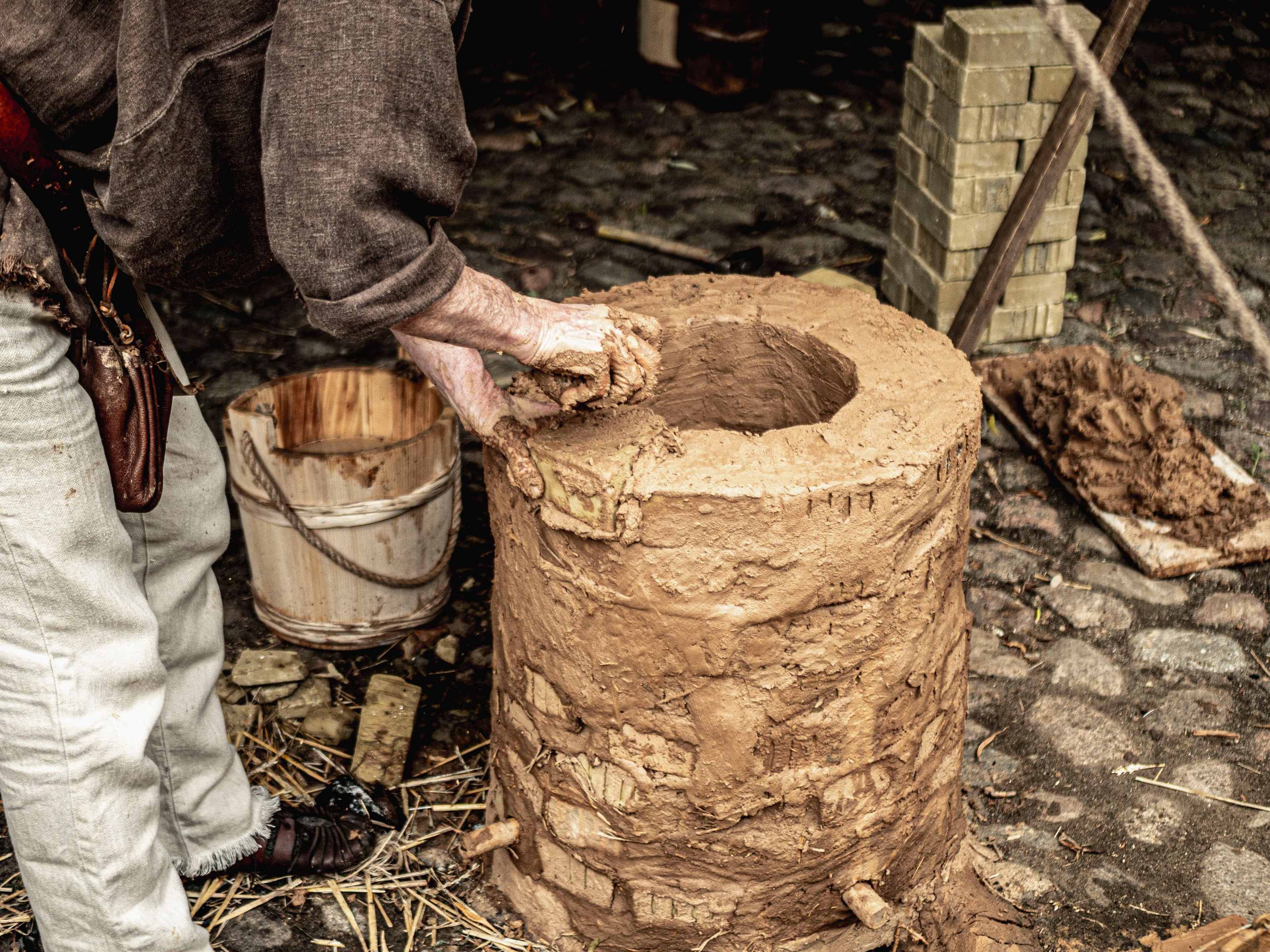
Feed it a double armload of sticks — branch wood and offcuts too small to bother splitting — and a rocket mass heater will still be pumping warmth into your cabin at two in the morning, eight hours after you let the fire die. Not embers. No glow. Just a curved bench of packed clay and sand, warm as fresh bread. That’s what a J-tube burn tunnel and a wad of cob do together: they don’t just burn wood cleaner than a normal stove, they store the heat somewhere a normal stove has nowhere to put it — in half a ton of thermal mass instead of up a flue and into the sky.
The design has circulated in off-grid and permaculture circles since the late 1980s, when Ianto Evans and the builders at Cob Cottage Company in southern Oregon got tired of feeding a woodstove every three hours through a wet Oregon winter. Ernie and Erica Wisner later turned decades of backyard iteration into the standard builder’s guide the DIY community still works from. None of it is patented or sold in a box at the hardware store — it’s owner-built folk engineering, which is why it can be built in a weekend for a few hundred dollars instead of ordered for four thousand.
A Chimney Turned Sideways, Then Set On Fire
A rocket mass heater is four components doing one job in sequence: burn the wood as completely as physically possible, then strip every last degree out of the exhaust before it leaves the building. Nothing about the shape is decorative — each part exists because of what the part before it does to the fire.
- The J-tube burn tunnel. Wood feeds down a vertical chute into a horizontal, insulated tunnel below it. Restricting the fire to that narrow tunnel forces a strong draft — the same physics as a chimney, just built sideways and three feet long instead of thirty.
- The heat riser. An insulated vertical flue above the burn tunnel holds those gases at extreme temperature — commonly 1,800–2,000°F (980–1,090°C) — long enough for a secondary burn to ignite the smoke and volatiles a normal stove just vents up the chimney. This is the “rocket” part: air gets pulled through so hard the assembly roars like a jet engine idling.
- The barrel. An inverted 55-gallon (~200L) steel drum caps the riser. Hot gas spills down the outside of the riser and radiates straight off the barrel’s skin — that’s your first hour of heat, before the mass has had time to warm through.
- The mass. What’s left of the exhaust — still a few hundred degrees — crawls through a duct buried inside a cob or masonry bench. By the time it reaches the exit, most of its heat has transferred into the mass instead of your roofline.
Key number
A well-built rocket mass heater’s exhaust commonly exits the mass at 100–150°F (38–66°C). A conventional wood stove’s flue runs 300–500°F+ (150–260°C+) for the entire burn. That gap — the heat a normal stove sends straight up the chimney — is exactly what ends up stored in the bench instead of in the sky above your roof.
The Wood-Use Math, Worked
“80% less wood” sounds like marketing until you put an actual cabin’s heat demand against four heating methods and count pounds instead of vibes. The table below assumes a small, reasonably insulated off-grid cabin that needs roughly the same total heat delivered over 24 hours — what changes between rows is how much wood, and how much babysitting, each method needs to deliver it.
| Method | Combustion efficiency* | Wood per day, same heat | Refuel | Heat once the fire’s out |
|---|---|---|---|---|
| Open fireplace | ~10–15% | 80–120 lb (36–54 kg) | continuous | gone within the hour |
| Basic steel box stove | ~40–50% | 60–90 lb (27–41 kg) | every 2–3 hr | 1–2 hr residual |
| EPA-certified wood stove | ~65–77% | 40–70 lb (18–32 kg) | every 4–8 hr | 2–4 hr residual |
| Rocket mass heater | ~90%+ | 15–25 lb (7–11 kg) | one 60–90 min burn/day | 12–24 hr from the mass |
*Open fireplace, steel box, and EPA figures are standardized lab combustion-efficiency tests. The rocket mass heater figure is community-reported from builder and field measurements, not a certified lab test — no standardized test protocol yet exists for owner-built masonry heaters.
Run the comparison against a modern EPA-certified stove — the fairest, cleanest-burning baseline there is — and a rocket mass heater lands at roughly 20 lb (9 kg) of wood against roughly 90 lb (41 kg) for the same day of heat: about a 78% cut, which is where the headline number comes from. Against an open fireplace or an old pre-EPA box stove, the reduction runs past 85%. Builders who track a full season report the same ratio at scale: a cabin that used four to six cords (roughly 14–22 stères/m³) a winter on a conventional stove commonly drops to one, maybe one and a half (about 4–5 stères/m³) — burned as scrap branches instead of split, seasoned cordwood.
The reduction isn’t really about the wood burning “better” in some vague sense — it’s two wins stacked on top of each other. The J-tube and riser push combustion efficiency close to complete, so almost nothing leaves as unburned smoke or creosote. Then the mass captures the heat a stove would otherwise radiate into an empty room while you’re asleep, and hands it back over the next day instead. A stove that burns just as cleanly but has no mass still loses that second win — the whole reason the mass exists, not the burn tunnel.
Built In a Weekend: Core Saturday, Mass Sunday
This is a two-day build and not a two-month one for the same reason experienced builders insist on the order: build and fire the core dry — no cob, no permanence — before committing a weekend’s worth of mixing to encasing it. A core that doesn’t draft right is an afternoon’s rework. A core that doesn’t draft right and is already buried in 1,500 lb (~680 kg) of cured cob is a demolition project.
Day one: build the core, test it outside
Dry-stack the firebrick into the J-tube burn tunnel and heat riser, following a dimensioned plan rather than guessing proportions — the ratio between burn-tunnel length, riser height, and system diameter is why a rocket mass heater drafts itself instead of needing a fan. Set the barrel over the riser, pack perlite or vermiculite insulation into the riser cavity to hold that secondary-burn temperature, and light a test fire before anything is permanent. You’re listening for the roar, watching for startup smoke that clears within a minute or two, and checking that the barrel gets uncomfortably hot to the back of a hand held near it — all three mean the core is drafting correctly.
Day two: cob the mass, then leave it alone
Mix cob in the classic ratio — roughly three parts sand to one part clay-rich subsoil, with straw worked in for tensile strength — and pack it by hand and foot around the exhaust manifold to build the bench. This is the part that takes a crew and a Saturday’s worth of energy: cob is mixed and applied wet, by hand, and there’s no shortcut that doesn’t compromise the mass’s density. Once it’s formed, the hard part becomes discipline — a full cob mass needs one to several weeks of slow, unheated curing before its first real fire, or trapped moisture flashes to steam and cracks the bench.
- Core components: firebrick for the burn tunnel and riser lining, a 55-gallon (~200L) steel drum, perlite or vermiculite insulation, fire cement or high-temp mortar.
- Mass components: sand, clay-rich subsoil or bagged clay, straw, and 6-inch (150mm) stovepipe or steel duct for the manifold buried in the bench.
- What you don’t need: a welder, a kiln, power tools beyond a mixing drill, or any part that isn’t sold at a builder’s merchant or salvage yard.
What It Actually Costs
The honest range is wide, because the two biggest line items — the barrel, and the sand and clay for the mass — are either free (salvaged, dug on-site) or a real expense (new, delivered). Figures below are USD reference points for materials only (a Europe build runs broadly similar totals in EUR, local VAT and material costs shifting it either way), assuming an existing hearth pad or slab to build on; add materially for a new foundation or chimney chase through a roof.
| Line item | Salvage-heavy | All new materials |
|---|---|---|
| 55-gallon (~200L) steel drum | $0–40 | $80–150 |
| Firebrick (~40–60 standard) | $80–150 | $150–280 |
| 6-inch (150mm) stovepipe / duct manifold | $40–90 | $90–180 |
| Perlite or vermiculite insulation | $20–40 | $40–70 |
| Sand, clay, straw for cob | $0–60 | $80–180 |
| Fire cement, gasket rope, misc | $30–70 | $60–120 |
| Total, materials only | ~$170–450 | ~$500–980 |
A new hearth pad, chimney chase, or roof penetration — if you don’t already have one — commonly adds $500–1,500 to either column, which is why community-reported total builds run as high as $2,000–3,000. Prefabricated, code-inspectable rocket-style heaters exist too, running $2,000–4,000 installed, but they trade away the point of building one: a weekend, a truck-bed of scrap, and a materials bill under a thousand dollars. If a full DIY build isn’t the right fit for your cabin or climate, our off-grid heating and cooling overview compares it against other systems.
Three parts are worth not scrimping on — the firebrick lining the highest-heat zone, the barrel that has to survive years of thermal cycling without warping, and the stovepipe carrying the manifold through the mass. Priced for your region:
The Part Nobody Puts In The Build Photos
No mainstream building code in the US or Europe lists an owner-built J-tube rocket mass heater the way it lists a UL-listed wood stove — there’s no box to check that makes it automatically compliant. Where it gets approved, it’s usually under an “alternative materials and methods” provision that treats it as a site-built masonry heater, so the outcome depends on the judgment of your local building official, not a national standard. Some rural counties wave a hand-built cabin heater through without a second look; others require an engineer’s sign-off or reject it outright. Call your local building department before you buy the barrel, not after you’ve cured the cob. European builders should also weigh how Ecodesign 2022 fits in — it regulates manufactured wood-stove emissions, not owner-built masonry heaters directly, but some local permitting authorities reference it anyway.
Insurance is the part almost nobody checks until a claim gets denied. A standard homeowner’s or cabin policy commonly excludes damage tied to “unlisted” or non-code heating equipment — and a chimney fire traced back to an owner-built heater can sink an unrelated claim too, not just the fire damage itself. If the cabin is mortgaged or insured, ask the insurer directly: does an owner-built masonry heater, inspected and permitted locally, stay covered? Off-grid cabins on bare rural land with no policy at all sidestep the question entirely — a real reason this build is so common on exactly that kind of property.
- Clearance to combustibles applies to the barrel and riser section the same way it applies to any solid-fuel stove — treat it as a full stove clearance until your local code official says otherwise, not a masonry-fireplace clearance just because part of it is cob.
- Make-up combustion air matters more in a tight off-grid cabin than in a drafty farmhouse — a dedicated outside air intake near the burn tunnel keeps the draft from fighting your range hood or bath fan for the same air.
- A battery CO detector and smoke detector are non-negotiable regardless of how the legality question shakes out — treat every solid-fuel heater, permitted or not, the same way on this one point.
Is a rocket mass heater actually legal to build?
It depends on your jurisdiction — there’s no national listing that settles it the way there is for a UL-certified wood stove. Some counties permit it as a site-built masonry heater under an alternative-methods provision; others don’t recognize it at all. Call your local building department before you build, not after.
Can a rocket mass heater be my only heat source off-grid?
Many off-grid builders do, in climates where a well-sized mass can carry a small, insulated cabin through the coldest nights. Size the mass and burn tunnel to your actual square footage and climate — see our wood stove sizing guide for the load math — an undersized system just means more frequent burns, not failure — but a genuinely severe winter climate is safer with a backup heat source regardless.
Does the cob bench really stay warm without any fire burning?
Yes — that’s the entire point of the design. A properly built and cured mass commonly holds usable radiant warmth for 12 to 24 hours after the day’s burn ends, because the exhaust gave up its heat to the mass on the way through instead of leaving with the smoke.
How long does the cob mass need to cure before I can use it?
Plan on one to several weeks of slow, unheated drying before the first real fire, longer in cold or humid conditions. Firing a mass before it’s cured traps moisture that flashes to steam and cracks the bench — the single most common rookie mistake in the build.