


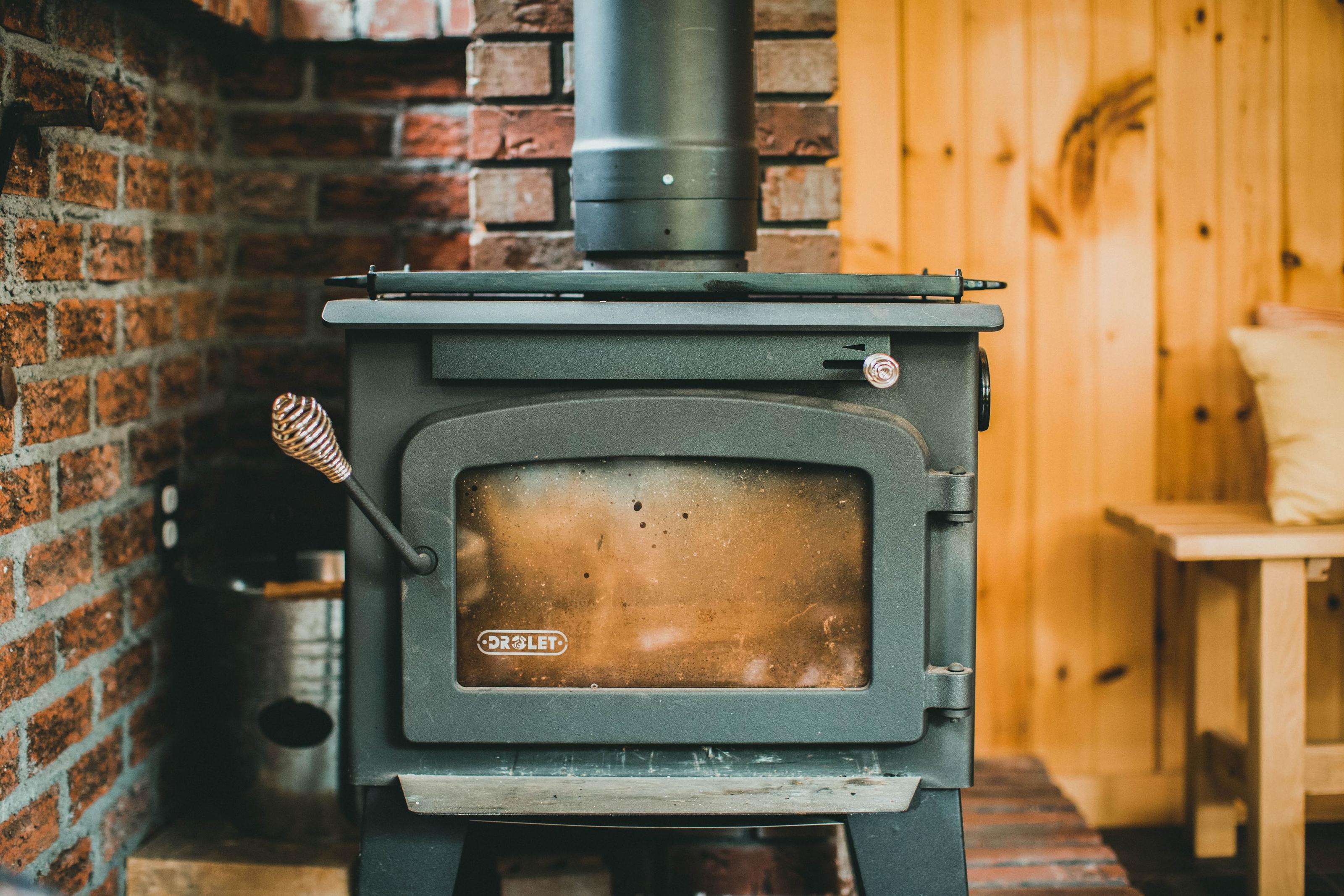
Every January the same post appears on every off-grid forum, written by a different person each year. The cabin was cold, so they ran a little space heater — just for the evening, just to take the edge off — and by nine the batteries were flat and the fridge was warming up.
The replies are never kind, but they are consistent, because the arithmetic is: a 1,500-watt heater running from dinner to bedtime pulls about 9 kWh, which is the entire usable capacity of a battery bank that cost more than the truck parked outside.
The January sun, meanwhile, put maybe two of those kilowatt-hours back.
The lesson is not “buy more batteries.” The lesson is that heat is not electricity. On the grid, every job in the house arrives down one wire, so heat feels like just another appliance.
Off the grid, heating is the largest energy job a building has — in a real winter, bigger than everything else on the load sheet combined — and it peaks at the exact moment your power plant produces least. Cooling is the mirror image: it peaks on the same afternoons your panels do.
Off-grid comfort is really two opposite problems wearing one thermostat. Heating wants fuel you can stack; cooling mostly wants the sun you were already catching. Hold onto that one idea and every purchase on this page — stove, heat pump, fan, or a bench made of clay — sorts itself.
This is the tour of the whole territory; each section links the deep-dive guide with the full math, and the rest of the system it all has to live inside is over at what we do.
Key number
A full cord of seasoned hardwood holds roughly 6,000 kWh of raw heat — about 1,650 kWh per stacked cubic meter. A lithium bank that stored that much energy would run well into seven figures. Firewood is the cheapest energy storage a household can own, which is why almost every off-grid home in a real winter burns something — and spends its precious battery on jobs only electricity can do.
On this page
Start With the Load: BTU by Climate and Insulation
Every good decision downstream hangs on one number: how fast your building loses heat on a normal cold night. Not the record night from 1994 — the one that shows up a dozen times each winter.
A full load calculation (Manual J in the US, EN 12831 in Europe) is worth paying for on a whole house; for a cabin or a first pass, the classic shortcut gets you within a size: floor area times a climate factor, corrected for insulation.
| Winter you design for | Tight, modern build | Average build | Old & leaky |
|---|---|---|---|
| Mild — design low ~30°F / −1°C | 15 | 20 | 30 |
| Cold — ~10°F / −12°C | 25 | 35 | 45 |
| Severe — ~−10°F / −23°C | 30 | 45 | 60 |
Values in BTU per square foot per hour. Working metric? Multiply by 3.15 for W/m² (and m² × 10.76 = sq ft). A true passive-house build sits far below the left column — some heat themselves on occupants and appliances alone.
Worked example: a 600 sq ft (56 m²) cabin of average tightness in a cold-winter climate needs about 600 × 35 = 21,000 BTU/hr, call it 6 kW, on its design night — and roughly half that on an ordinary one.
Both numbers matter: the first sizes the heater, the second is what it must idle at without misbehaving, which is where the trap below lives.
And before you buy any machine at all, remember the cheapest BTU is the one that never leaves the building — air-sealing and insulation move that table’s multiplier further than any hardware upgrade, which is exactly the envelope work covered under waterproofing & shelter.
The full sizing method, including the “20°F night test,” is worked end-to-end in sizing a wood stove for an off-grid cabin.
Wood & Pellet: Heating With Stored Sunlight
Firewood is solar energy that a tree spent thirty years collecting and compressing for you — about 4 kWh per kilogram once seasoned to 20% moisture — and it releases that energy with zero help from your battery. That independence is the whole argument.
A wood stove doesn’t care that it’s been overcast for nine days; it’s the rare machine that actually works better as the weather worsens, because a colder chimney-to-sky difference pulls a stronger draft.
Budget realistically: the example cabin above burns two to four full cords a winter (roughly seven to fifteen stacked cubic meters) depending on how hard the season leans on it.
Pellet stoves buy you what cordwood can’t — a thermostat, a hopper that feeds itself for a day or two, no 2 a.m. reload — but read the label off-grid: the auger, fans and controller draw 60–120 W whenever it runs, plus a 300–500 W igniter for a few minutes at each start.
Through a deep-winter day that’s 1.5–2.5 kWh of battery, spent precisely when your array earns least. A pellet stove is independent of the utility, not of your battery bank — it’s a wood stove that thinks it’s an appliance. Fine with margin, miserable without.
Whichever you choose, buy certified — a modern certified stove wrings a third more heat from the same wood than the rusty box it replaces and keeps the chimney far cleaner. Compliance differs by region, and the ratings don’t interchange: US stoves certify to EPA 2020, European stoves to Ecodesign, under different test protocols.
The Oversizing Trap
Walk into a stove showroom with your cabin’s dimensions and, if you’re not careful, you’ll walk out with the flagship — “for margin.” By February you’re cracking a window at 20°F outside, which is the most expensive method yet devised for heating a forest.
The physics is unforgiving: a modern stove only burns clean when the firebox is hot, because clean burning means re-igniting the smoke itself, at around 1,100°F.
Choke a too-big stove down to what the room can stand and it drops below that threshold — the glass blackens, unburned smoke condenses as creosote in the flue, and you feed it more wood for less heat, all season long.
Size to the design-night number from the table, and when you land between sizes, take the smaller one and run it hot. The record-breaking night is what blankets, backup and the spare heater are for — a small stove run hot beats a big stove run cold every single week of the winter.
Mini-Split Heat Pumps: Sized to the Array, Not the Room
A heat pump is the one legitimate way to heat with electricity off-grid, because it cheats: instead of turning 1 kWh of battery into 1 kWh of heat like a resistance heater, it uses that kilowatt-hour to move three or four kilowatt-hours of heat from outdoors to in. That multiplier is the COP — and the fine print is that it shrinks exactly when you need it most:
| Outdoor temp | Typical COP, cold-climate unit | Heat delivered per 1 kWh of battery |
|---|---|---|
| 47°F / 8°C | 3.5–4.0 | ~12,000–13,600 BTU |
| 17°F / −8°C | 2.3–2.8 | ~7,800–9,600 BTU |
| 5°F / −15°C | 1.8–2.2 | ~6,100–7,500 BTU |
| −13°F / −25°C | ~1.5 | ~5,100 BTU |
Even at its worst, a good cold-climate unit beats resistance heat — but the battery math tightens exactly as the weather does. Full watt-hour budgets and duty-cycle math in can you run a mini-split heat pump on solar.
The startup-surge fear, at least, is mostly obsolete.
Old fixed-speed compressors slam on at four to eight times their running current, and they’re why a generation of off-gridders flinches at the word “compressor.” An inverter-driven mini-split soft-starts instead, ramping over a couple of seconds and rarely surging past about 1.5× its running draw — and a 9,000 BTU unit heating hard runs only 600–900 W.
What actually trips off-grid inverters is simultaneity: a defrost cycle and a well pump landing in the same second. Check your inverter’s surge headroom against the whole house in inverter/charger sizing, not against the mini-split alone.
The real constraint is December. A kilowatt of panels that makes 5 kWh on a July day makes well under 1 kWh a day in a gray North-Sea December — but 2–3 kWh in Colorado, where winter is brutally cold and relentlessly sunny.
That split decides the machine’s job description.
In sunny-winter country — the Mountain West, the high plains, inland Iberia, the southern Alps — a cold-climate mini-split plus an honest array can carry a small, tight home as primary heat, with wood or a generator for the storm week.
In dark-winter country — Britain, the Low Countries, northern Germany, the Pacific Northwest coast — the heat pump owns October, November, March and April, and wood owns the deep months.
Sizing the array for that worst week, not the annual average, is the same discipline covered under solar generation — just applied to the hungriest appliance you’ll ever wire in.
See what heating does to your load numbers →
What the install actually costs
For calibration before any quote lands: a single-zone cold-climate mini-split professionally installed typically runs $3,000–$5,500, and a certified wood stove with a code-compliant flue $2,500–$6,000 — the flue is often half the bill. Both should be quoted against your load sheet and array, not the room count.
Rocket Mass Heaters: The Battery You Build From Clay
If firewood is stored sunlight, a rocket mass heater adds the missing piece: stored heat.
You burn small wood ferociously hot and clean in an insulated J-shaped core — a burn so complete there’s little smoke to waste — then route the exhaust through a ton or three of cob and masonry, usually shaped into a bench, before it leaves the building.
One or two 60–90 minute burns a day charge the mass; the mass then radiates gentle warmth for 12–24 hours.
The result is the nicest sensation in off-grid heating — a warm bench at 2 a.m. with no fire burning — on 50–80% less wood than a box stove, for a few hundred dollars or euros of firebrick, barrel and clay.
The catches are structural and bureaucratic: several tonnes wants a slab or ground floor, and an owner-built masonry heater sits awkwardly with insurers and inspectors on both sides of the Atlantic, so it suits land you own and plan to keep, not a rental.
Build order, materials list and the wood-savings math are in the rocket mass heater guide.
Cooling: The Problem That Brings Its Own Power
Here’s the happy inversion of everything above: cooling demand peaks within a couple of hours of solar noon, so air conditioning — the load everyone fears — is the one big load that arrives holding its own paycheck.
A 9,000 BTU mini-split in cooling mode draws 400–800 W; the same 4 kW array that limps through December is making 18–25 kWh a day in July. You can run midday cooling essentially straight off the panels and never touch the bank.
Still, cheap watts are watts — climb the ladder in order:
- Block the heat first. Exterior shading — awnings, shutters, a vine on a wire — stops solar gain before the glass and outperforms any interior blind. Costs nothing to run, ever.
- Move air second. A ceiling fan draws 15–75 W and lets the same body feel comfortable 3–4°F (about 2°C) warmer — the cheapest thermostat offset money buys. Night-flush ventilation dumps the day’s heat for the cost of an open window.
- Evaporate, if your air is dry. In the interior West or a Spanish summer, an evaporative cooler delivers real relief at 100–250 W — a fifth of a compressor’s draw. Above roughly 60% humidity it just makes the room sticky; skip it in Houston and Hamburg.
- Compress last. When you do need a compressor, the inverter mini-split you bought for shoulder-season heating is already the right machine — one appliance, both directions, and in muggy climates its dry mode handles the humidity that fans can’t.
Which Blend Fits Your Site
Almost no working off-grid home runs a single system; the winners pair one workhorse with one cheap assistant per season. As a starting point against your load number:
| Site profile | Deep-winter primary | Shoulder seasons | Summer |
|---|---|---|---|
| Cold, dark winters (NW Europe, PNW coast) | Wood or pellet stove | Mini-split | Fans + night flush |
| Cold, sunny winters (Mountain West, Alps, Iberian plateau) | Cold-climate mini-split, wood backup | Mini-split | Same unit, on midday surplus |
| Mild winter, hot dry summer (SW US, inland Iberia) | Small mini-split or small stove | Mostly nothing | Evaporative + fans, mini-split for heat waves |
| Mild winter, humid summer (US Southeast) | Small mini-split | Fans | Mini-split sized for dehumidification |
Sizing a Wood Stove for an Off-Grid Cabin
BTUs, square footage and the 20°F night test — the full method behind the table above.
Can You Run a Mini-Split on Solar?
The real watt-hour numbers, day by day and season by season.
The Rocket Mass Heater Build
Heat a cabin on far less wood — build order, materials and costs.
Ecodesign 2022: Europe-Legal Wood Stoves
Which stoves are still legal to install in Europe — and what to check before buying secondhand.
Can a heat pump alone heat an off-grid home?
In sunny-winter climates — the US Mountain West, inland Spain, the southern Alps — yes, if the house is tight and the array is sized for the worst week rather than the yearly average.
In dark-winter climates like Britain or the Pacific Northwest coast, December solar yield collapses to a fraction of summer’s while the heat load peaks, so the heat pump works the shoulder seasons and a non-electric source carries the deep winter.
Do pellet stoves work off-grid or during a power cut?
Only if your batteries do. The auger, fans and controller draw 60–120 W continuously plus a 300–500 W igniter at each start — call it 1.5–2.5 kWh through a cold day. That’s easy for a healthy bank and fatal for a marginal one, and it lands in the exact weeks your panels earn least. A cordwood stove needs nothing but a match.
What size wood stove for a 600 sq ft cabin?
In a cold-winter climate with average insulation, the design load is about 21,000 BTU/hr (6 kW), so a stove rated around 4.5–6 kW nominal fits — and if you’re between sizes, take the smaller. An oversized stove spends the whole season choked below its clean-burn temperature, blackening glass and lining the flue with creosote.
Are EPA 2020 and Ecodesign the same certification?
No. EPA 2020 (the US Step 2 rule) and Europe’s Ecodesign regulation both force modern clean-burn design, but they use different test protocols and metrics, so a stove certified for one market isn’t automatically compliant — or even rated comparably — in the other. Buy a model certified for the region where the chimney is.
The pattern behind all of it: give the deep winter to fuel you can stack, give the shoulders and the summer to the sun, and make the machines small enough to run clean and honest. If the mini-split is part of your answer, the sizing conversation — unit, line set, array headroom, battery draw at your actual design temperature — is exactly what a good installer earns their fee on.