


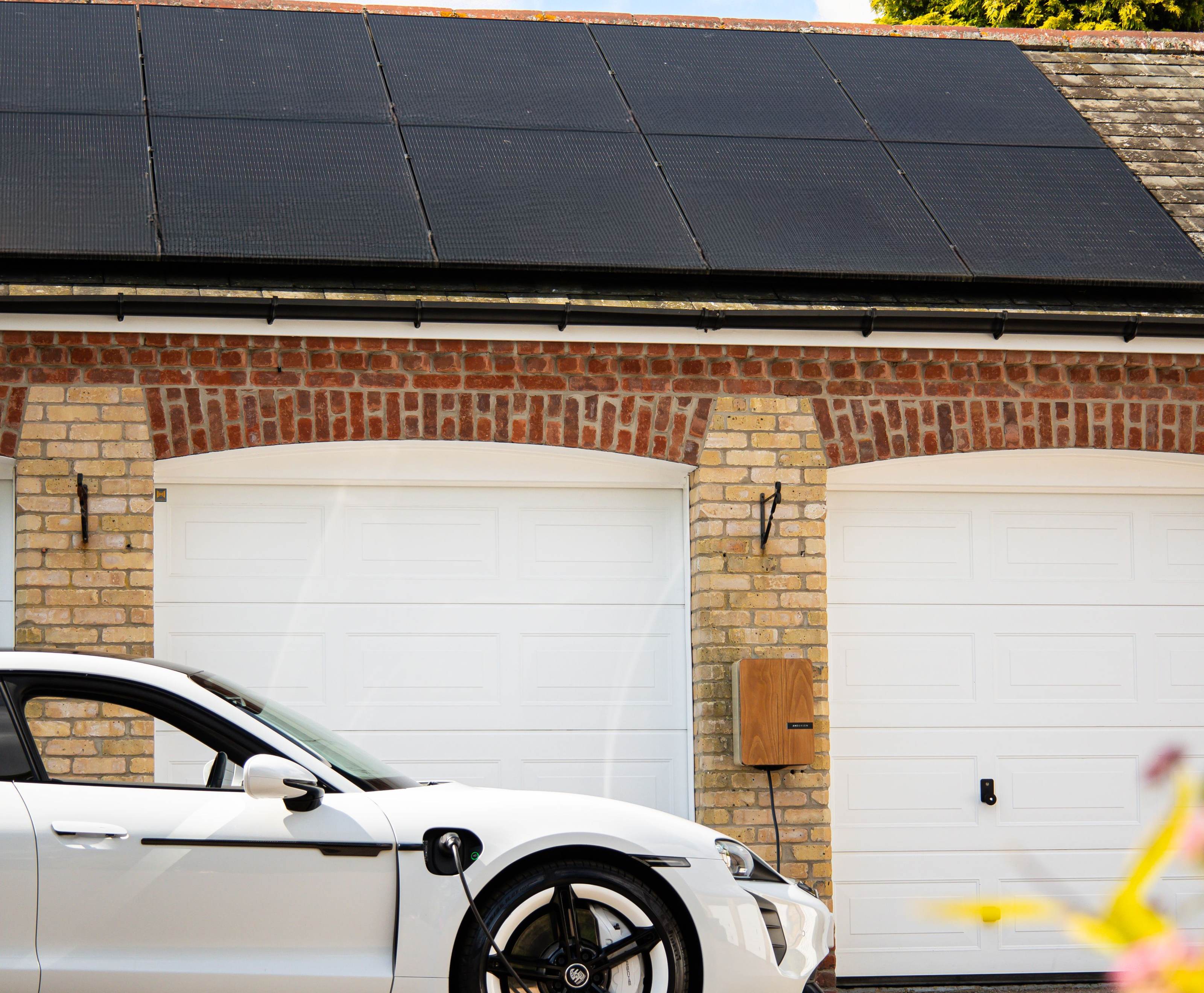
Ask whether solar can charge an EV off-grid and you’ll get an unhelpful yes almost every time — panels don’t know or care what they’re feeding, and a car charger is just another AC load, same as a water heater or a table saw. That’s the wrong question anyway. The one that actually decides whether the system works is narrower: does a day of sun make more energy than the car needs, delivered at a rate the rest of the house can survive at the same time? Those are two different problems, and every off-grid EV setup lives or dies on the second one, not the first.
Picture the scenario most people actually mean by “charging the car off-grid”: plug in near-empty at night, wake up to a full battery. A typical EV pack holds 60–100kWh usable, so filling one from around 10% pulls something like 65–90kWh out of the wall once charging losses are counted. A well-built off-grid home’s entire array, on an average day, often produces less than that — for the whole house, for 24 hours, not just the car. The “fill the tank” mental model that works fine at a gas station, or even at a grid-tied Level 2 charger backed by a utility transformer, quietly falls apart off-grid, because nothing is standing behind the plug to smooth over the gap. What replaces it is a daily-budget model, and that’s what the rest of this guide sizes.
The Real Math: One Charge vs. a Day of Solar
Two numbers decide almost everything here, and both come from the same load-audit thinking that sizes any other off-grid circuit — an EV is just one very large, very predictable appliance.
Key formula
Daily solar harvest = array size (kW, STC) × peak sun hours × system derate (0.75–0.80).
Daily EV energy need = miles driven per day × vehicle efficiency (kWh per mile).
Take a common off-grid setup — a 6kW array, a site averaging 4.5 peak sun hours, a realistic 0.77 derate for wiring, temperature and inverter losses — and the math is 6 × 4.5 × 0.77, or about 21kWh a day. That single number is the whole household’s energy budget: fridge, well pump, lights, everything a proper load audit already counted, plus whatever’s left over for the car.
Vehicle efficiency swings by class more than most shoppers expect, and it drives every number that follows.
| Vehicle class | Typical efficiency | Energy for a 37-mile day |
|---|---|---|
| Efficient sedan (Ioniq 6, Model 3 RWD) | 0.24–0.26 kWh/mi | ~9 kWh |
| Midsize crossover (Model Y, Ioniq 5, Equinox EV) | 0.28–0.32 kWh/mi | ~11 kWh |
| Full-size SUV | 0.35–0.42 kWh/mi | ~14 kWh |
| Electric truck (F-150 Lightning, Rivian R1T) | 0.45–0.55 kWh/mi | ~18 kWh |
Thirty-seven miles is roughly the US average day behind the wheel (Federal Highway Administration annual-mileage data, divided out). Against the 21kWh/day array above, the sedan and crossover rows are a genuinely modest add-on — call it half again the house’s own load. The truck row is a different story: 18kWh a day is nearly as much as the rest of the house put together, and that’s before anyone’s touched a full battery fill.
Key number
A near-empty-to-full charge on a 75kWh pack pulls roughly 75–85kWh from the wall once charging losses are counted — more than a 6kW array’s entire day of harvest, with nothing left for the house. Off-grid, that one-shot “fill-up” almost never happens in a single day; it happens as a top-up spread across several days of ordinary driving, which is exactly why the daily-need number above — not the pack size printed on the window sticker — is what actually sizes the system.
L1 vs L2 Off-Grid: Why Slower Often Wins
Grid-tied, the whole conversation is how fast you can charge — Level 2 exists because the utility can deliver whatever a transformer allows and the grid absorbs the spike without blinking. Off-grid, nothing is absorbing anything on your behalf; every watt the charger asks for comes straight out of the inverter, the battery or the array, in that exact instant. That flips the usual advice on its head: the charging rate that fits an off-grid system best is often the slowest one that still gets the car charged before it’s needed again, not the fastest one the hardware happens to support.
| Charge level | Typical rate | Hours to add 11kWh (avg. commute) |
|---|---|---|
| Level 1 (120V, 12–16A) | 1.4–1.9kW | 6–8 hrs |
| Level 2, US home, dialed down (16–24A) | 3.8–5.8kW | 2–3 hrs |
| Level 2, US home, full rate (30–48A) | 7.2–11.5kW | ~1–1.5 hrs |
| Level 2, European wallbox, single-phase | 3.7–7.4kW | 1.5–3 hrs |
| Level 2, European wallbox, three-phase | up to ~11kW | ~1 hr |
Full-rate Level 2 asking for 7–11kW continuous is, on a modest off-grid system, most of the entire inverter’s rated output — the same continuous-versus-surge ceiling that sizes every other off-grid circuit (see the inverter/charger sizing guide) now has to survive an EV plugged in on top of the fridge, the well pump and whatever else is running. A small system built around a 4–6kW-continuous inverter never signed up for that fight.
Two fixes, roughly in order of how little they cost:
- Dial the charger down. Nearly every EV and every decent Level 2 unit lets you cap the amperage in the car’s app or the charger’s own settings — pulling a 48A charger down to 16–24A turns Level 2’s convenience (the plug, the cable, the dashboard readout) into Level-1-scale power draw, with no new hardware.
- Charge on the sun’s schedule, not the driveway’s. Plugging in the moment you get home means charging straight off the battery, all night, with zero solar contribution — one of the most avoidable hits to an off-grid bank’s cycle life. A delayed-start timer for late morning through mid-afternoon lets the array carry some or all of the load directly, the same reason a well pump or a laundry load gets scheduled around midday on a well-run off-grid property.
When an EV Forces You to Upsize
Sometimes dialing down the amps and moving the schedule is enough on its own. Sometimes the daily-kWh math above makes it obvious the existing system was never built for this, and pretending otherwise just means a battery cycled too deep, too often, for the shortest possible lifespan. Here’s the line worth drawing before you plug in, not after the cycle count tells you: if the EV’s daily energy need is more than roughly 40–50% of the household’s existing daily load, plan the upsize as its own project rather than an afterthought.
| Component | House only | House + 37-mile daily commute |
|---|---|---|
| Daily load | 9 kWh | 20 kWh |
| Array (4.5 sun hrs, 0.77 derate) | ~2.6kW, round to 3kW | ~5.8kW, round to 6kW |
| Battery (2-day autonomy, LiFePO4 at 90% usable) | 20kWh nameplate | 44kWh nameplate |
| Inverter, continuous | 4–5kW class covers the house peak | 8–10kW class, once a dialed-down charger stacks on the house peak |
That 9kWh/day, 2-day-autonomy baseline is the same worked example the battery-bank sizing guide uses for a house alone — add a midsize crossover’s average commute and the array and battery both climb hard, from a 20kWh nameplate bank to 44kWh. The inverter line is the one people miss, because it isn’t sized by kWh at all: it’s sized by the worst moment the well pump, the fridge compressor and a charging EV all land at once, which is exactly the continuous-and-surge math the inverter guide walks through step by step. Run your own numbers through the solar sizing calculator and the battery-bank calculator, entering the EV as its own line item rather than folding it into “household load” and losing track of what’s actually driving the total.
Three Ways to Avoid a Full Rebuild
- Amp-limit the charger first. The cheapest lever by far, and often enough on its own for anything short of a long daily commute.
- Shift the charge window to the solar peak. Converts what would be overnight, grid-style charging into something closer to direct solar-to-car power, cutting how much of every session has to round-trip through the house battery at all.
- Give the car its own small subsystem. A dedicated array-and-battery pair, sized just for the commute and wired so it never competes with the house circuit for inverter headroom. Treat it as a second, smaller off-grid system rather than folding the math into the first one.
Charger & battery picks, priced for your region
Whichever route fits — a dialed-down existing charger, a dedicated EV subsystem, or a straight upsize of the array and bank — the hardware that makes it work is priced and stocked differently on each side of the Atlantic:
Can an EV charge directly from solar panels with no battery in between?
Technically yes, with a charge controller or diverter that only draws power in step with real-time panel output — but it only works while the sun is actually up, and stalls the moment a cloud passes over. Most off-grid setups still route EV charging through the battery so the session doesn’t depend on the weather holding still for hours at a stretch.
How many solar panels does it take to charge an EV every day?
It depends entirely on daily miles, not the car’s badge. At 0.30kWh/mile and a 37-mile average day (about 11kWh), and a single 400W panel producing roughly 1.4kWh a day at 4.5 sun hours, that’s around 8 extra panels dedicated to the commute alone — on top of whatever the house already needs before the car is added.
Is Level 1 charging actually fast enough for daily driving off-grid?
For most commutes, yes. Held for 8–10 daylight hours, 1.4–1.9kW delivers 11–19kWh, which comfortably covers the US average driving day. It stops being enough once daily miles climb into truck-and-long-commute territory, where a dialed-down Level 2 — not full-rate — is the more realistic pairing.
Does cold weather change these numbers?
Significantly. EV efficiency typically drops 20–40% in freezing temperatures — cabin heating, battery conditioning and denser air all take a cut — which can push an 11kWh commute to 15–18kWh right as short winter days cut solar harvest at the same time. An off-grid EV system sized only on mild-weather numbers is the one that comes up short in January.