


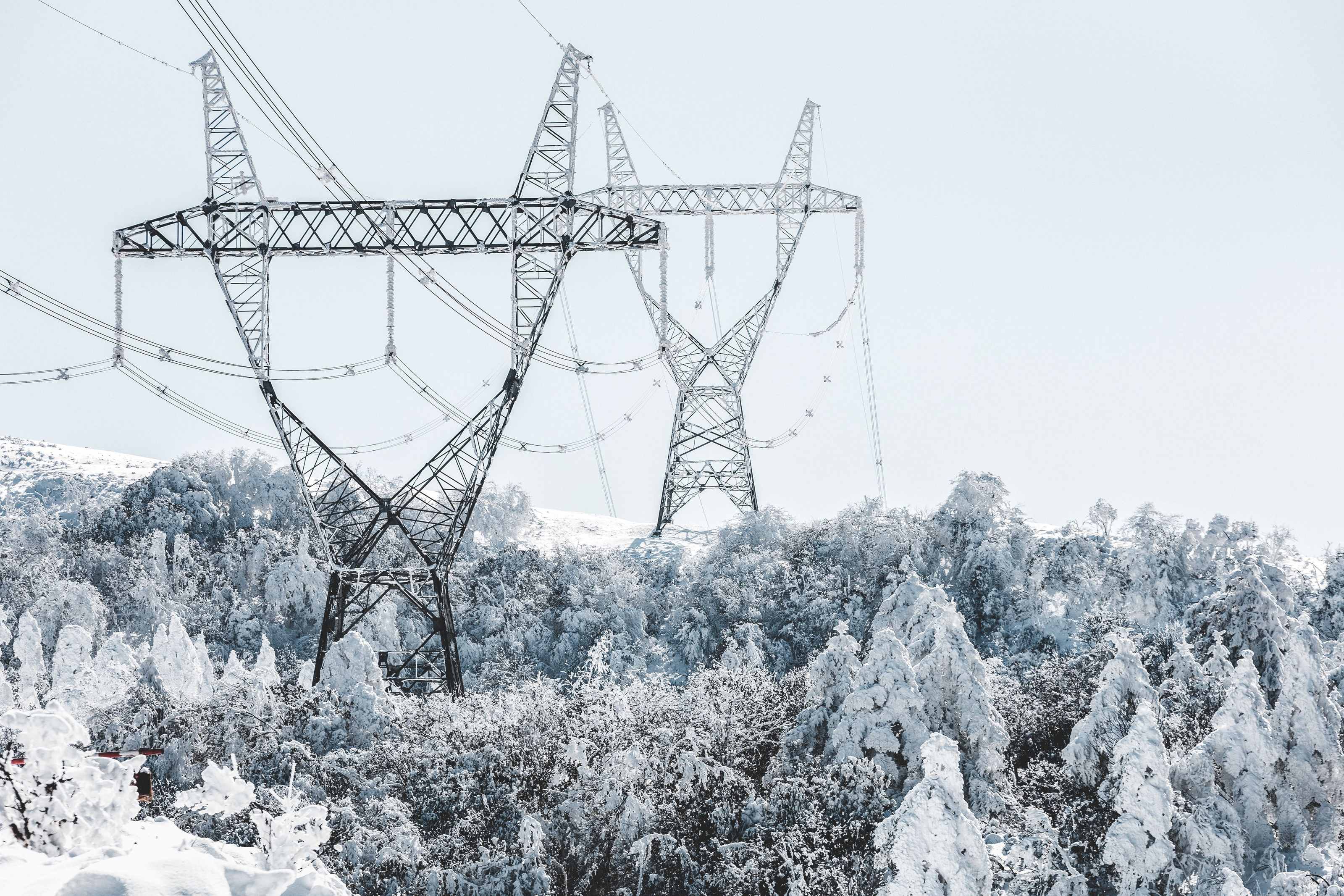
At 1:20 in the morning on February 15, 2021, the frequency on the Texas grid was sliding toward 59.4 hertz — the point at which power plants across the state are wired to automatically disconnect themselves rather than be damaged by an unstable grid. Every plant that trips off forces the remaining ones to carry more load, which drags the frequency down further, which trips more plants. It's a death spiral, and by ERCOT's own later account, the Texas grid was minutes — some published accounts say well under ten — from riding that spiral into a total, uncontrolled, statewide blackout. Not a bad week. A blackout that takes weeks or months to recover from, because restarting a grid from zero needs working power plants to make the electricity that starts the next power plant, and Texas isn't wired into its neighbors' grids to borrow a jump-start.
Grid operators shed 20,000 megawatts of load in the next few minutes to stop it — the largest manually ordered blackout in US history. It worked. That's the part of Winter Storm Uri most people never heard: the outage everyone remembers, the one that left more than 4.5 million Texas homes and businesses without power for up to four days, was ERCOT's controlled save. The uncontrolled version was worse, and it was minutes away.
More than 11 million Texans experienced an outage of some length that week. Officially, 246 people died — hypothermia, carbon monoxide, house fires lit for warmth, medical equipment with nowhere to plug in. Researchers who later compared the week's death count against a normal February put the real toll closer to 700. Some of those houses had no way to know a storm this size was coming. Others knew, and froze anyway, because "backup power" meant a flashlight and a full tank of gas in the car. A few houses never lost a heartbeat. The difference between those outcomes is the whole subject of this article.
The three layers of backup power — and which one actually held
Ask someone what "backup power" means and most describe one thing: a generator. Uri is a better teacher than that, because it ran three different kinds of household through the same four days and let you watch, in real time, which layer actually held.
| Layer | What it actually is | What it bought a Uri household | Where it broke |
|---|---|---|---|
| 1. Passive resilience | Insulation, pipe wrap, thermal mass, a fireplace — whatever traps heat already in the house | Hours to about a day of borrowed time before pipes freeze or the house equalizes with outside | It slows the clock, it doesn't stop it — and Uri's clock ran for four days |
| 2. Reactive backup | Whatever you scrambled for at 2am: a car run in the garage for heat, a borrowed generator, a camp stove | Warmth or charge for a few hours, at the cost of a decision made in the dark, in a crisis, usually for the first time | Carbon monoxide. This is the layer that also killed people. |
| 3. Installed automatic backup | A standby generator on an automatic transfer switch, or a home battery, sized and installed before the storm | Power within seconds of the outage starting, with zero decisions required from anyone asleep in the house | Only if it was undersized, unfueled, or never installed at all |
Layer 1 is what every house has by default, and it's genuinely useful — a well-insulated house with the curtains shut and interior doors closed can coast for the better part of a day before pipes are at real risk. But Uri's worst outages didn't run for an afternoon; some ran past 70 hours, and no amount of blankets turns a house with no heat source into one that survives three straight nights in the teens.
Layer 2 is also the layer that killed people
When Layer 1 ran out and Layer 3 didn't exist, people improvised — and Texas poison control centers logged a sharp spike in carbon monoxide exposure calls that week, with multiple deaths attributed directly to it. The pattern was almost always the same: a generator running in a garage or too close to a window, or a car left idling in an attached garage for heat — both of which can fill an enclosed space with lethal carbon monoxide in under an hour, often before anyone smells anything wrong, because CO has no smell at all. A generator is a legitimate Layer 2 tool if you already own one, already know how to run it, and run it correctly: 20 feet from the house, exhaust pointed away, never in a garage with the door cracked "for ventilation." The people who died running one indoors weren't careless; they were cold, scared, and improvising a solution they'd never had to think through before. That's the real case for Layer 3 — it removes the 2am decision entirely. A standby generator on an automatic transfer switch senses the outage and starts itself, typically within 10–30 seconds, with nobody touching anything. A home battery is already live and picks up the load in under a second, because there's no start-up at all.
Key number
ERCOT's overall winter reserve margin looks comfortable on paper heading into 2026. The number that matters more for a Uri repeat is dispatchable capacity — generation that shows up on demand regardless of weather — which per ERCOT's own Monthly Outlook for Resource Adequacy makes up only about 57% of the installed winter fleet. The rest leans on solar, wind and batteries: exactly the resources a windless, sun-starved, multi-day freeze can't count on.
It isn't a 2021 problem. It's a thinner margin in 2026.
The comfortable read on Uri, five winters on, is "that was a freak event and Texas fixed it." Partly true: the legislature mandated weatherization for power plants and gas infrastructure after Uri, and real work got done. But weatherization and reserve margin are two different numbers, and only one of them has been trending the right direction. Texas has added roughly 31 gigawatts of solar, 17 gigawatts of battery storage and 11 gigawatts of wind to the grid since Uri — genuinely enormous growth — against only about 3 gigawatts of new natural gas generation. That's a huge amount of new capacity on paper, and it helps enormously on a hot July afternoon or a mild, sunny January day. It helps far less on a windless, sun-starved, multi-day February freeze — exactly the scenario Uri was, and exactly the one solar and short-duration batteries are worst-suited to answer, because there's no sun to make solar power and no clear sky to recharge a battery from it.
The grid held through a serious cold snap this past January, and the new generation deserves real credit for that. But "it held this time" and "the margin is safe" are different claims — ERCOT's own winter risk assessments still carry a real, non-zero probability of emergency alerts and controlled outages in a bad enough freeze. A near miss that keeps not repeating isn't the same thing as a risk that's gone away; it's five winters of a coin that hasn't landed the same way twice. Betting your family's safety on that streak continuing isn't a backup plan.
Power wasn't even the whole story. Uri knocked treatment plants offline and burst pipes badly enough that an estimated 12–15 million Texans were placed under boil-water notices at some point that week — nearly half the state, from a storm that was fundamentally about electricity. Water, heat and communications all quietly depend on the same grid. Losing power for four days doesn't just mean a cold house. It can mean the tap water isn't safe to drink either.
What would have actually kept your house running
Run the four-day Uri outage against real hardware instead of hope, and the numbers are straightforward. A whole-home standby generator on a 500-gallon propane tank — filled to the usual 80% safety line, so 400 usable gallons — burns roughly 1.5–2 gallons an hour under a realistic household load, which works out to somewhere around 8–12 days of continuous run time. Uri's worst outages ran about four days. A properly sized, properly fueled standby generator doesn't just cover a Uri-length event; it covers one twice as long, with days to spare.
A home battery tells a different story here, worth knowing before you buy one as your only line of defense. A Powerwall-class unit holds roughly 13.5 kWh usable; curated down to the circuits that actually matter — heat source, some lighting, a well or sump pump, wifi, phone charging — that's a day to a day and a half per unit before it's empty. Normally a battery refills for free every day once solar starts producing again. Uri's problem was that there wasn't meaningfully any sun for days on end, under thick cloud cover and snow-covered panels. A battery is an excellent Layer 3 for the outages that are actually common: an hour here, an afternoon there, a blink during a summer thunderstorm. For the specific, low-probability, high-consequence event Uri represents, it wants a generator behind it — or a much larger bank sized for multiple sunless days, which is a bigger and more expensive system than most households install. We've written up the full generator-vs-battery decision, sizing tiers included, separately; the short version for Texas winter risk is that the two aren't competitors — a generator covers the tail event a battery alone is a poor fit for.
Either path starts with the same number: your household's actual critical-load draw, not a generator's kW rating or a battery's kWh rating taken in isolation. If you haven't sized that yet, this walks through it in Generac-class sizing tiers, or run it directly through the backup power sizing calculator.
- Know your critical-load number before the forecast turns, not during it — sizing takes five minutes with a clear head and considerably longer in a panic.
- If Layer 3 isn't installed yet, get Layer 2 right: decide the generator's location now, put battery-backed CO detectors on every level, and never run combustion equipment in a garage or covered space.
- Fill the propane tank, or confirm the gas line, before the season's first freeze warning — not after, when every installer in the state has the same waiting list.
- Treat a grid that "hasn't had a bad one since 2021" the way you'd treat a smoke detector that hasn't gone off — working, hopefully, but not something you find out for certain until the fire.
Common questions
Could Winter Storm Uri happen again in 2026?
The specific weather is unpredictable, but the grid vulnerability that turned a cold snap into a near-catastrophe is arguably less improved than most people assume. ERCOT's overall reserve margin looks comfortable on paper, but only about 57% of the installed winter fleet is dispatchable capacity that shows up regardless of weather, per ERCOT's own Monthly Outlook for Resource Adequacy — and the generation added since Uri is heavily weighted toward solar and short-duration storage, capacity that helps far less during a multi-day, sun-starved freeze than it does on an ordinary day.
Would a portable generator have been enough during Uri?
For a household that already owned one, knew how to run it safely, and had fuel on hand, a portable generator covered the essentials — a fridge, some lighting, a space heater in one room. It's a real Layer 2 tool. The risk is entirely in the "improvised at 2am" part: Texas poison control centers logged a spike in carbon monoxide calls that week from generators and vehicles run in enclosed spaces, which is why a permanently installed unit on an automatic transfer switch, sited correctly before the storm, is the safer version of the same idea.
Is a home battery enough backup for a Texas winter storm?
For most outages, yes — batteries handle the common case very well, especially with solar recharging them daily. For a Uri-length, multi-day, low-sun event specifically, a single battery typically runs a curated critical load for a day to a day and a half before it needs a recharge it can't get. Pairing it with a generator, or oversizing the bank well beyond a typical residential install, is what closes that gap.
What size standby generator do I need for whole-home backup in Texas?
Most single-family homes land in the 14–22kW range on natural gas or propane, sized against actual critical-load draw rather than guessed from square footage. A well pump is usually what pushes a home toward the higher end of that range or beyond it: its running draw is modest, but its motor-start surge — roughly 3–6× running watts for a second or two — stacks on top of an electric heat strip or a large HVAC system running at the same time.