


The short answer
A Carrington-scale storm is a very long outage rather than a gadget-killer. Induced currents build voltage along hundreds of kilometers of transmission line, saturate transformer cores, and either collapse voltage or cook windings. Nothing in a house is exposed — 8 V/km across 100 m of wiring is 0.8 V. Build weeks of autonomy, and skip the Faraday cages.
For two days at the start of September 1859, the only electrical infrastructure humanity owned began behaving like a haunted house. Sparks jumped off telegraph wires. Operators took shocks from their keys.
Across North America, Europe and parts of Australia and Asia, the network stopped carrying traffic. Lloyd's and Atmospheric and Environmental Research, reviewing it in 2013, ranked the storm the most extreme on record — the only one in the top five by all four measures of strength at once.
That was copper on wooden poles. The interesting question is what the same sun does to a grid of 765 kV lines and transformers the size of a delivery truck. The answer is stranger than the folklore, and has almost nothing to do with your laptop.
Key number
Lloyd's and AER put the mid-point return period for a Carrington-level storm at 150 years, range 100 to 250. Their North American scenario puts 20 to 40 million people at risk of an outage lasting 16 days to one or two years, depending almost entirely on how many spare transformers exist.
The chain that runs from a sunspot to a substation
A solar storm does not reach down and touch your wiring. It works through four handoffs, each changing the units.
Start with the handoff people get wrong. What a geomagnetic storm creates at ground level is not a voltage. It is a voltage per kilometer — an electric field lying flat across the landscape, pointing one way and then another as the storm rolls. Multiply it by the length of a conductor and you get volts, and that one multiplication explains everything that follows.
North American planners must test their networks against a benchmark field of 8 volts per kilometer, scaled for local latitude and ground conductivity, under NERC reliability standard TPL-007-4, with a localized supplemental event of 12 V/km alongside it. Both come from statistical analysis of historical magnetometer records.
A transmission line is grounded at both ends, through a transformer neutral at each substation. Line at the top, earth at the bottom, windings joining them: a closed loop, hundreds of kilometers around. The storm's field drives a slow, near-direct current around it — a geomagnetically induced current, or GIC.
Free calculator
Backup Power Calculator
Pick the circuits you keep alive and get generator kW, battery kWh and transfer-switch amps. Live, free, no sign-up — and the result becomes a brief you can buy against.
Why a transformer hates direct current
A power transformer is built for alternating current and nothing else. Its core is sized so the magnetic flux swings symmetrically, sixty or fifty times a second, and never runs out of iron to swing into.
Push a few amps of DC through the neutral and the symmetry breaks. On one half of every cycle the core runs out of headroom and saturates. NOAA puts it plainly: the transformer "no longer provides any back electromotive force," and the currents become abnormally large.
Three problems come out of those spikes, in order.
Reactive power. Every saturating transformer looks to the network like a sudden inductive load. Multiply that across a region and the grid can no longer hold its voltages up. That is voltage collapse, and it needs no broken equipment at all.
Harmonics. The distorted current is no longer a clean 50 or 60 Hz wave. Protective relays read harmonics as a fault and open breakers that had nothing wrong with them. The Royal Academy of Engineering names exactly this as the cause of both the Quebec blackout of 1989 and the Malmö blackout of 2003.
Heat. Stray flux escapes the saturated core into metal never designed to carry it: the winding hot spot, the tie plates. Lloyd's and AER model that against the IEEE guideline of 180°C. Above it, a transformer is a candidate for failure. Below it, the insulation ages faster and the machine quietly loses years of life.
Voltage collapse turns the lights off for hours. Cooked transformers turn them off for months, because they are custom-built and no warehouse keeps an aisle of them.
Four storms that left physical evidence
None of this is modeling. Each one left damage or a blackout in the record.
| Event | What it did | Source |
|---|---|---|
| Aug–Sep 1859 Carrington | Sparks along telegraph wires, operators shocked, the network inoperable across North America, Europe, Australia and parts of Asia. Cloud transit from flare to storm onset: 17.6 hours. Aurora visible down to 18° corrected geomagnetic latitude, near Panama. | Lloyd's / AER, 2013 |
| May 1921 | A telephone exchange in central Sweden badly damaged by a fire started by induced currents. | Royal Academy of Engineering, 2013 |
| 13 Mar 1989 Quebec | Dst reached −589 nT, the strongest since indices began in 1932. Harmonics tripped several static VAR compensators and the Hydro-Québec grid went down in less than two minutes. Over six million people lost power for nine hours. Two transformers damaged, plus permanent damage to a generator step-up transformer at a New Jersey nuclear station. Over 200 grid problems appeared across the United States within minutes. | Lloyd's / AER, 2013; NASA |
| Oct 2003 Halloween | Sweden lost power for under an hour across roughly 50,000 customers, from harmonic distortion meeting badly set relay thresholds. Twelve transformers in South Africa were damaged badly enough to be pulled from service — at about 40° corrected geomagnetic latitude, roughly Florida's, a band usually assumed to be out of range. | Lloyd's / AER, 2013 |
| May 2024 Gannon | Reached G5, the top of NOAA's geomagnetic storm scale, and the first G5 since 2003. Aurora reached the southern United States and northern India, as low as 26° magnetic latitude. No transformer losses reported. | NASA |
The South African line is the one worth sitting with. Low magnetic latitude was the standard reassurance for half the planet, and a storm well short of Carrington cooked a dozen transformers anyway.
The 2024 entry is there to break a habit. G5 is the top of the NOAA scale, but the scale tops out well below Carrington: NOAA puts G5 conditions at roughly four days per eleven-year solar cycle. A G5 headline is not the rare event. The rare event has no rung left to stand on.
The odds, and why nobody agrees on them
Four serious attempts, four methods, a spread of nearly an order of magnitude. That spread is the state of the science.
| Study | Method | Result |
|---|---|---|
| Riley, Space Weather, 2012 | Power-law fit to storm severity, Carrington defined as Dst below −850 nT | About 12% in the next decade |
| Lloyd's / AER, 2013 | Historical auroral catalogs, back to Roman and medieval records | Return period 150 years (range 100–250) for Carrington-level; 50 years (range 35–70) for Quebec-level |
| Royal Academy of Engineering, 2013 | Survey of contemporary expert view | Carrington-level within 250 years at about 95% confidence; within 50 years at about 50% |
| Moriña and colleagues, Scientific Reports, 2019 | Counting process with Weibull gaps between storms | 0.46% to 1.88% in the next decade, 95% confidence |
A once-in-150-years hazard is not a distant one. Lloyd's puts it in the bracket of a large earthquake or an explosive volcanic eruption, and nobody calls earthquake cover paranoid.
What a storm costs depends less on its size than on where its worst hours land. Damage spread thin gets patched; damage concentrated does not.
Lloyd's and AER weighted their North American risk map by population and found the highest exposure along the corridor between Washington, D.C. and New York City, with the Midwest and the Gulf Coast behind it.
Their headline scenario: 20 to 40 million people facing outages of 16 days to one or two years, at a cost of $0.6 to $2.6 trillion. A storm merely stronger than 1989 might damage only 10 to 20 transformers, which matters little unless they all serve one dense place.
Lead times on new units run five to twelve months domestically.
Britain's reasonable worst case, modeled by National Grid for the Royal Academy of Engineering and treated there as a one-in-100-year event, is narrower. Around six supergrid transformers in England and Wales and seven more in Scotland could be damaged and taken out of service.
Because most nodes carry more than one transformer, National Grid's analysis puts the disconnections at roughly two nodes nationwide, and the expected public effect at local interruptions of a few hours.
That count sits inside National Grid's existing spares policy. Emergency replacement, when a spare exists, normally takes 8 to 16 weeks; the record is four. Nordic latitudes carry more exposure than southern ones.
The mitigation that already happened while nobody watched
The part that never makes the documentaries: the grid did not sit still.
- Canada put about $1.2 billion — roughly $34 a head — into hardening the Hydro-Québec network, largely neutral blocking capacitors that stop induced current entering a transformer.
- Lloyd's costs a blocking capacitor at around $100,000, and the thousand most vulnerable North American transformers at about $100 million — rounding error against a trillion-dollar scenario.
- Relay thresholds have been reworked so storm harmonics no longer read as faults — the specific failure in both Quebec and Malmö.
- North American planning coordinators now assess geomagnetic vulnerability against that 8 V/km benchmark at least once every 60 months, under a mandatory standard rather than a voluntary one.
- Satellites watching the sun flag an incoming cloud hours to days ahead, which is enough time to raise reactive reserves and delay maintenance. Whether it will actually hurt is a later answer: the field strength and orientation that decide severity are only measured 15 to 30 minutes out, per Lloyd's and AER.
None of that makes a Carrington-level storm painless. It does mean the range runs from a bad week in some regions to the Lloyd's tail case, and the tail case is not the base case.
The myths worth dropping before you spend money
Do the multiplication yourself and most of the internet's advice here falls over.
Take the benchmark 8 volts per kilometer and apply it to the longest run of wire in a normal house — 100 meters, generously. That is 0.1 km, so the induced voltage is 8 × 0.1 = 0.8 V. Less than an AA battery. Apply the same field to 300 km of transmission line and you get 8 × 300 = 2,400 V, driving current round a loop with almost no resistance.
The hazard scales with conductor length, brutally. The exposed assets are transmission lines, long pipelines, undersea cables and railway signaling circuits — and nothing you own is on that list.
- "A solar storm fries every chip on Earth." It does not. A geomagnetic storm couples into kilometers of conductor, never centimeters. Nuclear electromagnetic pulse is a different hazard with a fast component that can reach short conductors, which is why the Royal Academy of Engineering left it out of its space weather report. Two physics, one word doing double duty.
- "Put your inverter in a Faraday cage." A metal box does nothing about a slow field driving current through a grounded network hundreds of kilometers long, and your inverter is not on one.
- "There will be no warning." There is warning, of a limited kind. The flare's light arrives in about eight minutes; the cloud that causes the geomagnetic storm follows 14.6 hours to three days behind it. What arrives late is the useful part, since how bad the storm will be is only readable 15 to 30 minutes ahead.
- "The whole continent goes dark for a decade." The credible modeling says concentrated regional damage and very uneven restoration. Some places see hours, some months, and which one you get turns on local transmission topology.
What an off-grid house actually needs for this
For a household this is not an equipment-destruction scenario. It is an unusually long outage, and every piece of gear that answers a two-week ice storm answers this one too. That is what makes the spending defensible: nothing on the list is bought for the solar storm alone.
One thing does need checking, and most solar owners have it wrong. A grid-tied inverter without islanding capability shuts down the moment the grid dies — anti-islanding, IEEE 1547 in North America and EN 50549 in Europe — so it cannot energize a line a repair crew is holding. A roof full of panels is not backup power unless the inverter can run the house alone.
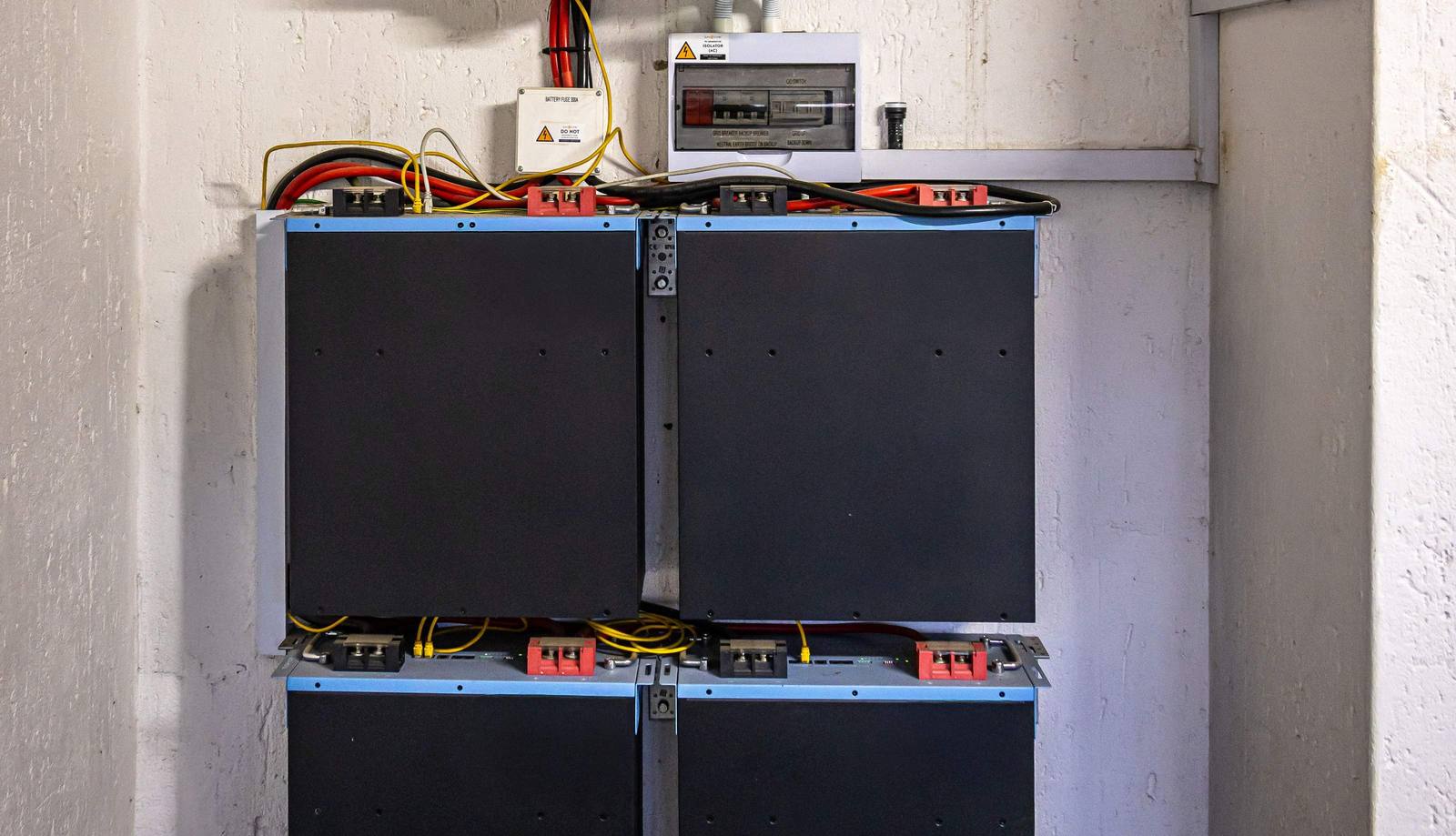
After that it is a sizing exercise, and the sizing is the whole job. Work out the daily kilowatt-hours of the circuits you would genuinely keep alive, then decide how many days of that you want with no grid at all. Our backup power calculator runs it against real battery and generator capacities, and tells you whether your setup buys two days or two weeks.
- Islanding. Confirm the inverter runs without the grid, and that the critical loads panel is wired to it.
- Think in days. Size autonomy in days of your curated critical load, then think about recharging. Solar keeps working through a geomagnetic storm, and that turns a fixed battery into an indefinite one.
- Fuel that keeps. Propane stores indefinitely; gasoline degrades in months without treatment. Grid-down also means the pumps at the filling station are dead.
- Water. A well pump is an electric appliance. Storage plus a manual or DC backup is the difference between inconvenience and evacuation.
- Spares nobody sells mid-outage. Charge controller, the right fuses, a second inverter if yours is a single point of failure.
- The freezer. The first thing a long outage costs most households is food, and that clock starts within hours.
Practical US numbers: a 500-gallon propane tank filled to the standard 80% line holds 400 usable gallons — weeks of intermittent generator running. Service is 120/240 V split-phase, so check any backup source feeds both halves of the panel, or the well pump and dryer stay dead. Regional exposure is mapped in power outage risk by state.
Practical European numbers: domestic LPG comes in 13 kg or 47 kg bottles rather than a bulk tank, so plan bottle count, and an exchange depot needs power too. Service is 230 V single-phase, or 400 V three-phase in much of the continent, which needs a transfer arrangement handling all three. Country records sit in the Europe outage and blackout atlas.
For what a long grid-down period does to a household day by day, see what breaks during a week without the grid. For the ordinary version of the machine, start with how the grid works and why it fails.
Common questions
Would a Carrington-level storm really damage transformers, or just trip breakers?
Both, by separate mechanisms. Relays tripping on harmonics causes blackouts within minutes and does no lasting harm, as in Quebec in 1989 and Malmö in 2003. Internal heating is the slow one: stray flux cooks the windings and tie plates, which Lloyd's models against the IEEE guideline of 180°C. Above it, a transformer becomes a replacement, and those take months.
Do I need to shield my inverter, batteries or generator?
No. The induced field is measured in volts per kilometer, so it only builds meaningful voltage across very long conductors — across a house, well under a volt. Shielding is a nuclear electromagnetic pulse idea that got attached to solar storms because both get called "EMP" casually. Different physics, different targets.
How much warning would there be?
Hours to days. The flare is visible in about eight minutes, but the coronal mass ejection that drives the storm is far slower — 17.6 hours at Carrington speeds, 14.6 hours for the fastest transit on record, in August 1972. Typical events take two to three days, and NOAA issues public storm watches inside that window.
Does off-grid solar keep working during a geomagnetic storm?
Yes. Panels, charge controllers and battery inverters are short-conductor devices, so the mechanism does not reach them. The only real question is whether the system can run islanded, which is a wiring choice rather than a space weather one.
Sources: NOAA Space Weather Prediction Center, storm scale and grid effects; NASA heliophysics, "The Day the Sun Brought Darkness" and the May 2024 Gannon storm; Lloyd's and Atmospheric and Environmental Research, "Solar Storm Risk to the North American Electric Grid," 2013; Royal Academy of Engineering, "Extreme space weather," 2013; NERC Reliability Standard TPL-007-4, Attachment 1; Riley, Space Weather, 2012; Moriña and colleagues, Scientific Reports, 2019.
Verified September 2026.