


The short answer
Most outages are local distribution faults fixed in hours. The rare ones are cascades: a line trips, its load shifts, protection opens the next, and a region islands. Under-frequency relays then drop pre-chosen feeders in a fraction of a second to save the rest. If that fails, a black start takes days. Size backup for the tail rather than the median.
Nothing is stored behind your wall socket. The electricity you are using was made in the last fraction of a second, by a machine spinning in step with every other machine on the continent, and it will be gone the instant you stop drawing it. The grid is not a reservoir. It is one rotating engine, thousands of miles across, held in balance every second of every day.
That design is why the lights are on almost all the time. It is also why, when it does go wrong, it can go wrong across eight states in under seven minutes.
Key number
Across Continental Europe the whole synchronous grid is meant to sit inside plus or minus 50 millihertz of 50.00 Hz — one twentieth of a single cycle per second, held across an area spanning some two dozen countries. The figure is set in Annex III of Commission Regulation (EU) 2017/1485, and it is the tightest routine tolerance in any machine you depend on.
Every generator on the grid turns in step
Alternating current does not flow one way. It reverses direction over and over, and the number of complete reversals per second is the grid's frequency. Every large generator on a synchronous grid turns at a speed locked to that frequency, so they are all effectively bolted to the same crankshaft.
Frequency is therefore the grid's tachometer, and it tells you instantly whether supply and demand match. Draw more than is being generated and the spinning machines are dragged down, so frequency falls. Generate more than is drawn and they speed up, so it rises. No meter reading is involved; the physics reports the imbalance directly.
North American grids run at a nominal 60 Hz, and little on the continent tolerates being far off it. In ERCOT, the Texas grid, protection lets plants disconnect themselves if frequency sits at or below 59.4 Hz for more than nine minutes, per the University of Texas at Austin Energy Institute's July 2021 review of the February 2021 blackouts.
European grids run at a nominal 50 Hz. Continental Europe, Great Britain, Ireland and the Nordic area are four separate synchronous islands, each with its own tolerance band, and each is bound by the same regulation to hold frequency inside it or explain why not.
| Synchronous area | Normal band | Worst momentary dip allowed | Back inside the band within |
|---|---|---|---|
| Continental Europe | ±50 mHz | 800 mHz | 15 minutes |
| Great Britain | ±200 mHz | 800 mHz | 15 minutes |
| Ireland & Northern Ireland | ±200 mHz | 1,000 mHz | 15 minutes |
| Nordic | ±100 mHz | 1,000 mHz | 15 minutes |
Annex III, Commission Regulation (EU) 2017/1485, which also sizes Continental Europe's reserves against a 3,000 MW reference incident.
Free calculator
Backup Power Calculator
Pick the circuits you keep alive and get generator kW, battery kWh and transfer-switch amps. Live, free, no sign-up — and the result becomes a brief you can buy against.
Inertia is the flywheel that buys the first seconds
When a big power station drops off, nothing human reacts in time. What reacts is mass. Every turbine and generator rotor already spinning is a flywheel storing kinetic energy, and the moment demand exceeds supply that energy is dragged out of them. They slow down, which is the same thing as frequency falling, and how fast they slow depends on how much spinning mass is connected.
Engineers call that the rate of change of frequency. Heavy thermal and hydro plant gives a gentle slope. A grid leaning on inverter-connected wind, solar and imports carries far less rotating mass, so the same loss makes frequency fall much faster.
Britain has a documented case. On 9 August 2019 a lightning strike on a transmission circuit was cleared normally, but within a second of each other the Hornsea offshore wind farm dropped 737 MW and a steam turbine at Little Barford dropped 244 MW. With about 150 MW of small generation that went with them, 1,131 MW vanished at once.
National Grid ESO's technical report found that parts of the system then saw a rate of change of frequency of 0.125 Hz per second or more. That is the trip setting on protection relays fitted to small embedded generators nationwide, and an estimated 350 MW of that generation duly took itself off, deepening the hole.
Four layers of defense, in the order they act
The grid has four safety nets, and they take over from one another as the seconds pass.
Inertia acts instantly and for free, because it is just physics. Frequency containment reserve is generation held back on purpose that ramps up as frequency droops; in Continental Europe half must arrive within 15 seconds of a 200 mHz deviation and all of it within 30 seconds.
Frequency restoration reserve then replaces it and pulls frequency back inside the band within 15 minutes. Load shedding is the fourth layer, and it works by taking customers off.
Transmission and distribution do completely different jobs
People say "the grid" as if it were one thing. It is two things wearing the same coat, and the difference decides how long your outage lasts.
In the United States, transmission runs at 115 kV to 765 kV, distribution feeders at roughly 4 kV to 35 kV, and the pole or pad transformer outside your house drops that to 120/240 V split-phase.
The Energy Information Administration's Electric Power Annual, table 11.1, puts the average US customer's total interruption in 2024, on the IEEE method, at 662.6 minutes including major event days and 131.6 minutes without them — about eleven hours in a storm-heavy year against a little over two hours of ordinary faults.
In Europe, transmission runs at 220 kV and 400 kV, medium-voltage distribution typically at 10 kV to 20 kV, and the street transformer drops that to 230/400 V three-phase. National regulators publish the same style of figures, and the pattern holds: a few severe outages sitting on a low background of local faults.
The lesson in those two numbers is the one most homeowners never hear. Nearly every time you lose power, the fault is a few streets away on the distribution network, and a crew fixes it in hours. The rare event that runs for days is a transmission or generation failure.
Push the domino
Transmission networks are built to a rule called N-1: whatever single component fails, the system must survive on what is left. It works, right up to the moment two things go at once, or one goes while something hidden was already broken.
The model below is a region leaning on four tie lines for part of its power. Trip what you like and watch what the survivors carry.
Cascade model
5,000 MW of load, 4,400 MW of local generation, 600 MW imported over four tie lines rated 200 MW each, sharing equally.
Ties in service
4 of 4Flow per tie
150 MWFrequency
60.00 / 50.00Customers dropped
0 MWEverything is inside its rating. Nobody notices anything.
A teaching model with round numbers. Real settings are fixed network by network.
Take one line out and the other three go from 150 MW to 200 MW each. That is exactly their rating, and exactly the point: the system was built to survive it. Take a second and the remaining pair is asked for 300 MW apiece, protection opens them, and the region becomes an island that cannot feed itself.
This is not a thought experiment. On 14 August 2003 three 345 kV lines in northern Ohio sagged into untrimmed trees between 15:05 and 15:41, while the control room's alarm software had been dead since 14:14.
The Sammis–Star line tripped at 16:05:57 on a relay reading overload, and in the four and a half minutes that followed, thirteen more 345 kV and 138 kV lines opened on the same kind of relay, northern Ohio separated from Pennsylvania, and 61,800 MW of load serving an estimated 50 million people went dark across eight states and Ontario.
Figures from the US–Canada Power System Outage Task Force's final report.
Load shedding is the grid saving itself by dropping you
When frequency keeps falling despite every reserve, the last defense is automatic and merciless. Relays across the distribution network watch frequency and disconnect whole feeders in pre-arranged blocks, on their own, in a fraction of a second. Nobody phones anybody. The point is to shed load faster than the shortfall can drag generators down to the speed where they trip themselves and everything goes black.
In ERCOT, under-frequency relays sit on transmission and distribution circuits, set to open at 59.3 Hz and drop up to 5% of a transmission operator's load in the first stage, with further stages below that. Distribution utilities must keep a quarter of their load on circuits carrying those relays. Settings per the University of Texas at Austin Energy Institute's July 2021 review.
In Europe the same job is called low frequency demand disconnection. Commission Regulation (EU) 2016/1388 obliges transmission-connected distribution operators to provide staged automatic disconnection across a frequency range of at least 47 to 50 Hz, adjustable in 0.05 Hz steps, operating within 150 milliseconds of the setpoint being crossed.
It works. When frequency in Britain fell through 48.8 Hz at 16:53:49 on 9 August 2019, the first block fired and disconnected 931 MW. The block is meant to be 5% of national demand; the relays actually reached 3.2%, and it was enough. Frequency stopped falling and was back at 50 Hz by 16:57:15.
The network operators counted 1,152,878 customers off, most of them back inside 45 minutes.
If you were one of the 1.1 million, your street was not unlucky. It was chosen in advance, by a relay setting, as the price of everyone else staying up.
Black start is the part that takes days
Load shedding buys the grid its life. When it fails, restarting is a different order of problem, because almost no power station can start without power. Boiler feed pumps, control systems, cooling and gas compressors all need electricity before they can make any.
So restoration begins with a few designated black start units — usually hydro, or gas turbines with their own diesel starting sets — that come up unaided. They energize a path to a larger station, which starts and energizes more path. Each step must match load to generation closely enough that the fragile island does not trip again, so customers return in blocks.
In 2003 that took four days in parts of the United States, and parts of Ontario ran rolling blackouts for over a week.
Texas in February 2021 shows the near miss: ERCOT's frequency bottomed at 59.302 Hz and sat below 59.4 Hz for four minutes and 23 seconds against a nine-minute limit, which the University of Texas review describes as leaving the grid within minutes of a complete blackout.
Load shed orders reached 20,000 MW. Had it gone black, restoration would have been measured in days, in a deep freeze.
Minutes, hours, or days: what this means for your house
It all collapses into one question: which failure are you preparing for, and how long does it last?
| What failed | How often | Typical duration | What carries you through |
|---|---|---|---|
| Local distribution fault: tree limb, blown fuse, animal, car into a pole | Roughly once or twice a year for the average customer | Minutes to a few hours | A battery or power station on a few circuits; you barely notice |
| Automatic under-frequency load shedding | Rare, and never announced | 15 minutes to a few hours | Anything with instant transfer; the grid comes back on its own |
| Rolling blackouts during a supply shortfall | Regional, in extreme heat or cold | Hours, repeated over days | Storage that recharges between rotations, or a generator |
| Storm damage to the distribution network | The main driver of the long tail | 1 to 7 days | Fuel or sun; a battery alone will not span it |
| Cascading failure and black start | Once in decades, per region | Several days, restored in blocks | Multi-day autonomy, water, heat, and a plan |
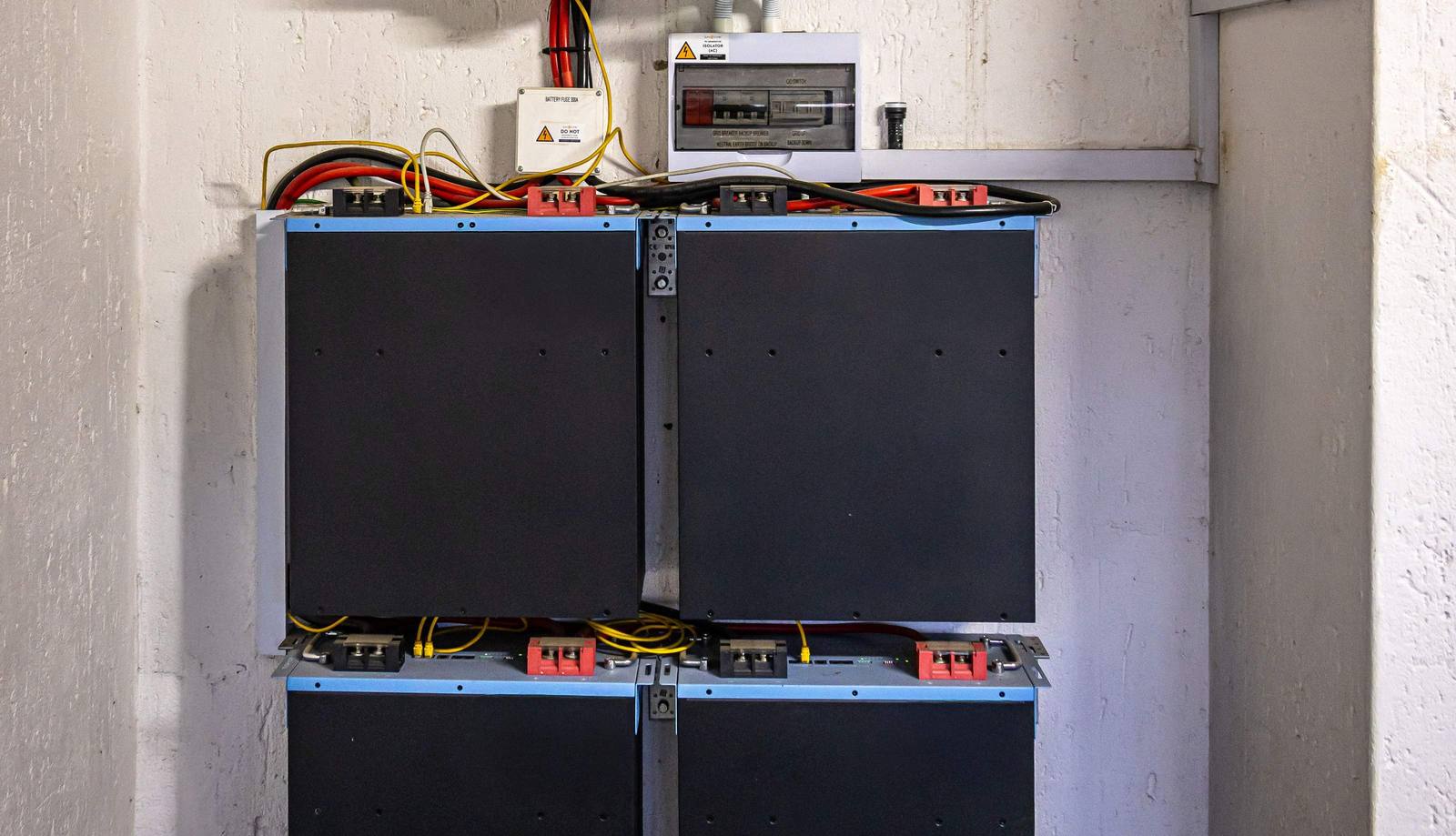
The common mistake is sizing for the common failure and then meeting the rare one. A single battery covers your fridge through a Tuesday feeder fault and runs flat halfway through a February ice storm. A generator with no fuel plan is a heavy ornament by day three.
Work it the other way round. Decide what must stay running, add up what it draws in a day, then ask how many days you want that to last. Our backup power calculator does that arithmetic against your own appliance list and gives the battery or generator size it implies.
Then read the risk where you live: outage risk by state for the United States, or the European outage and blackout atlas, which show how fat the multi-day tail is in your region.
And if you have never thought past the first few hours, what actually breaks in a week without the grid is the sobering version of this page.
Common questions
Why do people say the grid has no storage when batteries exist?
Grid-scale batteries are real and growing, but they are tiny next to instantaneous demand. The grid still balances second by second by adjusting generation, and batteries take part as very fast reserve rather than as a reservoir the system could coast on. Nothing behind your socket holds a buffer for you.
Does more wind and solar make cascading failure more likely?
It changes the shape of the problem more than it simply worsens it. Inverter-connected generation contributes little rotating mass, so the same power loss makes frequency fall faster and leaves reserves less time. Operators answer with faster reserves, synchronous condensers, grid-forming inverters and revised protection settings. The real variable is inertia and control rather than the fuel.
Will my solar panels keep working if the grid goes down?
Not on their own. A standard grid-tied inverter must shut down when it loses the grid, so it cannot energize a line a repair crew believes is dead. Producing power during an outage needs a battery with an islanding-capable hybrid inverter, or a dedicated backup circuit the inverter can feed while isolated from the network.
If load shedding drops my street, can I do anything about it?
Not directly. The circuits fitted with under-frequency relays are chosen by the network operator, and the relays act in milliseconds with no human decision. Critical sites are meant to be kept off those circuits, though after 2019 National Grid ESO recommended reviewing the list to make sure they are. Your only lever sits on your side of the meter: enough stored energy to ride through 15 minutes to a few hours.
Sources: US–Canada Power System Outage Task Force, Final Report on the August 14, 2003 Blackout (April 2004); Commission Regulation (EU) 2017/1485, Annex III; Commission Regulation (EU) 2016/1388, Article 19; University of Texas at Austin Energy Institute, Timeline and Events of the February 2021 Texas Electric Grid Blackouts (July 2021); National Grid ESO, Technical Report on the events of 9 August 2019, and Ofgem's investigation report (January 2020); US Energy Information Administration, Electric Power Annual table 11.1 (2024 data).